
Steven Criddle Sentenced: Brazos County Juvenile Probation Needs An Oversight Ledger
Field Desk voice
Ready when you are.
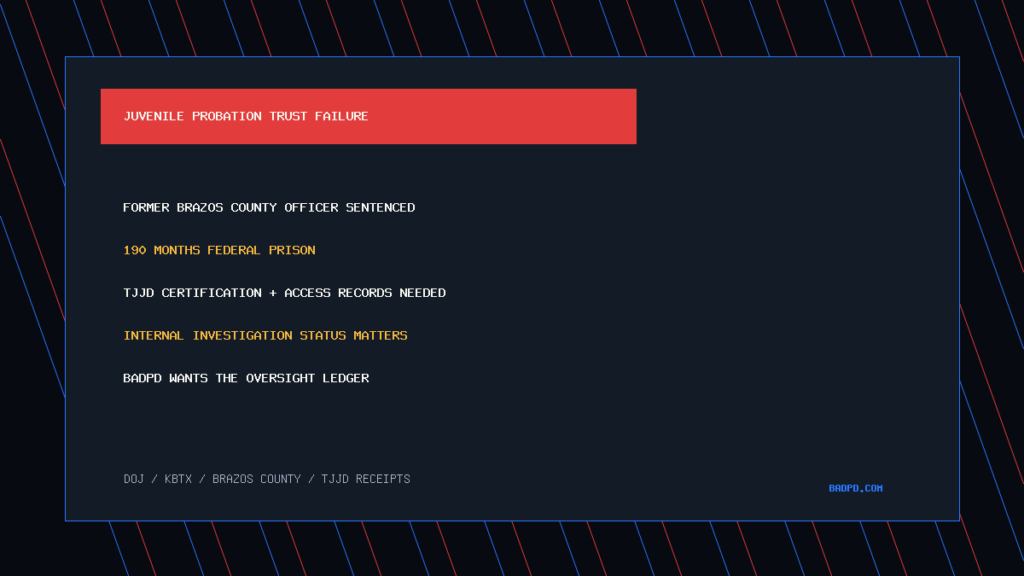
BadPD source-check, July 5, 2026: the Eastern District of Texas says Steven Dale Criddle, 51, a former juvenile probation officer from Bryan, Texas, pleaded guilty to attempted coercion and enticement of a minor and was sentenced on July 1, 2026 to 190 months in federal prison.
This is not an allegation-stage story. It is a guilty-plea and sentencing story. BadPD is not going to recycle graphic details. The public-interest question is straightforward: when someone with juvenile-probation authority is convicted in a child-exploitation case, the county and state oversight system owe the public more than a sentencing press release. They owe an access ledger, certification ledger, complaint ledger, internal-investigation ledger, and corrective-action ledger.
Juvenile probation is not a normal government desk job. Officers interact with children, families, courts, schools, service providers, detention staff, and sometimes vulnerable youth under court supervision. The job depends on trust. When that trust fails this badly, the accountability record has to move beyond the defendant and into the public systems that hired, certified, supervised, and later removed him.
What DOJ Says Happened In Court
DOJ’s July 2 release says Criddle was a former juvenile probation officer from Bryan, Texas. It says he pleaded guilty to attempted coercion and enticement of a minor and received a 190-month federal sentence from U.S. District Judge Jeremy D. Kernodle on July 1, 2026.
DOJ says the case involved online communications, travel from Bryan to Wylie, Texas, and law-enforcement apprehension. It also says the FBI investigated and Assistant U.S. Attorney Michael A. Anderson prosecuted the case. The release frames the case under Project Safe Childhood, the DOJ initiative that coordinates federal, state, and local resources against child exploitation.
Those court facts are enough to publish. They are also not enough to close the accountability file. A sentence tells the public what happened to Criddle. It does not tell the public what Brazos County found after the arrest, whether any official access was reviewed, whether any youth or family files were checked for red flags, whether any certification action occurred, or whether state juvenile-justice regulators were notified.
The Local Arrest Record Raised The County-Role Question Early
KBTX reported on October 6, 2025 that Criddle was a former Brazos County juvenile probation officer and that Brazos County said it opened an internal investigation after learning of the arrest. KBTX reported that Criddle resigned shortly after the arrest and that the county said it had not received formal complaints about his conduct in his official capacity at that time.
That local reporting matters because it gives the county a follow-up obligation now that the federal case has reached sentencing. If the county opened an internal investigation in October 2025, the public should be told what category of review was done, whether it was completed, what records were checked, what findings were made, what was referred to law enforcement or TJJD, and what policy changes followed.
BadPD is not saying the county knew about the federal conduct before the arrest. The available source mix does not prove that. The record we do have supports a narrower and stronger demand: once the arrest happened, once the county acknowledged an internal review, and once the federal guilty plea and sentence were entered, the public deserves the non-private oversight record.
Brazos County Says Juvenile Services Is Built Around Trust
Brazos County’s Juvenile Services page says the department is responsible for rehabilitating youthful offenders and balancing the interests of juveniles, families, victims, and the community. The page lists services including counseling, diversion and at-risk services, medical and mental health care, operation of a juvenile detention center, an alternative school for juveniles, and probation and parole supervision.
That mission statement raises the stakes. A juvenile probation officer can have access to sensitive youth information, family circumstances, court conditions, school coordination, treatment referrals, supervision records, and sometimes detention or placement information. A public-trust failure by a person in that role is not just an employment problem. It is a system-integrity problem.
The official county staff directory identifies current Juvenile Services leadership and contact routes. That is relevant because follow-up records should not depend on rumor or social media. The public should be able to ask the department, the county, the juvenile board, and state oversight agencies for a documented answer.
What Texas Standards Require
Texas Juvenile Justice Department Chapter 344 standards are directly relevant. The official state rules govern employment, certification, and training for juvenile officers. They include general qualifications for juvenile probation officers, criminal-history and background-check requirements, certification and active-certification requirements, and training topics.
Chapter 344 says juvenile probation officers must maintain active certification. It also says certification topics include the role of the probation officer, legal liabilities, preventing and reporting abuse, PREA, trauma-informed care, adolescent development and behavior, human trafficking, and mental health screening. For juvenile supervision officers, the standards also include juvenile rights and a code of ethics/disciplinary-procedures component.
Those standards do not mean every private criminal act is preventable by a background check or training module. They do mean the public has a legitimate interest in the officer’s certification status, training history, background-check compliance, post-arrest notification records, employment separation record, and any TJJD post-conviction or certification review.
Confirmed, Alleged, Pending, Limited
Confirmed: DOJ says Criddle pleaded guilty and was sentenced to 190 months in federal prison. DOJ says he was a former juvenile probation officer from Bryan, Texas. DOJ says the FBI investigated and the case was prosecuted in the Eastern District of Texas.
Confirmed by local reporting: KBTX reported in October 2025 that Criddle had been a Brazos County juvenile probation officer, that the county confirmed an internal investigation after the arrest, that he resigned after the arrest, and that the county said it had not received formal official-capacity complaints at that time.
Confirmed by official county sources: Brazos County Juvenile Services publicly describes its juvenile-services mission, Probation and Parole Supervision function, Juvenile Justice Center location, and current leadership/contact routes.
Confirmed by state standards: TJJD Chapter 344 contains current employment, certification, training, and background-check standards for juvenile officers. Those standards are the oversight frame, not proof of any separate county violation.
Pending: judgment document, plea agreement, factual basis, supervised-release conditions, BOP designation, sex-offender-registration obligations if reflected in judgment, county internal-investigation closeout, TJJD certification status, any juvenile-board review, and any county policy changes after the arrest.
Limited: BadPD has not pulled paid PACER filings in this run. The article relies on DOJ, local reporting, official county pages, TJJD standards, and DOJ program context. Direct court filings and county open-records responses should be added when available.
The Records BadPD Wants
First, publish the certification ledger. That means the dates Criddle was certified, certification type, continuing education status, any TJJD notices after arrest or conviction, any suspension, inactivation, revocation, or voluntary relinquishment, and the exact date the county notified TJJD of employment separation.
Second, publish the access ledger. That means what systems, offices, caseloads, juvenile files, detention areas, court records, school records, communication tools, and county devices Criddle could access during employment. It should include the date every access pathway was terminated after the arrest.
Third, publish the complaint and review ledger. If there were no official-capacity complaints before the arrest, say that in a formal closeout. If any concerns existed, separate substantiated, unsubstantiated, pending, and unrelated matters. Do not expose juvenile identities. Redact child and family information. But do not hide whether the county checked.
Fourth, publish the internal-investigation outcome. KBTX reported that the county opened an internal investigation. The public should know whether that investigation was completed, who conducted it, what scope was used, whether personnel files were reviewed, whether county devices were searched, whether interviews occurred, and whether any referrals were made.
Fifth, publish corrective action. If the county changed policy, supervision, device review, training, reporting, access termination, complaint intake, or escalation after the arrest, say so. If it changed nothing, say why.
Why This Is A BadPD Story
BadPD covers police and public-safety misconduct because the badge-adjacent systems only work when public power is checked. Juvenile probation sits inside that power structure. It is court-linked, youth-facing, and trust-heavy. That makes transparency more important, not less.
The public does not need private victim details. The public does not need graphic facts. The public needs to know whether a person with juvenile-probation authority was properly screened, trained, supervised, removed, reported, and reviewed. It also needs to know whether children, families, and case records were protected after the arrest.
There is also a statewide angle. TJJD standards are only as strong as the records that prove compliance. If a juvenile officer is arrested and later federally sentenced, the state system should be able to show a clean chain: county notice, employment separation, certification status update, background-review closure, and any disciplinary disposition.
What A Clean Public Response Would Look Like
Brazos County can answer this without compromising any child or family privacy. A clean response would say when Criddle worked for the department, what role he held, when he resigned or was separated, when access was terminated, whether he had a caseload at the time, whether affected systems were reviewed, whether the internal investigation closed, and whether any TJJD or law-enforcement referrals were made.
TJJD can answer its side without publishing sensitive case records. It can confirm whether certification was active or inactive, whether notice was received, whether any post-arrest or post-conviction review exists, and whether the public certification record has been updated.
Federal prosecutors can answer the court side by ensuring the judgment, supervised-release terms, and victim-protection conditions are public and easy to find. If there are sealed victim-protection filings, keep them sealed. But the public docket should still show the punishment, obligations, and restrictions imposed after conviction.
The BadPD Bottom Line
Criddle is sentenced. That part is confirmed. The open question is whether the juvenile-justice oversight system will show its work.
BadPD wants the certification ledger, access ledger, complaint ledger, internal-investigation ledger, and corrective-action ledger. Not gossip. Not graphic detail. Records.
Juvenile probation departments ask families, courts, schools, and communities to trust them with vulnerable kids. When a former officer is federally sentenced in a child-exploitation case, trust has to be rebuilt with proof.
Source Trail
- DOJ Eastern District of Texas sentencing release (July 2, 2026) – Primary conviction and sentencing source: Steven Dale Criddle, former juvenile probation officer from Bryan, pleaded guilty and was sentenced to 190 months on July 1, 2026.
- KBTX arrest and county-response report (October 6, 2025) – Local report identifying Criddle as a former Brazos County juvenile probation officer, reporting county resignation/internal investigation response, and noting no formal official-capacity complaints were reported at that time.
- Brazos County Juvenile Services Department official page (Accessed July 5, 2026) – Official county page describing Juvenile Services mission, services, Probation and Parole Supervision, Juvenile Justice Center, and victim/family/community obligations.
- Brazos County Juvenile Services staff directory (Accessed July 5, 2026) – Official directory identifying current department leadership and contact routes for records, oversight, and internal-investigation follow-up.
- Texas Juvenile Justice Department Texas Administrative Code page (Accessed July 5, 2026) – Official TJJD page linking Chapter 344 employment, certification, training, background-check, arrest/conviction notification, and ethics standards for juvenile officers.
- TJJD Chapter 344 standards PDF, effective April 1, 2026 (Effective April 1, 2026) – Official state standards for juvenile officer qualifications, criminal-history checks, certification, background review, mandatory training topics, PREA, abuse/neglect reporting, and active certification requirements.
- DOJ Project Safe Childhood program page (Accessed July 5, 2026) – Official DOJ program context for child-exploitation enforcement and federal/state/local coordination; used for records and victim-protection framing.
Send receipts for the desk to research
Send corrections, missing records, police-accountability tips, good-cop public-service receipts, government/court/war leads, recall alerts, or property-tax help resources. Tips are leads only until BadPD verifies records.
Links, dates, agency names, docket numbers, bodycam IDs, recall numbers, forms, and official pages.
Every tip is a lead, not a fact. The desk checks records before publishing.
Use advertising inquiry when you want clearly labeled sponsor space or available ad placements on BadPD.