
Armando Martinez Appraisal Fraud Sentence: $65M Mortgage Control Failure
News Anchor voice
Ready when you are.
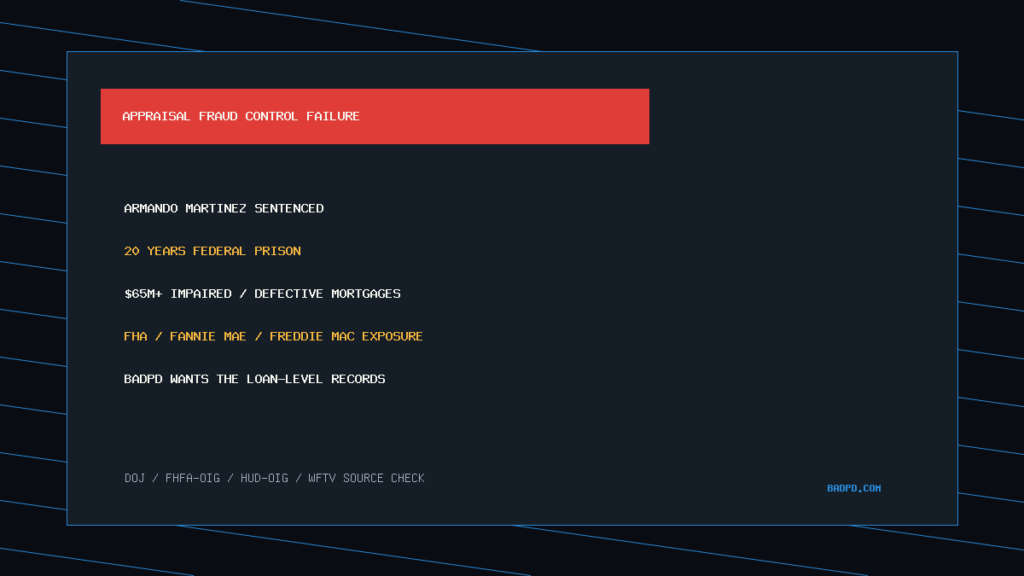
BadPD source-check, July 5, 2026: the U.S. Attorney’s Office for the Middle District of Florida says Armando Martinez, 51, of Plano, Texas, was sentenced to 20 years in federal prison for bank fraud. DOJ says he previously pleaded guilty. This is conviction-and-sentencing coverage, not allegation-only coverage.
The public angle is not just one fraudster getting prison time. The public angle is a mortgage-control failure. DOJ says Martinez had his Florida appraiser license revoked, took over the identity and license number of a legitimate licensed appraiser, and then sent appraisals that helped lenders approve and fund mortgage loans. DOJ says more than $65 million in mortgages were impaired or defective.
That should trigger a wider records demand. Which lenders accepted the appraisals? Which loans were FHA-guaranteed? Which were purchased or guaranteed by Fannie Mae or Freddie Mac? Which borrowers were left with bad paperwork, bad collateral files, or downstream risk? Which review systems failed to catch a revoked appraiser identity before the loans closed?
What DOJ Says Happened
DOJ’s July 2, 2026 release says Chief U.S. District Judge Amos Mazzant III, sitting in the Eastern District of Texas, sentenced Martinez to 20 years in federal prison for bank fraud. The Middle District of Florida release says U.S. Attorney Gregory W. Kehoe announced the sentence.
According to DOJ, court documents filed in the Middle District of Florida say Martinez had his Florida appraiser license revoked. DOJ says he then took over the identity and license number of a legitimate licensed appraiser. DOJ says he purportedly conducted onsite appraisals for dozens of Florida properties.
DOJ says the onsite work was not what it appeared to be. The release says Martinez paid others to go to the properties and take pictures for appraisals that he completed. DOJ also says he used his computer to send the appraisals to victim lenders after he had fled the United States to the Dominican Republic.
Based on those false and fraudulent appraisals, DOJ says financial institutions were induced to approve and fund mortgage loans and pay Martinez appraisal fees. DOJ says the resulting mortgage damage exceeded $65 million. It also says the mortgages were either guaranteed by the Federal Housing Administration or purchased and guaranteed by Fannie Mae and Freddie Mac.
Why This Is A Public Accountability Story
Mortgage fraud is not private paperwork when federal housing channels are involved. FHA, Fannie Mae, and Freddie Mac exist inside a public-risk structure. If an appraisal fraud scheme gets into those pipelines, the risk can move from one closing table to a lender, a guarantor, a government-backed system, a servicer, an investor, and eventually a homeowner who may not know the file was tainted.
An appraisal is supposed to be a control point. It is not decoration. It helps lenders decide whether collateral supports the loan. It helps government-backed programs decide whether a mortgage belongs in the system. It gives borrowers and buyers a record of value that can affect financing, insurance, refinancing, resale, and dispute posture.
That is why the revoked-license detail matters. If DOJ’s description is complete, the system did not only miss bad valuations. It accepted work tied to an identity and license-number problem. That raises practical questions about appraiser rosters, license verification, appraisal management company checks, lender vendor controls, quality-control sampling, automated review systems, and escalation procedures.
BadPD wants the loan-level ledger. Not private borrower data. Not doxxing. The public needs aggregate accountability: number of affected loans, states and counties involved, lenders involved, appraisal management companies involved, date range, FHA/Fannie/Freddie breakdown, default or repurchase status, corrective notices, restitution status, and any review that tells borrowers how to check whether their file was affected.
The loan-level ledger can protect privacy and still be useful. A public report can list loan channels, counties, closing years, guarantor buckets, and remediation categories without publishing names, addresses, Social Security numbers, account numbers, or borrower files. Agencies already know how to publish aggregate enforcement data when privacy matters. The public should not accept total silence just because the underlying files contain private information.
The same point applies to lenders and appraisal management companies. A lender can admit a control gap without exposing a borrower. An appraisal management company can explain credential-verification changes without publishing a property address. A regulator can publish how many defective reports were found, how many were cured, and how many remain unresolved. If nobody publishes that kind of answer, the sentence becomes the end of the story instead of the start of the repair.
The Agency Trail Matters
DOJ says the case was investigated by the Federal Housing Finance Agency Office of Inspector General and the U.S. Department of Housing and Urban Development Office of Inspector General. That source mix matters because FHFA-OIG is tied to oversight of FHFA-regulated entities and the housing-finance system. HUD-OIG is tied to HUD and FHA-related fraud reporting and enforcement lanes.
FHFA-OIG’s official Office of Investigations page says its mission includes preventing and detecting fraud, waste, and abuse in FHFA programs and operations. It also says the office specializes in deterring and detecting fraud perpetrated against the Enterprises and the Federal Home Loan Banks. In plain language: if Fannie Mae or Freddie Mac exposure is real, FHFA-OIG is the right oversight lane.
FHFA also runs a public fraud-reporting route for people whose concerns involve Fannie Mae, Freddie Mac, or a Federal Home Loan Bank. HUD-OIG runs its own hotline page for HUD and FHA-related complaints. BadPD is not telling anyone they have a claim. We are saying affected borrowers, brokers, appraisers, lenders, and whistleblowers should know that official reporting channels exist.
Appraisal Independence Is Supposed To Be A Guardrail
Fannie Mae publishes property valuation resources, including appraiser independence materials. Freddie Mac’s public guide includes appraisal requirements and market-area expectations for appraisers. Those official resources exist because valuation is a trust gate in mortgage lending.
The system is supposed to know who is doing the work. It is supposed to know whether the appraiser is qualified. It is supposed to know whether the report is based on a permitted inspection or data-collection method. It is supposed to protect the appraisal process from loan-pressure, false identity, fake inspection, and garbage-in valuation work.
That is why a $65 million impaired-or-defective mortgage finding should not end with a sentencing headline. The public needs to know what changed after the investigation. Were lenders required to rerun affected appraisals? Were borrowers notified? Were appraisal management companies reviewed? Were loans repurchased? Were FHA claims affected? Were Fannie Mae or Freddie Mac seller-servicers sanctioned, remediated, or required to strengthen controls?
BadPD also wants the timing. When did the first lender, servicer, investor, appraiser, regulator, or law-enforcement agency notice something was wrong? When was the license issue discovered? When were affected parties told to preserve files? When were loans flagged? When did any agency decide the mortgages were impaired or defective? A timeline shows whether this was caught quickly or allowed to sit inside the housing-finance system.
A real cleanup should include a control memo in plain English. It should say what failed, what was fixed, who owns the fix, and how the fix will be tested. It should also say whether the same type of identity/license takeover could happen today. If the answer is yes, the public needs to know that. If the answer is no, the public should see the new guardrail.
Confirmed, Alleged, Pending, Limited
Confirmed: DOJ says Martinez was sentenced to 20 years in federal prison for bank fraud. DOJ says he previously pleaded guilty. DOJ says the case involved false and fraudulent appraisals, affected more than $65 million in mortgages, and touched mortgages guaranteed by FHA or purchased and guaranteed by Fannie Mae and Freddie Mac.
Confirmed by source mix: WFTV published a local report that tracks the DOJ facts. FHFA-OIG and HUD-OIG are official oversight and reporting lanes. Fannie Mae and Freddie Mac maintain public property-valuation and appraisal requirement resources.
Pending: direct judgment, restitution and forfeiture terms, full plea documents, affected loan count, affected lender list, FHA/Fannie/Freddie breakdown, appraisal management company involvement, borrower-notice status, repurchase status, insurance-claim impact, and regulator remediation records.
Limited: BadPD has not pulled paid PACER filings in this run. We have not verified the state licensing revocation document outside DOJ’s release. We are not naming affected borrowers, addresses, lenders, or property records without direct source-cleared documents.
Records BadPD Wants Published
First, publish the judgment and sentencing record. The public needs the criminal outcome in direct court language, including restitution, forfeiture, supervised release, surrender dates, appeal posture, and any victim-identification process.
Second, publish the affected-loan audit in a privacy-safe way. That means counts by year, county, lender, loan channel, guarantor, and status. It should show whether each affected mortgage was active, paid off, refinanced, repurchased, defaulted, foreclosed, insured, or cured through corrective appraisal work.
Third, publish the control review. If a revoked appraiser identity was used, the lenders and appraisal management companies should have a record explaining how that happened. They should explain whether license checks were manual or automated, how often credentials were refreshed, whether reports were reviewed for inspection credibility, and whether any employee ignored a warning.
Fourth, publish borrower-facing instructions. A homeowner should not need insider language to ask a simple question: was my loan in the affected pool? If a public-backed mortgage system accepted defective appraisals, there should be a clean route for affected borrowers to ask for file review, appraisal copies, servicer contact, and regulator referral.
Fifth, publish the money trail. The sentence says prison. The consumer side needs to know what happened to appraisal fees, loan proceeds, claims, repurchases, losses, insurance exposure, and restitution. If the losses are still estimated, say that. If the loans were cured, say that. If some borrowers remain exposed, say that too.
Sixth, publish the professional accountability trail. If a legitimate appraiser’s identity and license number were used, the public needs to know whether the legitimate appraiser was a victim, a witness, a reporting party, or something else. The licensing board, lenders, appraisal management companies, and regulators should show how they protect appraisers from identity misuse and how they alert the market when credentials have been compromised.
What Borrowers Should Not Have To Guess
A borrower should not have to guess whether their file was part of a federal fraud case. A buyer should not have to guess whether an appraisal in their loan packet was completed by the person named on the report. A homeowner should not have to guess whether a defective appraisal could affect refinance, insurance, resale, foreclosure, or loss-mitigation records years later.
The answer does not need to be panic. It needs to be a clear path. Agencies and lenders can publish a basic script: gather your closing disclosure, appraisal copy, lender and servicer name, FHA case number if applicable, Fannie or Freddie lookup result if applicable, and any notice you received. Then contact the listed servicer, lender, FHFA-OIG, HUD-OIG, or a qualified housing/civil legal aid office if you believe fraud touched your file.
Why Homebuyers Should Care
A bad appraisal file can travel. It can sit in a loan file for years. It can come back during refinance, servicing transfer, foreclosure defense, insurance review, buyback dispute, fraud audit, or sale. Most buyers will never know how many hands touched their mortgage documents. That is why fraud inside the valuation process matters even after the person responsible is sentenced.
This is also why BadPD treats consumer-resource work as accountability work. Property-tax help, civil-rights filing help, recall tracking, and mortgage-fraud reporting all share the same principle. People should not need a lawyer, a lobbyist, or a newsroom contact to know where the official route starts.
If someone believes a mortgage file, appraisal, FHA loan, Fannie Mae loan, or Freddie Mac loan may involve fraud, the safest first step is not internet speculation. It is gathering documents, contacting the servicer or lender, and using the relevant official reporting channels. Eligibility, legal rights, borrower remedies, and deadlines require direct confirmation from the agency, court, lender, or a qualified attorney.
The BadPD Bottom Line
Martinez got 20 years. That is the criminal sentence. The public accountability question is whether the mortgage system has explained the damage and repaired the control gap.
BadPD wants the receipts: loan counts, lender controls, appraisal-management records, FHA/Fannie/Freddie exposure, borrower-notice proof, repurchase or remediation status, and regulator follow-through. A sentence punishes the fraud. A public ledger shows whether the system learned anything.
Source Trail
- DOJ Middle District of Florida sentencing release (July 2, 2026) – Primary sentencing source: Armando Martinez, 20-year federal sentence, prior guilty plea, revoked Florida appraiser license, alleged identity/license takeover, Dominican Republic transmission, and more than $65 million in impaired or defective mortgages.
- WFTV local report (July 2, 2026) – Central Florida local report summarizing sentence, affected mortgage value, appraiser-license issue, property-photo allegation, FHA/Fannie/Freddie exposure, and investigating agencies.
- FHFA-OIG Office of Investigations page (Accessed July 5, 2026) – Official FHFA-OIG page describing investigation mission for fraud, waste, abuse, Fannie Mae, Freddie Mac, and Federal Home Loan Bank oversight.
- FHFA homeowner/homebuyer fraud reporting page (Accessed July 5, 2026) – Official FHFA route telling consumers with Fannie Mae, Freddie Mac, or Federal Home Loan Bank fraud concerns to contact FHFA-OIG.
- HUD-OIG hotline page (Accessed July 5, 2026) – Official HUD-OIG reporting page for HUD/FHA-related concerns and hotline routing.
- Fannie Mae property valuation resources (Accessed July 5, 2026) – Official Fannie Mae property-valuation resource page listing appraiser independence requirements and valuation resources.
- Freddie Mac Guide Section 5605.1 (Accessed July 5, 2026) – Official Freddie Mac guide section on appraiser and appraisal requirements, including market-area knowledge and experience.
- Freddie Mac Guide Section 5604.1 (Accessed July 5, 2026) – Official Freddie Mac guide section addressing physical inspection expectations for appraisal reports and property data reports.
Send receipts for the desk to research
Send corrections, missing records, police-accountability tips, good-cop public-service receipts, government/court/war leads, recall alerts, or property-tax help resources. Tips are leads only until BadPD verifies records.
Links, dates, agency names, docket numbers, bodycam IDs, recall numbers, forms, and official pages.
Every tip is a lead, not a fact. The desk checks records before publishing.
Use advertising inquiry when you want clearly labeled sponsor space or available ad placements on BadPD.