
Jack Montoucet LDWF Kickback Sentence: BadPD Wants The Contract Records
News Anchor voice
Ready when you are.
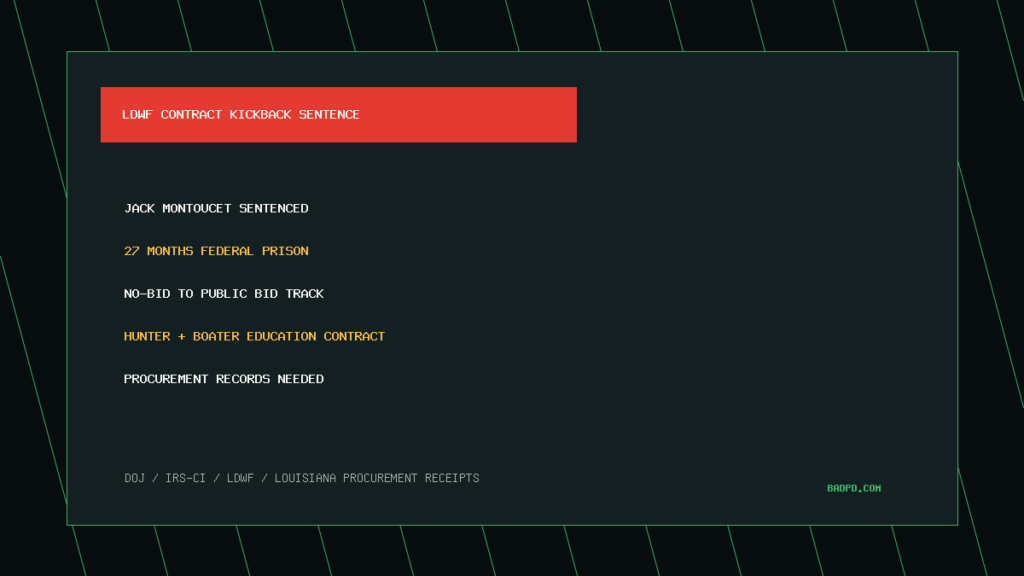
BadPD source-check, July 4, 2026: the U.S. Attorney’s Office for the Western District of Louisiana says former Louisiana Department of Wildlife and Fisheries Secretary Jack Montoucet was sentenced to 27 months in federal prison for conspiring to defraud the United States by soliciting and accepting kickbacks in return for awarding a state contract. This is conviction-and-sentencing coverage, not allegation-only coverage. Montoucet pleaded guilty on March 31, 2026.
The BadPD angle is public contracting. The public should not have to wait for a prison sentence to ask basic questions about no-bid decisions, competitive-bid repair attempts, vendor advantage, conflict checks, course-fee revenue, and who inside state government saw the warning signs before the contract became a kickback case.
What DOJ Says Was Sentenced
DOJ’s July 1, 2026 sentencing release says Montoucet, 78, was sentenced on June 30 to 27 months in federal prison. The release says he conspired to defraud the United States by soliciting and accepting kickbacks in return for awarding a state contract while he was Secretary of LDWF. DOJ says the case involved a company called DGL1, LLC, and online hunter and boater education courses.
According to DOJ, Montoucet steered an LDWF contract to DGL1 in exchange for one-third of the profit. The other two-thirds, DOJ says, was to be split between two co-conspirators, Dusty Guidry and Leonard Franques. DOJ says that on January 27, 2021, Montoucet caused LDWF to award a no-bid contract to DGL1 to provide online hunter and boater education courses.
DOJ says the Louisiana Division of Administration, Office of Special Procurement raised concerns about the no-bid contract. After that, LDWF put out a public bid for a contract to provide the educational classes. The key sentencing-record allegation is that Montoucet then used his LDWF position to ensure DGL1 had a competitive advantage and won the contract anyway.
DOJ says Montoucet signed the contract on October 8, 2021, knowing he would receive kickbacks. A month later, DOJ says, Montoucet met with Franques and Guidry to discuss concealing the payouts. The alleged concealment plan was that Franques would hold Montoucet’s portion until after Montoucet left LDWF and pay it as a supposed signing bonus for consulting work.
Why This Is More Than A Sentencing Note
Hunter and boater education are not side issues in Louisiana. LDWF’s official hunter education page says people born on or after September 1, 1969 must complete an approved hunter education course before hunting unless they are under direct supervision. The page also lists online course options, free in-person course options, youth rules, field-day rules, and certification details.
LDWF’s boater education page says people born after January 1, 1984 must successfully complete an approved boater education course to operate a motorboat over 10 horsepower unless accompanied by a qualifying adult. It also lists online provider options, free in-person courses, certification requirements, and in-person instruction taught by LDWF law enforcement agents and trained volunteers.
That matters because this was not an abstract paper contract. The contract lane touched public safety education, licensing-adjacent requirements, outdoor recreation access, course fees, and the trust people place in state-approved education systems. A corrupt award process can distort which provider gets the work, what the public pays, what the agency monitors, and whether program decisions are made for public safety or private payout.
The Procurement Control Failure
The Louisiana Office of State Procurement says its role is to ensure purchasing and contracting activities, including requests for proposals, competitive bids, and professional-service contracts, are conducted legally, fairly, and efficiently. OSP says it serves as the state’s central procurement authority and works to ensure full, fair, and forthright competition, statutory compliance, and contractor obligations.
That official mission statement is why this case deserves more records. DOJ says OSP raised concerns about the no-bid contract. That is a red flag that the procurement system did something useful. The next question is whether the system had enough power to stop the abuse after the concern was raised. If a no-bid warning simply pushed the same insiders into a public-bid track that was still allegedly influenced, the public needs the full procurement file.
BadPD wants the no-bid justification, the OSP concern record, the solicitation, the scoring sheets, evaluator names, conflict disclosures, bid protest records, communications between LDWF and vendors, the signed October 8 contract, amendments, invoices, payment records, revenue-share terms, and any compliance review after Montoucet left office.
The Records Should Show Where The Guardrail Broke
The first guardrail was the no-bid review. DOJ says OSP raised concerns. That fact matters. It means someone saw enough to question the original route. The public needs to know what the concern said, who received it, and whether the warning was treated as a stop sign or a paperwork problem.
The second guardrail was the public bid. A public bid is supposed to reset the field. It should create a clean record. It should show the solicitation, the required services, the evaluation method, the scoring, the vendor questions, the agency answers, the final award, and the reason one bidder won. If a preferred vendor still had an inside path, the bid record should show where that path entered the process.
The third guardrail was contract management. After an award, an agency still has to monitor performance, invoices, course fees, reporting, compliance, and changes to the work. If the contract involved public safety education, the agency had more than a price duty. It had a duty to make sure course access, certification, training quality, and public trust were not being shaped by private kickback expectations.
The fourth guardrail was disclosure. A contract system cannot rely on trust alone. It needs conflict forms. It needs recusal records. It needs notes that show who met with vendors and when. It needs a way for staff to raise concerns without being buried by political pressure. Those records are the difference between a one-person scandal and an agency-wide control review.
Indictment And Plea Records Add The Money Trail
The May 2025 DOJ indictment release is still important because it identifies the broader charge history and money figures that explain why the sentencing is not just about a bad meeting. DOJ said the indictment charged conspiracy to commit bribery and wire fraud, wire fraud counts, and conspiracy to commit money laundering. Those were indictment-stage allegations at the time.
The indictment release said LDWF received federal-program benefits involving grants, contracts, or other assistance. It said Montoucet, as secretary, was chief executive and had power to enter contracts on LDWF’s behalf. It also said Guidry was an LDWF Commission member and Franques owned DGL1 and LWF, LLC.
Most important for the public ledger: DOJ said that from around November 10, 2021 to June 10, 2022, LDWF received $454,174.14 from the LWF contract signed by Montoucet, and $122,507.96 was held as a kickback for Montoucet to be paid after he completed his term as LDWF secretary. The plea and sentencing releases then move the core conspiracy out of allegation-only posture because Montoucet pleaded guilty.
Confirmed, Alleged, Pending, Disputed
Confirmed: DOJ says Montoucet was sentenced to 27 months in federal prison on June 30, 2026. DOJ says he pleaded guilty on March 31, 2026. DOJ says he was former Secretary of LDWF. DOJ says the contract involved DGL1, online hunter education, and online boater education. DOJ says FBI and IRS-CI investigated.
Confirmed by official agency context: Louisiana OSP publicly describes its procurement role as legal, fair, efficient contracting and competitive-bid oversight. LDWF public pages show hunter and boater education requirements and approved course pathways. IRS-CI published the plea-stage enforcement release and framed the matter as a public corruption and financial-crime investigation.
Resolved by guilty plea and sentence: Montoucet pleaded guilty to the conspiracy described in the plea and sentencing releases. That does not mean every indictment count against every person is resolved in the same way. It means the Montoucet conviction/sentence lane is now adjudicated enough to publish as conviction-stage accountability.
Pending: judgment, restitution or forfeiture details if any, final status for co-conspirators, OSP concern documents, LDWF contract records, commission minutes, bid scoring files, conflict disclosures, revenue records, course-provider performance records, and any post-case procurement reform.
Limited: BadPD has not pulled paid PACER filings in this run. The article relies on DOJ, IRS-CI, official state pages, and local reporting. Direct court filings should be added when available.
What Louisiana Residents Should Ask For
This case should not end with a sentence and a shrug. Louisiana residents, hunters, boaters, conservation groups, instructors, and lawmakers should ask for the contract file. They should ask what OSP flagged, who received that concern, who approved the later public bid, who scored the proposals, whether anyone disclosed contact with DGL1 or related companies, and whether the state reviewed past course payments after the federal investigation became public.
The clean public question is not partisan. It is operational. Did the procurement system catch the no-bid problem but fail to prevent a corrupt competitive-bid outcome? Did anyone at LDWF or the commission ask why a vendor had an advantage? Were volunteers, law enforcement instructors, or education staff told anything about vendor selection? Were course users paying into a system affected by private kickback expectations?
What A Serious Cleanup Would Look Like
A serious cleanup starts with the full file. Louisiana should publish the no-bid request, the OSP warning, the bid packet, the scoring sheets, and the contract documents. If parts must be redacted, the state should say why. Redaction should not become a shield for embarrassment.
LDWF should also explain whether it reviewed education-course vendors after the federal case became public. The agency should say whether course users paid fees tied to the affected contract. It should say whether any money was recovered, whether any vendor was suspended or reviewed, and whether any employee, commissioner, or contractor faced administrative consequences.
The Legislature has a role too. Lawmakers do not need to wait for another indictment to ask whether no-bid exceptions are too easy, whether agency heads can overrule procurement warnings too quietly, and whether contract scoring files are visible enough to catch favoritism before money moves.
The public standard is simple. If a state contract touches required education, safety certification, or public access to outdoor recreation, the award process should survive daylight. It should survive a records request. It should survive a basic conflict review. If it cannot, the state should not ask residents to trust the next procurement promise.
The BadPD Bottom Line
Montoucet is going to federal prison. That is the criminal outcome. The public-contracting outcome is still unfinished. A no-bid contract allegedly became a public-bid contract that was still corruptly influenced. That is the part that should make every state agency nervous.
BadPD wants the paper trail because the lesson is bigger than one former secretary. Public education contracts, public-safety training, licensing-adjacent requirements, and course-fee systems need contracting controls strong enough to beat insider pressure. If the controls worked, publish the records. If the controls failed, fix them in public.
Source Trail
- DOJ WDLA sentencing release (July 1, 2026) – Official sentencing release for Jack Montoucet, 27 months, guilty plea, DGL1 contract, no-bid concern, competitive-bid process, concealment meeting, case number, FBI/IRS-CI investigation.
- DOJ WDLA indictment release (May 21, 2025) – Official indictment-stage release with original charges, LDWF federal-program status, Guidry/Franques/DGL1/LWF context, alleged $454,174.14 contract receipts and $122,507.96 held kickback.
- DOJ WDLA guilty-plea release (March 31, 2026) – Official plea release confirming guilty plea, five-year maximum at plea, contract steering admission, FBI/IRS-CI quotes, and case number route.
- IRS-CI guilty-plea enforcement release (March 31, 2026) – IRS-CI release confirming financial-crime/public-corruption investigation context and contract/kickback facts.
- KPLC local sentencing report (July 1, 2026) – Local Louisiana report summarizing the 27-month sentence, guilty plea, DGL1 contract, no-bid concern, public bid, and alleged concealment method.
- Louisiana Office of State Procurement (Accessed July 4, 2026) – Official state procurement page explaining OSP role in legal, fair, efficient purchasing, competitive bids, RFP lifecycle, statutory compliance, and contractor obligations.
- LDWF hunter education page (Accessed July 4, 2026) – Official LDWF page showing hunter education requirement, online options, free in-person courses, youth field-day rules, and education-program context.
- LDWF boater education page (Accessed July 4, 2026) – Official LDWF page showing mandatory boater education requirements, online provider options, in-person course availability, and certification context.
Send receipts for the desk to research
Send corrections, missing records, police-accountability tips, good-cop public-service receipts, government/court/war leads, recall alerts, or property-tax help resources. Tips are leads only until BadPD verifies records.
Links, dates, agency names, docket numbers, bodycam IDs, recall numbers, forms, and official pages.
Every tip is a lead, not a fact. The desk checks records before publishing.
Use advertising inquiry when you want clearly labeled sponsor space or available ad placements on BadPD.