
New York Medicaid Fraud Unit Decertified: BadPD Wants The Case Ledger, Not Spin
News Anchor voice
Ready when you are.
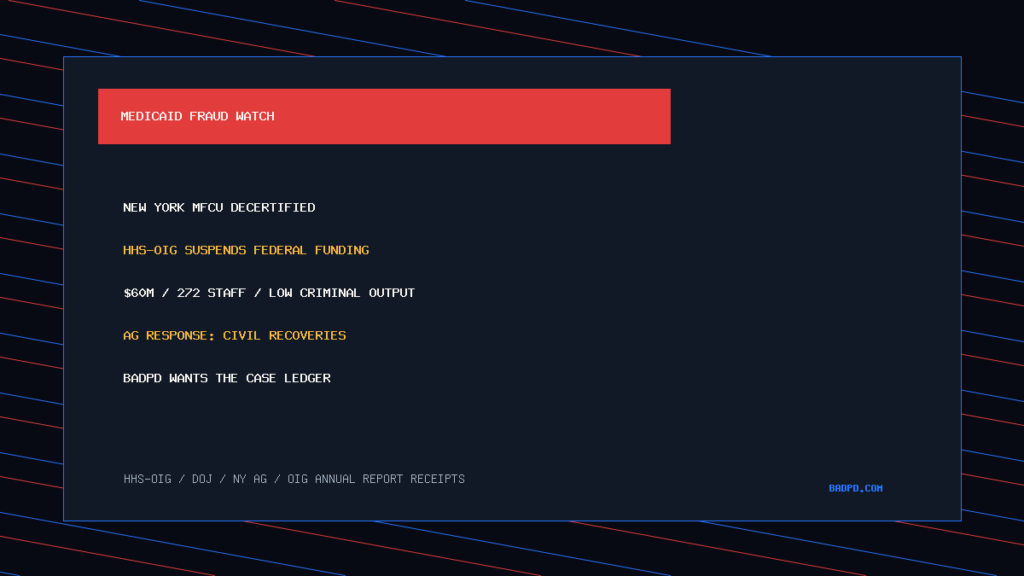
BadPD source-check, July 5, 2026: the federal fight over New York’s Medicaid Fraud Control Unit is now a public-accountability story with two competing ledgers. HHS-OIG says New York’s unit failed core criminal Medicaid fraud and patient-abuse enforcement expectations despite roughly $60 million in annual federal funding and more than 270 staff. New York Attorney General Letitia James says the funding cut is political, points to more than $627 million recovered for Medicaid since 2019, and says her office is weighing legal options.
BadPD is not taking either press office as final authority. The federal letter, the DOJ statement, the AG response, and HHS-OIG’s national annual report all point to the same practical demand: publish the case ledger. If New York is failing criminal enforcement, show the referrals, indictments, convictions, abuse-and-neglect cases, backlogs, case ages, managed-care referrals, and excluded-provider handoffs. If the federal government is overreaching or selectively punishing a political opponent, show the comparative state data, recovery mix, corrective actions, and recertification decision trail.
The public interest is larger than the Trump-versus-James fight. Medicaid fraud drains a public health program. Patient abuse and neglect cases involve some of the most vulnerable people in the state. A fraud-control unit does not exist to win press-release fights. It exists to investigate, prosecute, recover money, protect patients, and keep bad providers out of public programs.
What HHS-OIG Did
HHS-OIG’s June 30, 2026 letter denied New York MFCU’s 2026 recertification request. The letter says federal funding is allowable only if a unit is certified and recertified annually, and it says HHS-OIG is suspending New York’s federal MFCU grant effective July 1, 2026 through September 30, 2026, when the current grant period expires.
The letter is blunt. It says American taxpayers provide nearly half a billion dollars each year to state Medicaid Fraud Control Units nationwide. It says New York receives about $60 million per year and has a staff of more than 270 people. It says the New York unit serves one of the largest Medicaid programs in the country, covering about 7 million people at more than $100 billion annually.
HHS-OIG says New York was the lowest-performing similar-sized unit in both Medicaid fraud and patient abuse-and-neglect cases from 2023 through 2025. The letter identifies California, Texas, Ohio, and Florida as similar-sized comparison units. It says New York secured only eight or nine criminal indictments in FY 2025 and FY 2023 while other similar-sized units secured hundreds, even though some peers oversee Medicaid programs about half the size of New York’s.
HHS-OIG also says it conditionally recertified the unit on May 1, 2026 pending further review, then conducted a targeted onsite visit during the week of June 8, 2026. The letter says a major factor was a leadership choice to focus on high-impact, complex fraud cases, which shifted focus from criminal fraud and patient abuse and neglect toward civil fraud cases. HHS-OIG says that shift did not produce enough offsetting civil-case results to justify the criminal-enforcement decline.
The Numbers The Federal Letter Uses
Several figures deserve plain-language attention. The letter says that in 2025 New York MFCU received 2,599 total allegations, including 478 fraud allegations and 2,121 patient abuse or neglect allegations. It says New York had low viable referrals from managed care organizations and had struggled with MCO referrals since at least a 2017 onsite report.
The letter says 34 percent of the unit’s open cases were more than three years old. It says 69 percent of referrals received from the State Medicaid Program Integrity Unit were pending at the New York MFCU for two years or more. It says the unit was not regularly tracking cases referred for prosecution, especially criminal fraud and patient abuse or neglect cases, which can affect exclusion referrals and outcome reporting.
On criminal fraud convictions, HHS-OIG says New York ranked last among the similar-sized units from 2023 to 2025. It reports New York had 53 fraud convictions over that span. The next-lowest peer number in the letter is 129, while Ohio is listed at 270. The letter’s fraud-conviction table gives New York 7 in 2023, 21 in 2024, and 25 in 2025.
On indictments, HHS-OIG says the unit secured fewer than 10 criminal fraud indictments in four of the last five years. DOJ’s July 2 statement says New York averaged only nine criminal indictments per year from 2021 to 2025, while before James took office the unit averaged more than 100 indictments per year from 2016 through 2018.
The AG’s Rebuttal
Attorney General James’ June 30 response says the federal decision is an unprecedented attack and a political distraction. Her office says New York MFCU has recovered $627,812,108 for Medicaid through criminal and civil investigations and prosecutions from federal fiscal years 2019 through 2025.
The AG response says HHS’s own 2025 report recognized New York as one of four states accounting for half of total civil recoveries in fiscal year 2025. That is a real data point, and it should not be erased. HHS-OIG’s March 2026 national report says total civil recoveries increased from $407 million in FY 2024 to $706 million in FY 2025 and that Indiana, New York, Colorado, and Georgia accounted for half of total civil recoveries.
James’ office also points to recent examples: an indictment of a Long Island medical supply company owner for allegedly stealing more than $2.5 million from Medicaid; an indictment and arrest tied to an alleged $9 million Medicaid fraud scheme; a 2025 statewide transportation-company investigation that the office says led to ten criminal convictions and more than $13 million recovered; and a serial health care fraud sentencing.
That rebuttal matters because civil recoveries can be legitimate enforcement outcomes, and because large Medicaid fraud cases can take time. But the rebuttal does not fully answer the criminal-output and patient-abuse questions in the HHS-OIG letter. If the unit is choosing complex civil recoveries over criminal volume, the public should see that strategy, the tradeoffs, and the patient-protection impact, not just competing slogans.
Confirmed, Alleged, Pending, Disputed
Confirmed: HHS-OIG issued a June 30, 2026 letter denying New York MFCU recertification and suspending federal grant funding effective July 1, 2026 through September 30, 2026. DOJ’s Northern District of New York published a July 2 statement backing the federal findings. The New York AG published a June 30 response opposing the decision and saying legal options are being considered.
Confirmed by both sides: New York MFCU is a major public enforcement unit dealing with Medicaid fraud, patient abuse, and neglect. The dispute is not whether the unit exists or whether Medicaid fraud enforcement matters. The dispute is whether New York is performing adequately and whether the federal funding cutoff is justified.
Federal finding: HHS-OIG says New York is not effectively carrying out required MFCU functions and is not complying with the terms and conditions of the grant. It cites low criminal fraud and patient abuse-and-neglect outcomes, case backlog, referral problems, tracking weaknesses, and staffing mix concerns.
State rebuttal: The AG says the action is political, emphasizes more than $627 million in recoveries since 2019, says HHS previously recognized New York’s civil recoveries, and cites recent criminal Medicaid fraud cases.
Alleged examples: The AG’s June 2026 examples include indictment-stage cases. Those are not convictions unless and until a court record says so. BadPD is using them as examples of the AG’s enforcement rebuttal, not as final proof that the named defendants committed crimes.
Pending: any litigation over the funding suspension, HHS-OIG recertification reconsideration or reapplication terms, corrective-action plan, New York’s September 30 funding status, updated criminal-output statistics, case-backlog cleanup, MCO referral reforms, and patient-abuse prosecution tracking.
Why The Case Ledger Beats The Press Fight
This fight is politically loaded. The federal prosecutor statement names James directly and criticizes her leadership. The AG response names the Trump administration and calls the decision political. That political context is real, but it is not enough to decide the public-accountability question.
The only useful way through the noise is the ledger. New Yorkers need an annual criminal Medicaid fraud ledger that lists referrals, opened cases, declined referrals, case ages, indictments, pleas, trials, convictions, dismissals, recoveries, exclusions, abuse-and-neglect matters, and referral sources. Taxpayers need the same ledger for managed-care referrals and State Medicaid Program Integrity Unit referrals. Patients and families need to know whether abuse and neglect referrals are moving or sitting.
Recovery totals alone can hide weak criminal enforcement. Criminal indictment totals alone can undervalue complex civil recoveries. Both sides can cherry-pick if the ledger is not public. BadPD wants the full table: civil, criminal, abuse-and-neglect, fraud, recoveries, staff, referrals, case age, and outcomes by year.
The Patient-Abuse Issue Cannot Be A Footnote
The federal letter’s patient abuse and neglect findings should not be buried under campaign rhetoric. HHS-OIG says New York received more than 2,000 patient abuse or neglect allegations in 2025. DOJ’s statement says the unit obtained just four convictions involving patient abuse or neglect over FY 2023 and 2025 despite receiving more than 2,000 such referrals each year.
That does not automatically mean every referral was chargeable. Some referrals may be unfounded, duplicative, civil-only, administratively resolved, or better handled by another agency. But the public deserves a breakdown. How many referrals were screened out? How many became investigations? How many were referred to local prosecutors? How many led to licensing action, facility penalties, exclusions, pleas, trials, or convictions? How many are still pending?
A Medicaid fraud unit is not just about dollars. It is also a protection mechanism for elderly, disabled, and medically vulnerable people. If abuse-and-neglect referrals are not producing outcomes, the answer cannot be a press quote. It has to be a transparent operational fix.
What HHS-OIG Should Also Have To Show
The federal government is not exempt from scrutiny. If HHS-OIG is cutting off funding, it should show the standards applied to every state, the peer comparison method, the correspondence timeline, the conditional recertification terms, the onsite review scope, and the corrective-action options offered before suspension.
HHS-OIG should also publish whether other units with weak output received lesser remedies, special conditions, technical assistance, or extensions. Selective enforcement would be a problem even if New York’s performance data is bad. The public deserves a consistent federal standard, not a standard that shifts by political convenience.
The federal decision runs through September 30, 2026. That deadline should force transparency. It should not turn into a quiet bureaucratic fight where taxpayers and patients never see the data.
What New York Should Publish Now
New York should publish a year-by-year MFCU performance file from at least 2016 through 2026. It should include total referrals, MCO referrals, Program Integrity referrals, patient-abuse referrals, fraud referrals, open cases, case age, indictments, convictions, civil settlements, criminal recoveries, civil recoveries, exclusions referred to OIG, staff counts, investigator-to-auditor ratios, and prosecution referrals.
The AG should also explain the strategic pivot alleged by HHS-OIG. If leadership intentionally focused on high-impact complex cases, say so directly. Show the cases, dollars, patient outcomes, and opportunity cost. If HHS-OIG is wrong about the pivot or misreading the data, publish the documents that prove it.
New York should not rely on aggregate recovery totals. Recoveries matter, but a Medicaid Fraud Control Unit also has criminal and patient-protection obligations. The public should be able to see whether one mission crowded out the others.
What Federal Officials Should Publish Now
HHS-OIG should publish the non-confidential portions of its May 1 conditional recertification decision, the June 2026 targeted onsite review scope, the data tables used for peer comparison, and any corrective-action demands. If there are privacy or law-enforcement limits, redact names and case-sensitive details. Do not hide the performance framework.
DOJ should separate political criticism from operational data. Calling a state official a failure may be satisfying. It is not the same thing as explaining how federal prosecutors will cover any patient-abuse or Medicaid fraud gap if state funding remains suspended. The Northern District statement says federal enforcement efforts have expanded through the Healthcare Fraud Task Force. BadPD wants the task-force ledger too: cases opened, referrals accepted, prosecutions filed, victims protected, and dollars recovered.
BadPD Bottom Line
New York’s Medicaid Fraud Control Unit is too important for spin. HHS-OIG says the unit is failing core criminal and patient-protection obligations. The AG says the federal government is slashing resources from a nationally recognized anti-fraud office with hundreds of millions recovered. Both claims can be tested.
The test is the case ledger. Publish it. Publish the federal recertification record. Publish the state rebuttal data. Publish the patient-abuse referral outcomes. Publish the MCO referral history. Publish the backlog. Publish the corrective-action plan.
Medicaid fraud steals from taxpayers and from the people who need care. Patient abuse and neglect cases are not campaign talking points. If New York is failing, fix it. If the federal government is politicizing oversight, prove it. Either way, the public deserves records, not vibes.
Source Trail
- HHS-OIG letter denying New York MFCU recertification (June 30, 2026) – Primary official letter to Attorney General Letitia James and Director Amy Held denying recertification, suspending federal grant funding effective July 1 through September 30, 2026, and explaining performance findings.
- DOJ Northern District of New York statement (July 2, 2026) – Federal prosecutor statement summarizing HHS-OIG findings, criminal indictment and patient-abuse conviction figures, funding suspension, and federal enforcement response.
- New York Attorney General response (June 30, 2026) – State rebuttal calling the action political, citing more than $627 million recovered since 2019, legal options, and recent Medicaid fraud cases.
- HHS-OIG Medicaid Fraud Control Units annual report FY 2025 (March 2026) – National MFCU performance report with aggregate convictions, recoveries, civil-recovery context, and OIG oversight explanation.
- New York AG medical supply Medicaid fraud indictment release (June 29, 2026) – State example cited by AG James involving alleged theft of more than $2.5 million from Medicaid and children deprived of nutritional supplements; allegation-stage case.
- New York AG $9 million Medicaid fraud takedown release (June 24, 2026) – State example cited by AG James involving an alleged $9 million Medicaid fraud scheme; allegation-stage case.
- New York AG $13 million transportation Medicaid fraud release (2025) – State enforcement example cited in the AG response involving medical transportation companies, ten criminal convictions, and more than $13 million recovered.
Send receipts for the desk to research
Send corrections, missing records, police-accountability tips, good-cop public-service receipts, government/court/war leads, recall alerts, or property-tax help resources. Tips are leads only until BadPD verifies records.
Links, dates, agency names, docket numbers, bodycam IDs, recall numbers, forms, and official pages.
Every tip is a lead, not a fact. The desk checks records before publishing.
Use advertising inquiry when you want clearly labeled sponsor space or available ad placements on BadPD.