
Oribe Serene Scalp Shampoo Recall: BadPD Wants Lot Pullback Proof
News Anchor voice
Ready when you are.
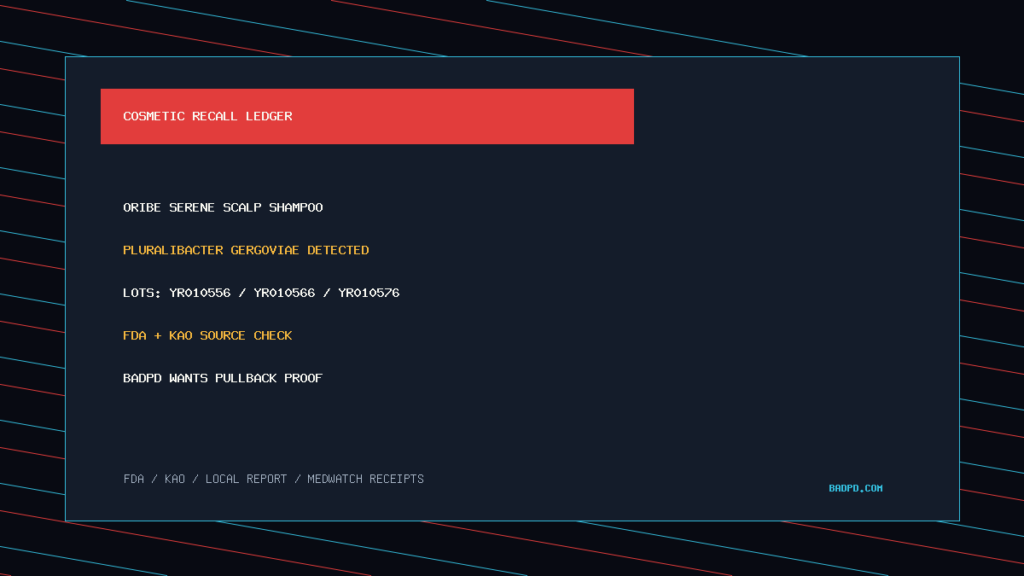
BadPD source-check, July 5, 2026: FDA posted a company announcement for Kao USA’s voluntary recall of select lots of Oribe Serene Scalp Densifying Shampoo after detection of Pluralibacter gergoviae bacteria. The affected product is the 8.5 oz and 33.8 oz Oribe Serene Scalp Densifying Shampoo, with the specific lot codes listed below.
This is a consumer-safety recall brief. It is not a claim that every Oribe product is unsafe. It is not medical advice. It is a lot-code ledger and a records-demand piece because a recall only works if the affected products actually leave warehouses, salons, retail shelves, bathrooms, and online resale channels.
The official recall says the bacteria pose little medical risk to healthy people, but that people with certain health issues, including weakened immune systems, may be more susceptible to infection. Kao says anyone with affected product should discontinue use regardless of health status. That is the controlling consumer action from the source record.
The Affected Lot Ledger
FDA’s recall page says the affected product is Oribe Serene Scalp Densifying Shampoo in 8.5 oz and 33.8 oz sizes. Kao says the affected product was manufactured between February 21, 2026 and February 26, 2026.
The affected lot code for the 8.5 oz bottle, UPC 840035231242, begins with the prefix YR and is listed as YR010556. The affected lot codes for the 33.8 oz bottle, UPC 840035231273, are listed as YR010566 and YR010576. The FDA-hosted announcement says the lot codes are printed in black on the bottom of the bottle.
Kao says the recall is limited to specific lots, but it also says further investigation to confirm the scope of the issue is ongoing. That sentence matters. It means the public should preserve the current lot list, but also watch for updates, expanded lot ranges, retailer notices, and any later FDA or company changes.
What Kao Says Consumers Should Do
Kao says consumers with affected products should discontinue use. It says consumers can report adverse events, arrange for a replacement, or ask questions by contacting the Kao Professional Hair Technical Hotline at 800-333-2442 or emailing oribecomplaints@kao.com.
Kao also says it is working with FDA to recall affected lots from warehouses and is asking retail and salon partners to remove affected lots from use or sale and return them for safe disposal. That is where the accountability trail starts. A recall announcement is not the same thing as completed removal.
BadPD wants the pullback proof: how many affected units were produced, how many shipped into the United States, how many shipped into Canada, how many went to salons, how many went to retailers, how many were sold online, how many were returned, how many replacements were issued, and how many affected units remain unaccounted for.
Confirmed, Alleged, Pending, Limited
Confirmed: FDA posted the Kao USA company announcement on July 1, 2026. The company announcement date is July 1, 2026. Kao’s Americas news listing dates the recall item June 30, 2026. The recall involves select lots of Oribe Serene Scalp Densifying Shampoo in 8.5 oz and 33.8 oz sizes due to detection of Pluralibacter gergoviae bacteria.
Confirmed lot codes: FDA lists 8.5 oz UPC 840035231242 with affected lot code YR010556 and 33.8 oz UPC 840035231273 with affected lot codes YR010566 and YR010576. The lot codes are reported as printed in black on the bottom of the bottle.
Confirmed consumer route: the recall announcement tells consumers to contact the Kao Professional Hair Technical Hotline at 800-333-2442 or email oribecomplaints@kao.com for replacement/questions/adverse-event reporting to the company. FDA also maintains official cosmetic complaint and MedWatch reporting routes.
Pending: final scope investigation, number of affected units, distribution list, salon/retailer removal confirmation, online marketplace cleanup, adverse-event totals, replacement totals, disposal proof, and whether any expanded recall or enforcement report follows.
Limited: BadPD has not seen a standalone FDA enforcement report entry with unit counts in this run. The article relies on FDA’s recall page, Kao’s news listing, local consumer coverage, and FDA adverse-event reporting pages.
Why This Recall Belongs In The BadPD Ledger
BadPD covers recalls when they can prevent harm or expose control failures. A premium salon product can still create public-safety work if contamination appears and the affected products move through salons, retailers, warehouses, and homes. The higher the brand trust, the more important the recall execution record becomes.
This recall also touches people who may be at higher risk. Kao’s own recall language says healthy people face little medical risk, but people with certain health issues may be more susceptible. That is why the consumer message cannot be buried in beauty-news blurbs. Lot codes, contact routes, and replacement instructions need to be searchable.
For salons, the recall creates a separate duty. A consumer can check a bottle at home. A salon may have inventory, backbar products, partially used bottles, or retail stock. BadPD wants to know whether salon partners received direct notice, how affected bottles were identified, whether staff were told to stop use, and whether clients who may have been exposed were notified when appropriate.
What Retailers And Salons Should Prove
First, prove inventory removal. Retailers and salons should be able to show affected lots were pulled from sale or use, quarantined, and returned or disposed of according to the company’s instructions.
Second, prove consumer notice. If affected lots were sold through customer accounts, loyalty programs, salon booking records, ecommerce orders, or retailer accounts, the recall notice should reach the buyer. A recall posted on FDA’s website is useful. Direct notice is better.
Third, prove online cleanup. If affected lot codes appeared in online listings, marketplaces, resale listings, or salon shops, the recall record should include takedown or warning steps. A consumer should not be able to buy a recalled lot because a platform failed to connect lot-level inventory with the recall.
Fourth, prove replacement handling. Consumers should not have to fight for a replacement when the official recall says replacement is available. The public should know how many contacts came in, how many replacements were issued, and whether any consumers reported trouble with the hotline or email route.
Plain-Language Consumer Checklist
Start with the bottom of the bottle. Do not guess from the brand name, scent, price, salon shelf, or purchase date alone. The source record is lot-specific. The 8.5 oz bottle listed by FDA is UPC 840035231242 with lot YR010556. The 33.8 oz bottle listed by FDA is UPC 840035231273 with lots YR010566 and YR010576. If the size and lot do not match the source-listed recall, that does not prove every risk question is answered, but it does mean this specific FDA-posted recall does not identify that bottle in the current source record.
If the bottle matches, stop using it and keep the bottle long enough to document the lot code. Take a clear photo of the bottom lot marking, the front label, the size, and any purchase record you still have. That proof can help with replacement, retailer follow-up, and any FDA or company report. Do not throw away the only evidence before making the official contact if you may need the lot number later.
If the product was used in a salon, the salon should not leave the burden entirely on the customer. Salons can check inventory, backbar bottles, retail shelves, and purchase invoices. If a recalled lot was used on clients, the salon should document when the bottle was removed and whether any direct notice is appropriate. BadPD is not saying every client was harmed. BadPD is saying a professional-use setting has records that can make the recall cleaner, faster, and more transparent.
If the product came from an online seller, preserve the order page and seller name. Lot-level recalls can be harder to police online because listings may reuse product photos, ship from mixed inventory, or move through third-party sellers. If an online seller still offers a recalled lot after the recall notice, that becomes a marketplace accountability issue, not just a consumer mistake.
Why The Unit Count Matters
A recall without unit counts leaves the public guessing. A small lot-specific recall can be handled quickly if the company can identify where the bottles went. It becomes more serious if the distribution list is incomplete, if salons do not confirm removal, if ecommerce inventory is mixed, or if replacements are slow. The FDA page names the lot codes. The next public-interest question is how many bottles those lot codes represent.
BadPD also wants the distinction between manufactured units, shipped units, sold units, returned units, destroyed units, and replacement units. Those are different numbers. A company can announce a recall and still have a gap between the products it knows about and the products sitting in bathrooms or salon stations. That gap is where consumers get missed.
The clean closeout would be simple: state the final affected unit count, state the distribution channels, state the recovery count, state whether any adverse events were reported, state what corrective action was taken, and state whether FDA reviewed or closed the recall. If the investigation expands the scope, the update should be public and dated. If it does not expand the scope, the public should still get a final closeout.
FDA Reporting Matters Too
FDA’s cosmetic complaint page says consumers and health professionals can report cosmetic-product problems through MedWatch and other FDA routes. FDA’s MedWatch page identifies cosmetics such as shampoos, conditioners, hair dyes, and tattoos as products within the safety-reporting framework.
Consumers who believe they experienced a health problem should use official reporting routes and consult qualified health professionals. BadPD is not diagnosing anyone and is not telling anyone what treatment they need. The accountability point is narrower: adverse-event reporting is how the public record learns whether a recall remained precautionary or became an injury pattern.
If adverse reports exist, the public should see aggregate counts with privacy protected. If there are no reports, the public should see that too. The worst outcome is a recall where products are pulled quietly, affected consumers are scattered, and no one can tell whether the safety system actually worked.
The Records BadPD Wants
BadPD wants the unit-count ledger, distribution ledger, salon and retailer notice ledger, replacement ledger, adverse-event ledger, returned-product ledger, and final root-cause ledger. The source record says the scope investigation is ongoing. That should end with public proof, not a disappearing recall page.
The root-cause record should explain whether the issue came from raw materials, water, equipment, filling, packaging, storage, preservation, cleaning, testing, hold-and-release controls, or another manufacturing step. If the root cause is still unknown, say that and update it later.
The recall also needs a final closeout. How many affected bottles were recovered? How many were estimated sold? How many are still in homes? Were salons and retailers audited? Were replacement requests fulfilled? Did the FDA receive adverse-event reports? These are not trade secrets. They are the practical proof that a consumer recall protected people.
The BadPD Bottom Line
Check the bottle. The source-listed affected lots are YR010556 for the 8.5 oz size and YR010566 or YR010576 for the 33.8 oz size. If the lot matches, use the official Kao contact route and FDA reporting route as appropriate.
BadPD will keep this in the recall ledger because the first press release is only step one. The real test is whether affected bottles are found, removed, replaced, and documented.
Source Trail
- FDA recall page for Kao USA / Oribe shampoo (FDA publish date July 1, 2026) – Primary FDA-hosted company announcement for Oribe Serene Scalp Densifying Shampoo recall, affected sizes, lot codes, bacteria, contact route, and ongoing scope investigation.
- Kao Americas news listing (June 30, 2026) – Company source listing the Oribe recall and stating select lots were recalled in the U.S. and Canada due to detection of Pluralibacter gergoviae bacteria.
- MidMichiganNow / WKRC local consumer report (July 5, 2026) – Local/syndicated consumer-safety coverage summarizing FDA recall, affected product, lot-code prefix, and replacement contact route.
- FDA: How to report a cosmetic product related complaint (Accessed July 5, 2026) – Official FDA route for cosmetic adverse-event and product-problem reporting through MedWatch, CosmeticAERS email, and supporting evidence.
- FDA MedWatch program page (Accessed July 5, 2026) – Official FDA safety-reporting context for consumers and health professionals, including cosmetics such as shampoos.
Send receipts for the desk to research
Send corrections, missing records, police-accountability tips, good-cop public-service receipts, government/court/war leads, recall alerts, or property-tax help resources. Tips are leads only until BadPD verifies records.
Links, dates, agency names, docket numbers, bodycam IDs, recall numbers, forms, and official pages.
Every tip is a lead, not a fact. The desk checks records before publishing.
Use advertising inquiry when you want clearly labeled sponsor space or available ad placements on BadPD.