
Hawaii County Affordable Housing Bribery Sentencing: Rudo 46-Month Ledger
Document Desk voice
Ready when you are.
Status, July 1 source check: source-cleared for a government-accountability and financial-fraud ledger. The controlling current record is the U.S. Attorney’s Office for the District of Hawaii sentencing release dated May 29, 2026. Supporting official records are the April 24, 2026 co-defendant sentencing release, the June 4, 2025 jury-conviction release, and the July 25, 2022 charging release.
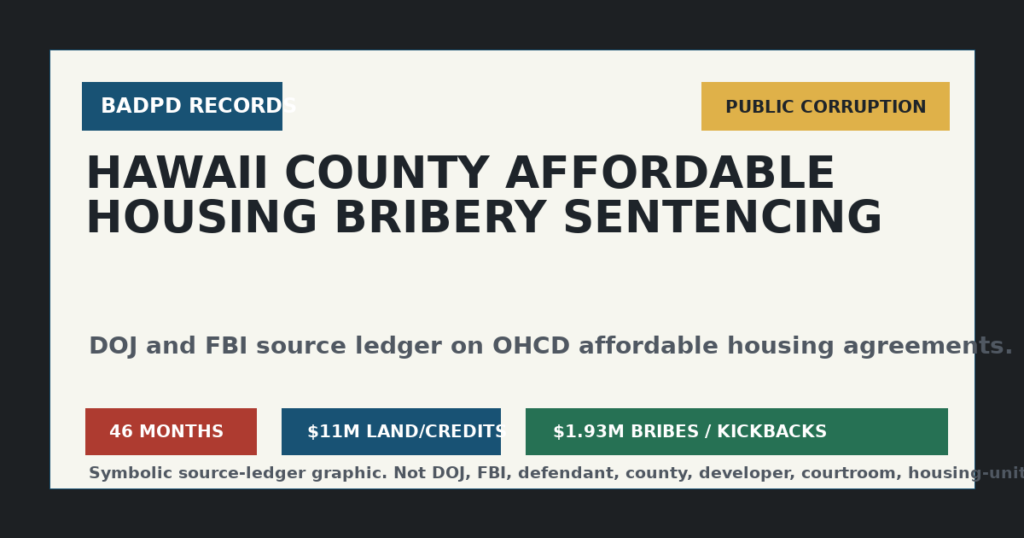
DOJ says Alan Scott Rudo, a former Hawaii County official and Housing Specialist at the Hawaii County Office of Housing and Community Development, was sentenced to 46 months in prison for his role in a conspiracy to receive bribes in exchange for official actions tied to county affordable-housing agreements. The DOJ record says the affordable housing development agreements were worth more than $11 million.
This article uses a narrow record frame. It does not say every Hawaii County housing program was corrupt, and it does not claim that every land, credit, or recovery issue has been resolved. It says the official court and DOJ source set now supports a public corruption ledger on one county housing official, three co-defendants, three affordable housing agreements, a bribe and kickback trail, and missing follow-up records the public still needs.
What The Rudo Sentence Adds
The May 29 release moves Rudo’s lane from a guilty-plea and cooperation posture into a sentencing posture. DOJ identifies him as a former Housing Specialist at the county OHCD and says he received a 46-month prison sentence for conspiracy to receive bribes in exchange for official action. That is the headline change for this update.
The sentencing release also ties Rudo to the broader trial record. DOJ says court documents and trial evidence showed that Paul Joseph Sulla, Gary Charles Zamber, and Rajesh Pankaj Budhabhatti conspired to pay Rudo bribes and kickbacks so that Rudo would use his county position to help secure approval of three affordable housing agreements. The development companies named in the source set are Luna Loa Developments LLC, West View Developments LLC, and Plumeria at Waikoloa LLC.
DOJ says the companies promised to build affordable housing but never built a single unit. Through the agreements, DOJ says the defendants fraudulently obtained more than $11 million worth of land and excess affordable housing credits. DOJ also says Sulla, Zamber, and Budhabhatti paid or attempted to pay Rudo about $1,931,778 in bribes and kickbacks.
That combination is why this deserves a full BadPD post rather than a short watch-list note. The source set ties public office, affordable housing policy, land or credit value, alleged and proven private benefit, and criminal sentencing into one record chain.
The Co-Defendant Sentences
The Rudo release does not stand alone. DOJ’s April 24 co-defendant sentencing release says Zamber was sentenced to 70 months on January 30, 2026, Budhabhatti was sentenced to 90 months on February 6, 2026, and Sulla was sentenced to 60 months on April 23, 2026. That release also says Zamber’s and Sulla’s Hawaii law licenses were suspended at that time.
The same release says a District of Hawaii jury convicted Sulla, Zamber, and Budhabhatti on June 4, 2025 on all counts of a superseding indictment. DOJ describes the counts as conspiracy to commit honest services wire fraud and nine honest-services wire-fraud counts. DOJ says Sulla was also convicted of money laundering.
Those labels matter. Rudo is the former public official who pleaded guilty and was later sentenced. Sulla, Zamber, and Budhabhatti were convicted by a jury and sentenced earlier in 2026. The original 2022 release contains charge-stage language and presumption-of-innocence language for the defendants who were then not yet convicted. The newer 2025 and 2026 records change the posture for the co-defendants, but they do not remove the need to identify which facts come from which source date.
The Three Affordable Housing Agreements
The official records identify three affordable housing agreements, often shortened to AHAs, as the center of the scheme. The companies attached to those agreements are Luna Loa Developments LLC, West View Developments LLC, and Plumeria at Waikoloa LLC. DOJ says the agreements benefited development companies tied to the defendants and were connected to projects in South Kohala, Kailua-Kona, and Waikoloa.
The public-interest problem is plain. Affordable housing agreements and affordable housing credits are not ordinary private perks. They exist because local governments are trying to produce housing or extract public benefit from development. When an official record says those tools were converted into a bribe-and-credit scheme, the next accountability question is whether the county recovered the credits, corrected the land or credit records, and fixed the control weakness that let one official carry so much influence.
DOJ’s 2022 charging release said the United States had recovered more than $2.3 million in criminal proceeds and 45 affordable housing credits connected to the charges. It also said Rudo had agreed to forfeit his interest in those funds and credits, other real estate connected to the charges, and a money judgment of $2,114,170. Those 2022 recovery and forfeiture figures should be treated as an earlier official snapshot, not proof that every recovery issue is now closed.
Confirmed, Alleged, Sentenced, And Pending
Confirmed by the May 29, 2026 Rudo sentencing release
- Alan Scott Rudo, a former Hawaii County official, was sentenced to 46 months in prison.
- DOJ identifies Rudo’s former county role as Housing Specialist at the Hawaii County Office of Housing and Community Development.
- DOJ says the scheme involved affordable housing development agreements worth more than $11 million.
- DOJ says the development companies never built a single affordable housing unit under the agreements described in the release.
- DOJ says Sulla, Zamber, and Budhabhatti paid or attempted to pay Rudo about $1,931,778 in bribes and kickbacks.
- DOJ says the FBI investigated the case.
Confirmed by the April 24, 2026 co-defendant sentencing release
- Zamber was sentenced to 70 months on January 30, 2026.
- Budhabhatti was sentenced to 90 months on February 6, 2026.
- Sulla was sentenced to 60 months on April 23, 2026.
- A jury convicted Sulla, Zamber, and Budhabhatti on all counts of a superseding indictment on June 4, 2025.
- The release identifies conspiracy to commit honest services wire fraud and nine honest-services wire-fraud counts, with Sulla also convicted of money laundering.
Charge-stage and early recovery records from July 25, 2022
- The 2022 release described an indictment against Sulla and Zamber and separate informations against Rudo and Budhabhatti.
- It said Rudo pleaded guilty before U.S. Magistrate Judge Rom A. Trader on July 18, 2022.
- It said the government had recovered more than $2.3 million in criminal proceeds and 45 affordable housing credits connected to the charges.
- It said Rudo agreed to a $2,114,170 money judgment and forfeiture tied to funds, credits, and other real estate connected to the charges.
Pending or missing records
- Final written judgment for Rudo and any amended judgment.
- Forfeiture collection status, substituted-asset records, and satisfaction records.
- Disposition of the recovered 45 affordable housing credits and any additional land or credit recovery.
- Hawaii County OHCD remedial controls, audit findings, policy changes, and administrative-rule changes after the case.
- Final law-license discipline records for Zamber and Sulla beyond the suspension status described by DOJ.
- Appeal notices, post-judgment motions, restitution orders, civil recovery cases, and settlement records if any are filed or published.
Why This Is A BadPD Accountability Story
The BadPD frame is not simply that several people were sentenced. The public record describes a county office that controlled affordable housing approvals, a public official who accepted or solicited bribes and kickbacks, private actors who sought county approval through corrupt payments, and agreements that produced land or credit value without producing the promised housing units.
The harm is not abstract. Affordable housing credits and land-value arrangements are public-interest tools. They are supposed to move a community closer to housing supply, not become a private profit mechanism. When those tools fail, the public needs more than a sentencing number. It needs a ledger of what was promised, what was approved, what was built, what was paid, what was recovered, and what controls changed after the case.
This is also a good example of why source labels matter in public-corruption reporting. A sentencing release can confirm a sentence. A jury-conviction release can confirm the verdict posture for the co-defendants. A charging release can explain original allegations and early recovery steps. None of those documents should be stretched into unsupported claims about every county housing decision, every developer, or every official who worked near the program.
The Records Still Needed From Hawaii County
DOJ’s case answers the criminal-sentencing question for the named defendants. It does not answer every public-administration question. Hawaii County residents still have a direct interest in the administrative repair record: who reviewed the agreements, who signed them, how affordable housing credits were tracked, whether credits could be issued before housing units existed, and what safeguards were adopted after the federal case exposed the weakness.
A complete local follow-up would attach county audit records, OHCD rule changes, county council materials, land-transfer records, affordable housing credit ledgers, and any recovery or cancellation actions tied to Luna Loa Developments, West View Developments, and Plumeria at Waikoloa. Those records would show whether the public value that DOJ identified was recovered, protected, or written off.
The case also needs license-discipline follow-up. DOJ says Zamber’s and Sulla’s law licenses were suspended at the time of the April 24 release. Suspension status is not the same as final disciplinary closure. If the Hawaii attorney-discipline record later shows disbarment, reinstatement, probation, resignation, or another final action, that should be added with source date and docket reference.
County-Control Questions For Residents
The simplest resident question is whether the county can show a clean ledger for every affordable housing credit touched by this case. A criminal sentence proves punishment for the named people. It does not, by itself, prove that the public ledger has been repaired. Residents should be able to see which credits were issued, which credits were recovered, which credits were canceled, and which credits remain tied to active land or development records.
The second question is who can approve an agreement now. A system that depends on one staff member to draft, route, recommend, or explain key affordable housing agreements creates obvious control risk. A stronger record would show separated duties, written review steps, public tracking, supervisor signoff, legal review, and a rule that credits do not become spendable public value before the promised housing units exist or a verified substitute public benefit is recorded.
The third question is whether affected projects were unwound or corrected. The DOJ source set names Luna Loa Developments, West View Developments, and Plumeria at Waikoloa. A local follow-up should not guess what happened to those entities or their agreements. It should attach county records showing whether agreements were terminated, amended, assigned, litigated, recovered, or left in place.
The fourth question is public notice. Affordable housing programs are often difficult for ordinary residents to track. If a credit is issued, canceled, transferred, or counted toward a developer’s obligation, the county should have a record that a resident can inspect without needing inside knowledge of the program. That is the practical difference between a sentencing story and an accountability ledger.
Source Ledger
- DOJ Hawaii Rudo sentencing release, May 29, 2026
- DOJ Hawaii co-defendant sentencing release, April 24, 2026
- DOJ Hawaii jury conviction release, June 4, 2025
- DOJ Hawaii original charging release, July 25, 2022
Source status note: justice.gov local curl fetches were blocked by a DOJ interstitial in this run, so the official DOJ pages were browser-index verified and the source URLs were preserved in the local package. The article relies only on official DOJ source pages and labels sentencing, conviction, and charging posture separately.
Featured image is symbolic editorial artwork created for BadPD. It is not DOJ, FBI, Hawaii County, OHCD, a defendant, a development company, a housing unit, a courtroom, land-record imagery, or evidence photography.
Send receipts for the desk to research
Send corrections, missing records, police-accountability tips, good-cop public-service receipts, government/court/war leads, recall alerts, or property-tax help resources. Tips are leads only until BadPD verifies records.
Links, dates, agency names, docket numbers, bodycam IDs, recall numbers, forms, and official pages.
Every tip is a lead, not a fact. The desk checks records before publishing.
Use advertising inquiry when you want clearly labeled sponsor space or available ad placements on BadPD.