
Garvin County Jail Ledger: Kayla Turley Died In Custody; One Verdict And Five Pleas Demand The Records
News Anchor voice
Ready when you are.
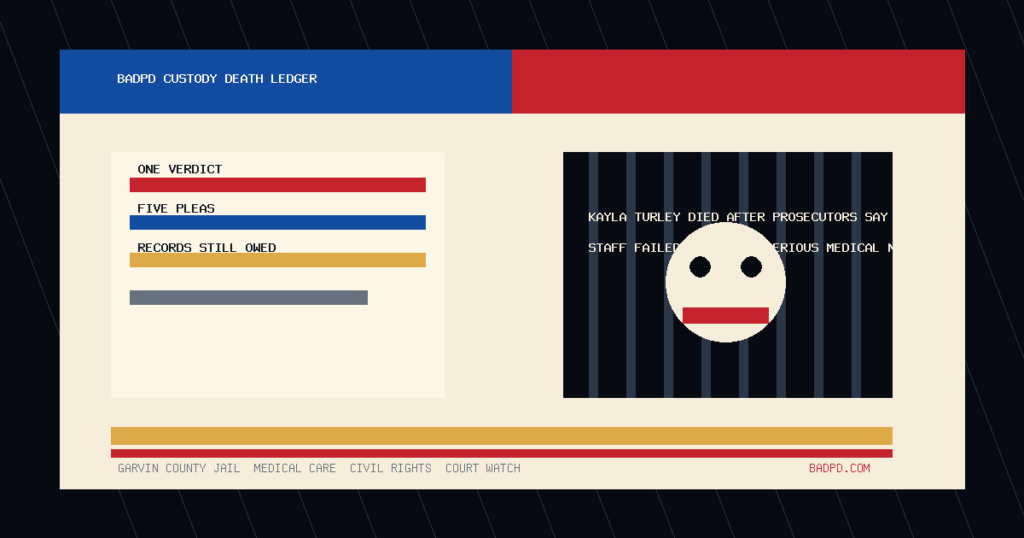
BadPD source-check, June 22, 2026; source dates December 6, 2024 through June 15, 2026: Kayla Turley died after the government took custody of her. That sentence is the whole accountability frame. Whatever led to her booking, whatever charges were pending, whatever arguments people want to have about jail crowding or medical vendors, the state had her body, her liberty, and the duty to get her medical care when the danger became obvious.
On June 15, 2026, the Justice Department announced that a federal jury convicted former Garvin County Jail detention deputy Paula Kelley of a civil-rights violation under 18 U.S.C. 242. The DOJ release says the conviction followed a June 12 jury trial in the Western District of Oklahoma and centered on deliberate indifference to the serious medical needs of pretrial detainee Kayla Turley, resulting in bodily injury and death.
That is a confirmed federal verdict, not a rumor and not a lawsuit allegation. It is also not the end of the story. Kelley has not been sentenced in the source trail reviewed. Five other jail or jail-medical employees pleaded guilty in related federal civil-rights counts. A separate civil case brought by the estate names individual defendants, the Sheriff of Garvin County in his official capacity, and Turn Key Health Clinics. A federal judge stayed most of that civil case until July 1, 2026, because the criminal case and the civil claims overlap.
BadPD is publishing this as a custody-death accountability ledger because the public record points to three layers at once: individual jail staff conduct, jail medical-care systems, and county/vendor accountability. If the only thing the public gets is a conviction headline, the system learns how to punish one person and leave the architecture intact.
What Is Confirmed Now
The confirmed current event is the federal verdict. DOJ says Paula Kelley was a former detention deputy at the Garvin County Jail in Pauls Valley, Oklahoma. DOJ says a federal jury found her guilty of violating 18 U.S.C. 242 after prosecutors established at trial that she was on duty when she learned Turley had serious medical needs and failed to take reasonable steps to address those needs. DOJ says Turley suffered bodily injury and died because of the failure to act by Kelley and other Garvin County Jail staff.
Kelley faces a maximum penalty of life in prison and a fine of up to $250,000. That is the statutory maximum reported by DOJ; it is not the sentence. The actual sentence will be determined later by a federal judge after the court applies sentencing law, the record, guidelines, and arguments from the parties.
DOJ also says four other former detention deputies and one former jail nurse previously pleaded guilty to federal civil-rights violations tied to Turley's death. The names in the DOJ source trail are Jennifer Baxter, Lynsee Noel, Vincent Matthews, Alesha Ingram, and Melissa Melton. Baxter and Noel pleaded guilty based on failures to take reasonable measures to help Turley obtain medical care. Baxter, Noel, Matthews, and Ingram also pleaded guilty to being deliberately indifferent to Turley's safety when they failed to intervene and stop other inmates from assaulting her after those inmates became frustrated with her cries for help. Melton pleaded guilty to deliberate indifference to a substantial risk of serious harm due to Turley's medical needs, resulting in bodily injury.
Those plea descriptions are official-source summaries, but sentencing is still a separate step. BadPD will not treat maximum penalties as outcomes. The next update must check sentencing dates, judgment entries, restitution if any, supervised release, appeal notices, and any factual basis attached to each plea.
The Indictment Trail Matters, But It Is Not A Verdict By Itself
The December 6, 2024 Western District of Oklahoma indictment announcement remains important because it shows what federal prosecutors alleged before the pleas and verdict. It said a grand jury charged five current and former correctional officers and one correctional nurse with federal civil-rights violations.
The indictment announcement described two core lanes. First, it alleged that on August 6, 2023, former Garvin County Jail Sergeant Jennifer Baxter, former deputies Alesha Danielle Ingram and Vincent Matthews, and former nurse Lynnsee Noel were deliberately indifferent to a substantial risk of serious physical harm to a pretrial detainee identified as K.T. at the hands of other inmates. Second, it alleged that on August 6 and 7, 2023, Baxter, Ingram, Matthews, Noel, Melissa Melton, and Paula Kelley were deliberately indifferent to K.T.'s serious medical needs and willfully failed to ensure necessary medical care.
At the indictment stage, all defendants were presumed innocent. That caveat matters. The case has now moved past the indictment stage for the people who pleaded guilty and for Kelley after trial, but BadPD still keeps the time labels attached because the public record changed over time. Allegation in December 2024. Guilty pleas before June 2026. Jury verdict on June 12, 2026. DOJ release on June 15, 2026. Sentencing and civil discovery still pending.
This is how we avoid low-value crime content. We do not freeze a case at its first press release. We track the record as it changes.
What Local Reporting Adds
Local reporting fills in why this case should not be reduced to a one-line federal verdict.
KXII reported on June 15, 2026 that Kelley was convicted for failing to meet an inmate's medical needs in a case prosecutors said resulted in death, and repeated the DOJ account that five others had pleaded guilty. KOKH/OKC Fox similarly reported the verdict, the life-maximum exposure for Kelley, and the ten-year maximum exposure for the five who entered plea agreements.
NonDoc's December 12, 2024 report is the deeper local receipt in the source trail. It reported that Kayla Lee Turley died August 9, 2023, and that her final days included physical abuse in a crowded Garvin County Jail cell, multiple trips to hospitals, and organ failure. NonDoc reported that Garvin County District Attorney Greg Mashburn charged Tiffani Stapp and Kathleen Tolison with aggravated assault and battery over alleged physical abuse of Turley in the jail cell, while federal prosecutors charged jail employees and a nurse over what they allegedly failed to do.
Those state charges and detailed allegations are not the federal verdict. They are related accountability lanes. BadPD is treating them as local/court-reporting receipts to be checked, not as final findings against every person named. The reason they matter is that the federal civil-rights case was never only about whether someone typed the wrong note or missed one medication pass. The public-source record describes a woman in visible distress, in custody, moving between jail and hospital, and surrounded by people who had the power to call medical help or intervene.
NonDoc also reported jail-conditions context from Garvin County Sheriff Jim Mullett, including that the jail holds about 80 people and does not accommodate detainee segregation in the way a larger facility might. That does not excuse civil-rights violations. It points to a policy question: if a county knows its jail design or staffing model creates predictable danger for medically fragile detainees, then the county cannot hide behind the chaos the county itself accepts.
The Civil Case Is The System Lane
The federal civil case matters because criminal prosecutions can punish individual conduct while leaving the policy machine under-examined.
A GovInfo copy of a January 21, 2026 order in Bundy v. Sheriff of Garvin County shows the estate's personal representative brought a 42 U.S.C. 1983 action over Turley's death. The order says the complaint alleges constitutional violations from deliberate indifference to serious medical needs. It also says the suit seeks to impose liability on Noel, Baxter, Melton, Ingram, Kelley, and Matthews in their individual capacities, and on Turn Key Health Clinics and the Sheriff of Garvin County for alleged unconstitutional customs, practices, or policies.
That is the part BadPD wants readers to watch. Individual accountability is necessary. It is not sufficient. If a county jail contracts medical care to a private provider, the public needs the contract, staffing standards, incident-report obligations, emergency-transfer rules, quality-assurance reviews, death-review reports, grievance records, and the county's oversight record. If the sheriff says jail design or staffing was part of the problem, the public needs budget requests, inspection reports, failed improvement plans, and the voter-facing claims used to justify any new jail proposal.
The January order stayed most of the civil case until July 1, 2026 because the court found the criminal case and civil claims were heavily interrelated. The court left pending motions to dismiss outside the stay. That is a normal legal-management issue, but it has a public consequence: civil discovery that could expose vendor and county practices was delayed while criminal proceedings moved first.
Now that the federal verdict has happened, the next public question is whether that stay lifts cleanly, whether defendants file new notices, whether discovery begins, and whether any settlement attempt keeps key records sealed.
The Docket Context Does Not Erase Her Rights
ODCR lists a Chickasaw Nation District Court felony case against Kayla Turley filed March 14, 2023, with a burglary-in-the-second-degree count listed as dismissed and an August 31, 2023 dismissal calendar entry. That record is included only for timeline context. It does not make her disposable. It does not lower the jail's duty of care. It does not make medical neglect acceptable.
The constitutional rule is not complicated: pretrial detainees do not lose the right to necessary medical care because they are accused of a crime. They are presumed innocent in the criminal case that put them in custody. They cannot leave to get care on their own. Their survival depends on the people controlling the door, the phone, the transport decision, the camera room, the medical vendor, and the shift chain of command.
That is why custody-death reporting has to be careful about old charges. The public should know the timeline, but the state cannot use a dismissed or unresolved case as a moral shield against accountability for what happened after booking.
Confirmed, Alleged, Pending, Disputed
Confirmed by federal verdict and plea source trail: Paula Kelley was convicted by a federal jury on June 12, 2026 of violating 18 U.S.C. 242 in connection with deliberate indifference to Kayla Turley's serious medical needs. DOJ announced the verdict June 15, 2026. Five other jail or jail-medical employees pleaded guilty to related federal civil-rights violations. Kelley faces a statutory maximum of life in prison; the plea defendants face maximum penalties reported as ten years in prison and fines up to $250,000.
Confirmed by court records: The civil case brought by the estate is in the Western District of Oklahoma as Bundy v. Sheriff of Garvin County, Case No. CIV-25-850-SLP. The January 21, 2026 order says the civil claims and criminal case involve the same conduct, stayed most of the civil action until July 1, 2026, and kept pending motions to dismiss available for court consideration.
Reported by local journalism and court-file lanes: NonDoc reported the broader timeline of Turley's August 2023 final days, allegations of physical abuse by other detainees, state charges against Tiffani Stapp and Kathleen Tolison, jail crowding/segregation context, hospital-transfer questions, and sheriff/vendor lanes. KXII and KOKH reported the June 2026 conviction and related pleas. Those details should be tested against the indictment, plea agreements, trial transcript, medical records, jail video, state-court dockets, and civil discovery.
Pending: sentencing dates and judgments for Kelley, Baxter, Noel, Matthews, Ingram, and Melton; appeal notices; the factual basis for each plea; any restitution or victim-impact record; the state cases against Stapp and Tolison; the civil motions to dismiss; the July 1 civil stay checkpoint; Turn Key contract and policy records; sheriff/jail inspection records; hospital transfer and discharge records; and any death review.
Disputed or incomplete: exact medical causation details, what each employee saw and heard at each time point, what the hospital knew when Turley was returned or discharged, whether policy failures extended beyond the six federal defendants, what the sheriff and vendor knew before August 2023, and whether the county had notice from prior jail incidents that its housing, staffing, or medical-care system was unsafe.
Records BadPD Wants Next
Release the criminal docket sheet, verdict form, jury instructions, sentencing minutes, plea agreements, factual bases, judgments, and any appeal notices. Release the civil docket updates after July 1, 2026, including whether discovery opens and whether the motions to dismiss narrow or preserve the claims against the Sheriff and Turn Key.
Release jail video that can lawfully be released. Release audio, intercom logs, call-button logs, medical request logs, med pass records, transport logs, nurse notes, hospital-transfer paperwork, hospital discharge instructions, shift rosters, supervisor notifications, incident reports, death-review records, jail inspection reports, and any outside investigative reports from OSBI, Chickasaw Lighthorse Police, the FBI, or county investigators.
Release the Turn Key contract. Release the county's oversight correspondence. Release staffing minimums, emergency-care escalation policy, detainee-segregation policy, use-of-force/intervention policy, sick-call policy, intoxication/withdrawal policy, mental-health crisis policy, and the policy for returning a medically fragile detainee from hospital to jail.
If records are withheld because of the criminal case, name the exemption and set a review date. If records are withheld because of medical privacy, produce redacted policy, timeline, and accountability records. If the county says the problem was the old jail building, show the inspection reports and the budget requests that prove officials knew the risk before Turley died.
Why This Is A BadPD Story
BadPD covers police accountability, court accountability, public corruption, public safety, and government power. A county jail is government power at its most direct. A person in a cell cannot shop for a better provider. She cannot drive to the emergency room. She cannot call her own doctor without permission. If she cries for help and the people with keys ignore her, the harm belongs in the public ledger.
This is also a good test of whether a community responds to custody death with reform or just replacement rhetoric. A new building may be needed. It may not fix a culture that delays medical care, ignores cries for help, houses medically fragile detainees without proper segregation, or contracts health care without meaningful oversight. Build better if the old facility is unsafe, but do not use construction as a substitute for accountability.
The federal verdict is significant because Section 242 cases against jail staff are not routine. The guilty pleas are significant because they show more than one person admitted federal civil-rights exposure. The civil case is significant because it reaches the sheriff/vendor policy lane. The local reporting is significant because it preserved details before the national attention arrived.
BadPD Bottom Line
Kayla Turley's death is not a one-person paperwork failure. The public record now shows a federal jury verdict, five guilty pleas, local reporting about abuse and medical distress, and a civil case that names county and vendor policy lanes.
Paula Kelley is entitled to sentencing process and any appeal rights. The five plea defendants are entitled to sentencing process. The state-case defendants are entitled to due process. Garvin County and Turn Key are entitled to defend the civil case. None of that cancels the public's right to demand records from the government that held Turley when she was too sick to protect herself.
The next test is whether the court system produces only punishment, or whether it also produces repair. Sentences matter. Records matter too. Policies matter. Contracts matter. Video matters. Hospital-transfer paperwork matters. The public should not have to wait for another death to learn what was broken.
BadPD will update this ledger when sentencing, civil discovery, docket orders, state-case outcomes, or official records move. Until then, the demand is simple: release the custody-death file, identify every policy failure, and stop treating medical care in jail as optional.
Source-Status Note For Readers
This article is a source-status ledger. It treats the June 2026 federal verdict and guilty pleas as confirmed court outcomes, labels older indictment and civil-case details by source date, and treats local reporting as receipts to check against court files, official records, and future discovery. Do not harass family members, witnesses, jail employees, medical workers, lawyers, judges, or local residents. The lawful next step is records, docket tracking, and source-cleared updates.
Source Trail
- DOJ Office of Public Affairs: Paula Kelley federal civil-rights jury conviction (June 15, 2026; accessed June 22, 2026) – Official federal verdict release for the June 12, 2026 jury conviction, Section 242 count, serious-medical-needs finding, five related guilty pleas, penalties, and FBI/USAO/Civil Rights Division source trail.
- DOJ Western District of Oklahoma: local USAO verdict release (June 15, 2026; accessed June 22, 2026) – Western District version of the verdict release; raw local curl snapshot hit an Akamai interstitial, but public DOJ page was source-checked through browser/search.
- DOJ Western District of Oklahoma: December 2024 indictment announcement (December 6, 2024; accessed June 22, 2026) – Official indictment-era receipt for the original allegations against five current/former correctional officers and one nurse, including the serious-medical-needs and inmate-assault-risk counts.
- KOKH/OKC Fox: ex-Oklahoma jail deputy conviction report (June 15, 2026; accessed June 22, 2026) – Local Oklahoma report cross-checking the conviction, five other pleas, penalties, and federal statements.
- KXII: Garvin County correctional officer convicted by federal jury (June 15, 2026; accessed June 22, 2026) – Texoma/local report preserving the verdict, plea names, maximum penalties, and FBI investigation note.
- NonDoc: 2024 deep report on Garvin County Jail death charges (December 12, 2024; accessed June 22, 2026) – Independent Oklahoma reporting adding timeline, local/state charges, jail-capacity context, sheriff statements, Turn Key lane, and FBI affidavit details; claims are treated as reporting/court-file lanes.
- GovInfo: Bundy v. Sheriff of Garvin County civil stay order (January 21, 2026; accessed June 22, 2026) – Federal civil case order showing Estate claims against individual defendants, the Sheriff, and Turn Key; civil discovery was stayed until July 1, 2026, with motions to dismiss excepted.
- ODCR: Chickasaw Nation v. Kayla Turley docket snapshot (Case filed March 14, 2023; accessed June 22, 2026) – Court-record context for one pre-custody criminal case listed as dismissed; included only to anchor timeline and avoid reducing Turley to allegations.
Send receipts for the desk to research
Send corrections, missing records, police-accountability tips, good-cop public-service receipts, government/court/war leads, recall alerts, or property-tax help resources. Tips are leads only until BadPD verifies records.
Links, dates, agency names, docket numbers, bodycam IDs, recall numbers, forms, and official pages.
Every tip is a lead, not a fact. The desk checks records before publishing.
Use advertising inquiry when you want clearly labeled sponsor space or available ad placements on BadPD.