
Hapeville Taser Ledger: Shevoy Brown Got 37 Months, But The Bench, Bodycam And POST Questions Are Not Done
News Anchor voice
Ready when you are.
BadPD source-check, June 22, 2026; source dates June 10, 2024 through June 11, 2026: Former Hapeville Police Officer Shevoy Brown is now a federal prison story, but BadPD is not treating the sentence as the end of the file. The public record says a restrained detainee was alone in a small holding cell, handcuffed to a stationary bench, and posed no threat when Brown entered the cell twice and used a Taser at least six times. The public record also says Brown wrote a false use-of-force report afterward.
On June 10, 2026, the U.S. Attorney's Office for the Northern District of Georgia announced that Brown had been sentenced to three years and one month in prison, followed by two years of supervised release. DOJ says Brown was convicted on February 26, 2026 after a jury trial. The case was investigated by the FBI.
That gives this story a confirmed federal outcome: conviction, sentence, supervised release. It does not answer every public accountability question. Who approved Brown for Hapeville while, according to local reporting, Georgia POST had already placed him on certification probation after a prior-agency allegation he denied and that did not produce an indictment? What did Hapeville supervisors see before the FBI case? Did internal review catch the false report before public pressure, local reporting, GBI involvement, or federal prosecutors did? What happened to the officer who intervened? What did the bodycam, holding-cell camera, Taser logs, and report-review chain show?
BadPD is publishing this as a police-accountability ledger because the criminal sentence addresses Brown, but the public still needs the system record.
What DOJ Says Is Confirmed
The June 10, 2026 DOJ sentencing release says Brown, a former Hapeville officer, was sentenced by U.S. District Judge Steven D. Grimberg to three years and one month in prison and two years of supervised release. DOJ identifies Brown as a 31-year-old from Hampton, Georgia. DOJ says a federal jury convicted him on February 26, 2026.
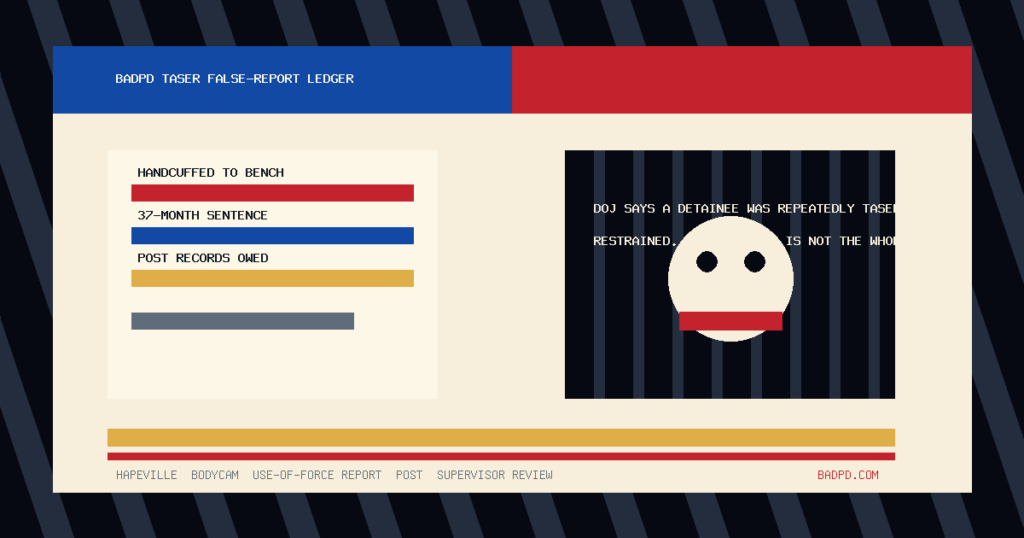
The official sentencing release says the incident began June 3, 2024, after a man was arrested for trespassing and transported to Hapeville Police Department headquarters. The man was placed alone in a small holding cell. He was handcuffed to a stationary bench. DOJ says Brown entered the cell twice and tased the detainee at least six times, including in the groin/genital area, while the detainee posed no threat.
DOJ says Brown stopped only after another officer intervened. DOJ also says the detainee suffered injury that required medical attention. Local Atlanta reports say ambulance/medical transport became part of the aftermath.
The obstruction lane is just as important as the force lane. DOJ says Brown wrote a false use-of-force report. The official release says Brown claimed he tased the detainee only twice to gain compliance after the man allegedly kicked a door and window. DOJ says trial evidence showed the detainee had stopped hitting the window before Brown entered and had never kicked anything. DOJ says Brown omitted that the detainee was handcuffed to the bench and omitted the four additional Taser uses.
That is the core BadPD accountability issue. Excessive force is one harm. A false report is a second harm. A false report can turn a restrained person's pain into paperwork that looks justified. It can mislead supervisors, prosecutors, judges, defense lawyers, civil lawyers, city officials, insurers, POST regulators, and the public.
The Charge Trail Shows The Case Changed Over Time
The March 3, 2025 DOJ indictment and arraignment release said Brown had been charged after a federal grand jury indictment returned on February 12, 2025. At that stage, the allegations were not verdicts. DOJ said Brown was accused of using unreasonable force by repeatedly tasing a handcuffed detainee who had been arrested for trespassing. DOJ also described the false-report allegation as an obstruction count.
BadPD keeps the dates attached because the legal posture changed. On March 3, 2025, Brown was an indicted former officer presumed innocent. On February 26, 2026, according to DOJ, a jury convicted him. On June 10, 2026, he was sentenced. Those distinctions matter because accountability reporting should be aggressive without turning allegations into findings before the court record does.
The federal case also shows why local receipts matter. The public first learned key pieces through Atlanta-area coverage in 2024, before the 2025 federal indictment and before the 2026 sentence. When local reporters, family members, attorneys, city statements, and agency releases preserve early details, they help keep the official record from shrinking into a short sentencing paragraph.
What Local Reporting Adds
FOX 5 Atlanta reported in July 2024 that the victim was 64-year-old Robert Martin. WSB-TV also identified the man as Robert Martin in a June 2024 interview. BadPD is using the local identification carefully because DOJ's sentencing release did not name the detainee in the source trail reviewed. The name is part of the public local reporting record, but the legal finding BadPD relies on here is the federal conviction and sentence.
Local reporting adds several accountability lanes. FOX 5 reported that Hapeville fired Brown on June 20, 2024 and requested a GBI investigation. WSB-TV reported in June 2024 that Hapeville officials said Brown's Taser use was outside department guidelines and that the department contacted the GBI. Those are important city-response receipts, but they raise more questions than they answer.
If Hapeville fired Brown quickly after reviewing bodycam or internal evidence, what exactly did supervisors find? Was the false use-of-force report detected by Hapeville, GBI, FBI, or prosecutors? Did the department audit every report connected to Brown after finding one false report? Were any cases, arrests, or complaints reopened? Did Hapeville notify prosecutors and defense attorneys in cases where Brown had been a witness?
FOX 5 also reported that an attorney for Martin sent a demand letter seeking a $2 million settlement and warning of a larger lawsuit if no settlement occurred. That is an attorney/civil-claim lane, not a court finding. It still belongs in the ledger because civil accountability is where city policy, insurance, damages, training, hiring, and records often come out.
The Other Officer's Intervention Matters
DOJ says Brown stopped only after another officer intervened. FOX 5, Atlanta News First, and WSB-TV all preserve that intervention detail in local reporting.
That detail should not be used as a department-wide public-relations shield. It should be used as a records demand. Who was the intervening officer? What did that officer say in the moment? Did the officer file a report? Did the officer trigger a supervisor response? Did Hapeville protect the officer from retaliation? Did the intervention follow a written duty-to-intervene policy? Did supervisors use the intervention to teach, discipline, or audit?
BadPD includes verified good-cop or public-service-done-right receipts when they are real. Here, the source trail indicates that another officer intervened to stop further force. That is a useful act. The public still needs proof of whether the system rewarded it, buried it, or only acknowledged it after prosecutors did.
Intervention also sharpens the question of obviousness. If another officer saw enough to intervene, the public should ask what every reviewing supervisor saw later. The video, Taser downloads, holding-cell camera, CAD notes, medical transport record, and Brown's written report should have been enough to trigger a serious review without waiting for a federal trial.
The POST And Hiring Question
WSB-TV reported on June 10, 2024 that Brown was on probation with Georgia Peace Officer Standards and Training Council after an alleged prior incident while he worked for Clayton County Police. WSB's report also says Brown denied that prior allegation and that a grand jury declined to indict him. BadPD is not treating the prior allegation as proof of a crime. It is a certification, hiring, and risk-management question.
That distinction matters. The public does not need a smear file. The public needs the employment and certification file. If a department hires an officer who is already on POST probation, the city should be able to explain who knew, what records were reviewed, what restrictions or monitoring existed, and why the hire served public safety.
If Hapeville knew about a probationary certification status, did it put Brown under closer supervision? Did it limit assignments? Did it audit his bodycam? Did it require remedial training? Did supervisors know about the prior Clayton County internal-affairs history? Did Hapeville request POST records, separation records, disciplinary records, or Brady/Giglio information?
If Hapeville did not know, the question changes: why not? What did the background process miss? What did POST disclose? What did Clayton County provide? What did Brown disclose? What did the city require from lateral police hires?
The June 2026 federal sentence makes those old questions current again. A restrained detainee was tased repeatedly, the officer was convicted, and the official record says a false report followed. The city cannot answer that only by saying the officer is gone.
False Reports Are Public-Safety Failures
A false use-of-force report is not just an employment violation. It is a public-safety failure. Police reports move through criminal courts, civil courts, records systems, prosecutor files, internal-affairs files, insurance claims, and public trust. When an officer lies about force, the lie can turn a victim into a suspect, a supervisor into a rubber stamp, and the court into a laundering machine for misconduct.
DOJ says Brown's report understated the number of Taser uses, misrepresented the reason for force, omitted that the detainee was handcuffed to a bench, and omitted four extra Taser uses. Those are not tiny wording problems. They are the facts that determine whether force was legal.
That means Hapeville should disclose how use-of-force reports were reviewed in 2024. Did a supervisor compare the report to bodycam? Did anyone compare Taser cartridge data or device logs? Did the holding-cell camera capture the event? Did medical transport paperwork contradict the report? Did anyone interview the detainee before writing off the force as compliance? Did anyone preserve the door, window, bench, and cell layout as evidence?
If those checks existed and worked, the city should prove it. If those checks did not exist, the city should fix them publicly.
Confirmed, Alleged, Pending, Disputed
Confirmed by DOJ and federal court posture: Brown was convicted by a jury on February 26, 2026 and sentenced on June 10, 2026 to three years and one month in prison plus two years supervised release. DOJ says the underlying June 3, 2024 conduct involved a handcuffed detainee in a Hapeville holding cell, Taser use at least six times, injury requiring medical attention, another officer's intervention, and a false use-of-force report.
Confirmed by local reporting, subject to source labels: FOX 5 and WSB-TV identify the detainee as Robert Martin, age 64. FOX 5 and WSB reported Hapeville fired Brown and requested or involved GBI review in June 2024. WSB reported Brown had Georgia POST probation context from a prior Clayton County allegation he denied and for which a grand jury declined indictment.
Alleged or civil-claim lane: Attorney settlement demands, any civil damages claim, exact injury severity beyond official and local descriptions, and any broader city policy liability remain allegations or pending records questions unless admitted, adjudicated, settled with findings, or proven through released records.
Pending or missing: Brown's federal judgment entry, BOP reporting date and facility, appeal notice if any, full docket sheet, trial transcript, verdict form, jury instructions, sentencing memorandum, Taser logs, bodycam, holding-cell camera, use-of-force report, supervisor review, internal-affairs file, GBI file, FBI investigative records if releasable, POST action, city hiring file, Clayton County separation/IA records, prosecutor notifications, civil docket or settlement records, ambulance run sheet, medical records where lawfully releasable, and Hapeville policy updates.
Disputed or incomplete: what Hapeville knew before hiring Brown, what supervisors knew immediately after the incident, whether the false report was caught internally before outside pressure, whether other cases should be reopened, whether the intervening officer's action was protected and documented, and whether POST or prior-agency records were adequate to warn a hiring department.
Records BadPD Wants Next
Release the use-of-force report that DOJ says was false, with redactions only where legally required. Release the internal-affairs findings. Release the Taser download, activation logs, cartridge records, bodycam, holding-cell camera, CAD notes, dispatch audio, medical transport record, supervisor notifications, and any GBI or city investigative summary that can lawfully be released.
Release Brown's Hapeville hiring file, background checklist, POST certification status at hire, training history, remedial training, field-training records if relevant, discipline history at Hapeville, and separation record. Release the policy for lateral hires with prior-agency disciplinary or certification issues. Release the city's duty-to-intervene policy and show whether the intervening officer filed a report or received protection.
Release any notice to prosecutors, defense counsel, courts, or case parties whose cases involved Brown as a witness. A false-report conviction is not limited to one victim if the officer's credibility was used in other matters. Prosecutors and defense counsel should not learn about that through search results.
If records are withheld because of appeal rights or privacy law, identify the legal basis and set a review date. If the city says the records cannot be released, publish a redacted chronology and policy-correction memo. Silence is not a reform plan.
Why This Is A BadPD Story
This case is a clean BadPD case because it combines force, restraint, documentation, intervention, medical care, and hiring oversight. The public record does not show a chaotic street fight. It shows a detainee handcuffed to a stationary bench inside a police facility. That setting makes the power imbalance impossible to ignore.
Police departments often tell the public to wait for all the facts. Fine. Then release the facts when the criminal case reaches a sentence. Brown has been convicted and sentenced. Hapeville can no longer hide every public answer behind the idea that no court has spoken.
The public also needs to know whether the department used this case to improve its own review system. Did Hapeville change Taser policy? Did supervisors get retrained on report-video reconciliation? Did the city audit holding-cell force events? Did POST take final certification action? Did the city revise lateral-hiring rules? Did the intervening officer's conduct become training material? Did the department notify the community in a way that admits what happened without forcing the victim or family to carry the whole burden?
BadPD Bottom Line
Shevoy Brown is responsible for his conduct and has now received a federal prison sentence. That is not the whole accountability file. The full file belongs to the public because the harm happened inside a police building, with a restrained detainee, a Taser, another officer's intervention, medical injury, and a false report.
Hapeville should not get credit for firing Brown unless it also releases what its system found, when it found it, and what changed. Georgia POST should not be a mystery box. Prosecutors should make sure every case touched by Brown is checked for credibility issues. The public should not have to wait for a lawsuit to learn whether the city reviewed its own failures.
BadPD will update this ledger when docket records, POST records, Hapeville records, civil filings, policy updates, or appeal notices move. For now, the demand is simple: release the restraint-cell record, release the false-report review, and prove the next person handcuffed to a bench will not have to rely on luck for another officer to intervene.
Source-Status Note For Readers
This article is a source-status ledger. It treats the June 2026 federal conviction and sentence as confirmed court outcomes, labels older indictment and local-reporting details by source date, and treats POST, hiring, attorney-demand, and civil-liability lanes as records to verify before treating them as final findings. Do not threaten or harass family members, witnesses, officers, city employees, lawyers, judges, reporters, or local residents. The lawful next step is records, docket tracking, and source-cleared updates.
Source Trail
- DOJ Northern District of Georgia: sentencing release (June 10, 2026; accessed June 22, 2026) – Official federal sentencing receipt: Shevoy Brown sentenced to 3 years and 1 month in prison plus two years supervised release after conviction for repeatedly tasing a handcuffed detainee and writing a false report.
- DOJ Northern District of Georgia: charge and arraignment release (March 3, 2025; accessed June 22, 2026) – Official indictment-era source for the February 12, 2025 grand-jury charge, June 3, 2024 incident allegations, obstruction count, FBI investigation, and GBI assistance.
- FOX 5 Atlanta: former Hapeville officer sentenced (June 10, 2026; accessed June 22, 2026) – Local sentencing cross-check with trial evidence, ambulance/medical-care detail, and open administrative questions about other employees.
- Atlanta News First: sentencing report (June 10, 2026; accessed June 22, 2026) – Atlanta local cross-check for sentencing, repeated taser use, stopped-by-another-officer detail, medical transport, and false-report lane.
- WSB-TV: former metro Atlanta officer going to federal prison (June 11, 2026; accessed June 22, 2026) – Local cross-check for federal prison sentence, restrained holding-cell facts, private-area/groin tasing detail, intervention, and injury/ambulance lane.
- FOX 5 Atlanta: 2024 victim and firing report (July 30, 2024; accessed June 22, 2026) – Earlier local account identifying the victim as Robert Martin, age 64, reporting Hapeville fired Brown, requested a GBI investigation, and preserving attorney/civil-claim context.
- FOX 5 Atlanta: federal arraignment report (March 3, 2025; accessed June 22, 2026) – Local arraignment receipt for the federal indictment, charges, obstruction/false-report allegations, and due-process posture at the charging stage.
- WSB-TV: POST probation and prior-agency context (June 10, 2024; accessed June 22, 2026) – Local reporting that Brown was on Georgia POST probation after a prior Clayton County allegation; article notes Brown denied the allegation and a grand jury declined indictment, so this is treated as a certification/hiring question, not proof of prior crime.
- WSB-TV: victim interview after Hapeville arrest (June 12, 2024; accessed June 22, 2026) – Early local victim interview and Hapeville statement context; used for timeline and records-to-request questions, not as a substitute for court findings.
Send receipts for the desk to research
Send corrections, missing records, police-accountability tips, good-cop public-service receipts, government/court/war leads, recall alerts, or property-tax help resources. Tips are leads only until BadPD verifies records.
Links, dates, agency names, docket numbers, bodycam IDs, recall numbers, forms, and official pages.
Every tip is a lead, not a fact. The desk checks records before publishing.
Use advertising inquiry when you want clearly labeled sponsor space or available ad placements on BadPD.