
McCurtain County Jail Supervisor Pleads Guilty: Civil-Rights Force Ledger
News Anchor voice
Ready when you are.
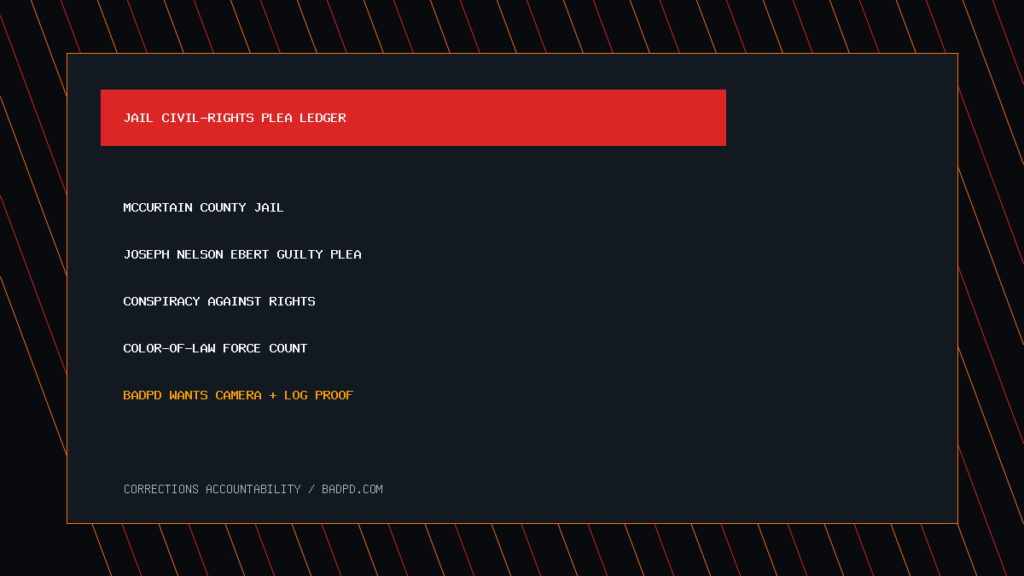
BadPD source-check, July 9, 2026: the U.S. Attorney’s Office for the Eastern District of Oklahoma says former McCurtain County Jail shift supervisor Joseph Nelson Ebert pleaded guilty to one count of conspiracy against rights and one count of deprivation of rights under color of law. This is a guilty-plea ledger. It is not a sentencing article yet.
DOJ says the two charges came from two separate jail incidents. The first information alleged a September 15, 2021 conspiracy to injure, oppress, threaten, and intimidate an arrestee in the right to be free from unreasonable seizure, including unreasonable force by a person acting under color of law. The second information alleged a January 4, 2022 deprivation of a pretrial detainee’s right not to be deprived of liberty without due process, including the right to be free from unreasonable force by a correctional officer.
What DOJ Says Is Confirmed
DOJ confirmed that Ebert entered guilty pleas to both federal civil-rights counts. DOJ says each count is punishable by up to 10 years in prison and a $250,000 fine. DOJ also says Ebert will remain in the custody of the U.S. Marshals Service pending sentencing.
DOJ says U.S. District Judge Ronald A. White presided over the plea hearing and ordered a presentence investigation report. The final sentence will be determined later after the court considers the U.S. Sentencing Guidelines and other statutory factors.
DOJ identifies the Federal Bureau of Investigation, Oklahoma State Bureau of Investigation, and Oklahoma State Auditor’s Office as investigating agencies. DOJ also says Trial Attorneys Alec Ward and Kathryn Gilbert from the Criminal Section of the Civil Rights Division are prosecuting with Assistant U.S. Attorney Nicole Paladino.
Confirmed, Alleged, Pending, Disputed
Confirmed by DOJ: Joseph Nelson Ebert pleaded guilty to conspiracy against rights and deprivation of rights under color of law. DOJ confirmed the former position, the jail, the court, the custody posture, and the maximum statutory penalties.
Alleged in the informations as described by DOJ: the September 2021 count involved a conspiracy against an arrestee’s right to be free from unreasonable force. The January 2022 count involved deprivation of a pretrial detainee’s right to be free from unreasonable force by a correctional officer.
Pending: the full informations, plea agreement, factual basis, detention record, presentence report schedule, sentencing date, victim-impact record, jail video or incident-log preservation, staff rosters, use-of-force reports, medical records with private details protected, policy records, and any state certification or employment consequences.
Limited: this article does not name victims or publish private medical details. It does not say every current McCurtain County employee is responsible for Ebert’s plea. It does not treat any separate civil defendant as criminally guilty unless a criminal court record says so.
Why The Civil Case Context Matters
BadPD found related federal civil-case context in Harris v. McCurtain County Jail Trust. GovInfo identifies the case as an Eastern District of Oklahoma civil-rights action involving McCurtain County Jail Trust and, among other defendants, Joe Ebert. That does not replace the criminal plea record. It shows that the jail-force allegations also moved through civil court.
The Justia-hosted July 17, 2024 order says the civil case arose out of arrest and detention at the McCurtain County Jail on or about September 15-16, 2021. It says the plaintiff alleged he was assaulted in violation of the Fourteenth Amendment. It also says defendants moved to stay the civil case after learning the FBI had an open investigation into one or more individual defendants relating to allegations in the case. The court denied those stay motions.
That context is important because DOJ’s current plea release lists September 15, 2021 as one of the criminal-information dates. BadPD is not collapsing the whole civil case into the criminal plea. The civil case has its own parties, claims, defenses, and docket history. But the overlap makes the record demand stronger. The public needs the plea documents, the civil docket, and the jail records side by side.
What The Civil Case Does Not Prove By Itself
Civil allegations are not criminal findings. BadPD is keeping that line clear. A civil complaint can point to records and witnesses, but it does not prove every fact alleged. A court order denying a stay does not decide the whole case. It tells readers where the public-record trail exists.
That said, civil files can be valuable because they often identify dates, defendants, discovery disputes, medical-care claims, video issues, and policy questions before a criminal plea is announced. The public should use those filings as a map, not as a shortcut to a verdict.
For this McCurtain County Jail matter, the civil docket helps show why September 2021 records are important. It also helps identify the kinds of documents that should be preserved now: jail logs, force reports, staff rosters, video files, medical notes, and internal communications. The guilty plea makes those records more urgent, not less.
Jail Force Is Public Power
People in jail are under government control. An arrestee cannot simply walk away from a shift supervisor. A pretrial detainee cannot choose another jail. That is why use-of-force controls inside a county lockup are not optional. They are constitutional safeguards.
A jail force case should produce basic records. There should be incident reports. There should be camera logs. There should be housing-unit records. There should be rosters. There should be medical response notes. There should be supervisor reviews. There should be a use-of-force packet. There should be preservation of video. There should be discipline if policy failed.
The guilty plea answers one question. It says Ebert admitted federal civil-rights guilt. It does not answer the system questions. Who else was present? Who reported the force? Who reviewed it? Who preserved or failed to preserve video? Who checked injuries? Who knew about earlier complaints? Who changed policy afterward?
What The County Should Be Able To Show
The official McCurtain County sheriff page gives the public contact and address for the sheriff office in Idabel. That is the public-facing agency context. The accountability context now needs more than a contact page.
McCurtain County should be able to explain the jail’s force-review process during 2021 and 2022. It should be able to identify what policy governed arrestees and pretrial detainees. It should be able to say whether camera systems were active, whether video exists, and whether any video was lost. It should be able to say whether staff were disciplined, retrained, terminated, decertified, or reported to prosecutors.
If the county already fixed the control gap, publish the proof. If the jail changed leadership, publish the transition records. If the jail trust changed policies, publish the policy. If civil cases remain pending, preserve the evidence. Public trust does not recover because a plea exists. Public trust recovers when the system shows the fix.
What Should Happen Before Sentencing
Sentencing is not only about prison time. It is also the point where the public may learn more about harm, cooperation, accepted responsibility, guideline calculations, and any request for restitution or conditions. BadPD will watch for that record.
Before sentencing, McCurtain County should not wait quietly. The county can identify what records exist. It can confirm whether video was preserved. It can publish current force-review policy. It can say who reviews force inside the jail now. It can say whether supervisors must report force outside their own chain of command.
The county can also answer a basic medical-care question. When force is used in jail, who checks injuries? Is medical care automatic? Is refusal documented? Is a nurse or outside provider notified? Are photos taken? Are reports locked from later editing? These are ordinary controls. They should not require a federal criminal case to become visible.
If those controls are already in place, the county should show them. If they were added after the investigation, say when. If they still do not exist, that is the next problem.
Why This Is A BadPD Corrections Story
BadPD covers police and corrections misconduct because the same pattern appears in different uniforms. Street officers control people during stops and arrests. Jail officers control people after booking. Prison officers control people during confinement. The law changes by setting, but the public-power question stays the same.
A corrections supervisor has more than direct force power. A supervisor can shape reports, rosters, staff conduct, medical access, and witness pressure inside a closed environment. That is why shift-supervisor cases need special scrutiny. When the supervisor is involved, the internal control chain is already under stress.
The DOJ plea release does not provide every operational detail. That is normal for a press release. It is also why BadPD does not stop at the press release. The next work is records. The next work is the docket. The next work is the policy trail.
Nearby EDOK Civil-Rights Enforcement Context
DOJ EDOK also announced in April 2026 that an Oklahoma Highway Patrol trooper pleaded guilty to deprivation of rights under color of law in a separate force case. BadPD is not connecting that trooper’s facts to Ebert. The point is that EDOK has an active civil-rights enforcement lane involving force by law-enforcement or custody officials.
That matters for residents because isolated press releases can make each case feel disconnected. A public ledger makes the pattern visible without fabricating a conspiracy. It asks which agencies are being charged, which records are public, which supervisors failed, and whether state certification or local policy changes follow federal pleas.
The Minimum Public-Control Checklist
A jail with a civil-rights guilty plea should be able to answer a short checklist. Does every force incident get a numbered packet? Does every packet include video status? Does every packet include a medical review? Does a supervisor outside the incident chain review the packet? Does the jail trust see aggregate force numbers? Does the county preserve video when litigation or criminal investigation is possible?
Those questions are not anti-jail. They protect staff too. A clean force packet protects honest officers from false claims. A camera log protects the county from guessing. A medical review protects detainees and employees. A retention rule protects the evidence.
BadPD’s position is simple. A county jail is not a black box. The public pays for it. Courts send people there. Families worry about people inside. Staff work inside it every day. A federal civil-rights plea is the moment to open the control ledger.
Records BadPD Wants Next
- the July 2, 2026 informations for both federal counts;
- the plea agreement and factual basis, including any admitted facts beyond the press release;
- the sentencing date, guideline calculation, and any victim-impact filings that become public;
- use-of-force reports, jail incident logs, housing-unit logs, and shift rosters for September 15-16, 2021 and January 4, 2022;
- camera availability, video-preservation logs, missing-video explanations, and chain-of-custody records;
- medical-response records with private medical details redacted where required;
- internal-affairs, discipline, termination, retraining, decertification, and Brady/Giglio records;
- McCurtain County Jail Trust minutes, policy updates, claims notices, and litigation-hold records;
- civil-case filings that overlap the same use-of-force allegations;
- current jail-force policy and proof of supervisory review after force incidents.
BadPD Take
A guilty plea by a jail shift supervisor is not a small administrative problem. It is a warning that the closed-door system failed at least badly enough for federal civil-rights prosecutors to secure an admission of guilt. The public response should not be limited to sentencing day.
McCurtain County residents should demand the records that show how the jail handled force before the plea, during the investigation, and after the plea. The jail should not be a camera dead zone, a report-writing game, or a place where the person in custody has no reliable path to medical help and no reliable record of what happened.
BadPD will track the sentencing record, the civil docket, the information and plea documents, jail trust records, policy changes, video-preservation issues, and any state certification consequences tied to Ebert’s guilty plea.
Source Trail
- DOJ EDOK: Former McCurtain County jail shift supervisor pleads guilty to conspiracy against rights and deprivation of rights under color of law (Published July 8, 2026; accessed July 9, 2026) – Primary source for plea, charges, statutory maximums, July 2 informations, alleged dates, court, custody status, investigation, and prosecution roles.
- GovInfo: Harris v. McCurtain County Jail Trust docket metadata (Accessed July 9, 2026) – Official federal-court metadata for related civil-rights case involving McCurtain County Jail Trust and Joe Ebert; used for docket context only.
- Justia: Harris v. McCurtain County Jail Trust July 17, 2024 opinion and order (Published/court order dated July 17, 2024; accessed July 9, 2026) – Court-order mirror for civil-case background, alleged jail assault claims, and denial of motions to stay pending criminal investigation.
- McCurtain County official sheriff page (Accessed July 9, 2026) – Official county context for sheriff office location and public contact; not used for plea facts.
- Hoodline: McCurtain County jail boss pleads guilty in federal rights rap (Published July 8, 2026; accessed July 9, 2026) – Secondary report preserving current local/context framing and prior civil-suit lead; treated as reporting to test, not final authority.
- DOJ EDOK: Oklahoma Highway Patrol trooper pleads guilty to deprivation of rights under color of law (Published April 23, 2026; accessed July 9, 2026) – Nearby EDOK civil-rights enforcement context; not used to prove Ebert facts.
Send receipts for the desk to research
Send corrections, missing records, police-accountability tips, good-cop public-service receipts, government/court/war leads, recall alerts, or property-tax help resources. Tips are leads only until BadPD verifies records.
Links, dates, agency names, docket numbers, bodycam IDs, recall numbers, forms, and official pages.
Every tip is a lead, not a fact. The desk checks records before publishing.
Use advertising inquiry when you want clearly labeled sponsor space or available ad placements on BadPD.