
Newport News Officer Indicted: Body-Camera Shutdown And On-Duty Rape Allegation Ledger
News Anchor voice
Ready when you are.
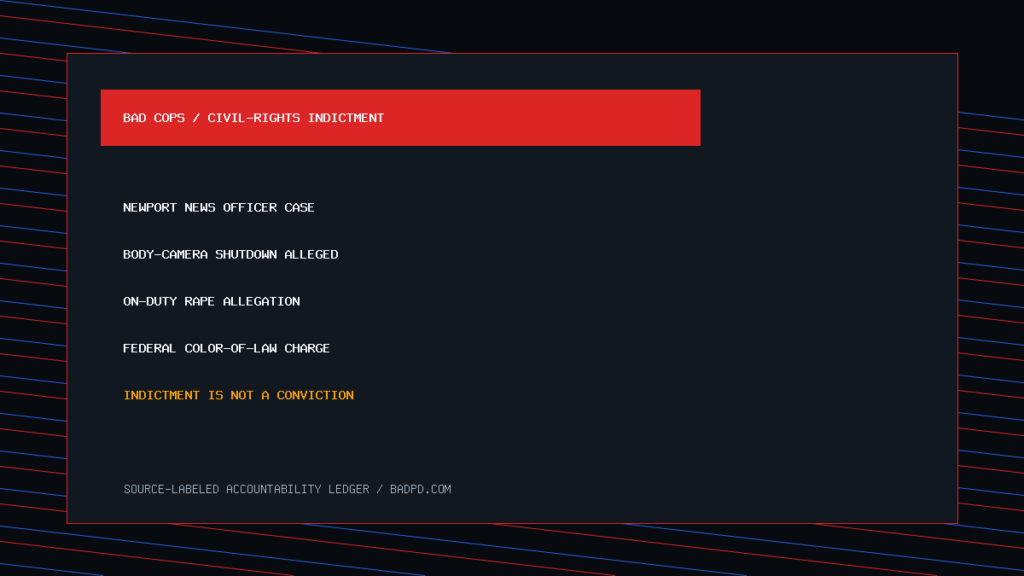
BadPD source-check, July 8, 2026: the U.S. Attorney’s Office for the Eastern District of Virginia says a federal grand jury indicted former Newport News Police officer Raheem Massiah Askew on a deprivation-of-rights charge tied to an alleged on-duty rape. This is an indictment-stage BadPD ledger. It is not a conviction story. The defendant is presumed innocent unless and until proven guilty in court.
The core accountability issue is not complicated. DOJ alleges that an on-duty police officer responded to a vulnerable person, transported her in a patrol vehicle, deactivated his body-worn camera in violation of department policy, entered her hotel room, and engaged in sex without her consent. If proved, that is not only a sex-crime allegation. It is an abuse-of-office allegation. It is a body-camera-control allegation. It is a public-trust failure allegation.
What DOJ Says Happened
According to DOJ’s July 8 release, Askew and another Newport News officer responded on March 14, 2026, with Newport News Fire Department emergency medical personnel, to a report of a woman on the ground in a shopping-center parking lot. DOJ says officers determined the woman had been drinking alcohol and was staying at a hotel in Newport News.
DOJ says Askew asked whether he could take the woman to her hotel, and she agreed. DOJ says another officer explained that Askew would take her back to the hotel to meet her friends. DOJ then alleges that, before entering the patrol vehicle, Askew deactivated his body-worn camera in violation of Newport News Police Department policy.
After arriving at the hotel, DOJ alleges that Askew entered the woman’s room for about 17 minutes and engaged in sex with her without consent. DOJ says that later the same evening, citizens reported that the woman needed help. Officers returned, found her disoriented in a parking lot, and she later collapsed and vomited before being taken to Riverside Regional Medical Center for treatment.
DOJ says Askew faces up to life in prison if convicted. The case number listed by DOJ is 4:26-cr-53 in the Eastern District of Virginia. DOJ also says Homeland Security Investigations Norfolk investigated with help from the Newport News Police Department Major Crimes Division Special Victims Unit.
Confirmed, Alleged, Pending, Disputed
Confirmed by DOJ: a federal grand jury returned an indictment charging former Newport News officer Raheem Massiah Askew with deprivation of rights under color of law. DOJ confirmed the case number, the maximum possible penalty if convicted, and the presumption-of-innocence warning.
Alleged by DOJ: Askew deactivated his body-worn camera in violation of NNPD policy, transported the woman to a hotel, entered her hotel room, and engaged in sex without consent while on duty.
Reported by WTKR: local court documents described the earlier state charge path, the later federal charge path, and the fact that state charges were nolle prossed before the federal color-of-law case proceeded. WTKR also reported that Askew was fired by the department and has been in federal custody since July 1.
Pending: the indictment PDF, detention-hearing record, body-camera audit trail, dispatch log, GPS/AVL records, hotel video exhibits, radio traffic, officer statements, EMT notes, internal-affairs file, termination record, and any public court orders that explain why state prosecutors stopped the state case before the federal case moved forward.
Disputed or limited: this is an indictment. BadPD is not treating the allegation as a conviction. BadPD is also not publishing the victim’s private details and is not blaming EMTs, the other responding officer, or fire personnel unless records show a specific act or failure.
The Body-Camera Control Problem
The alleged body-camera shutdown is the control point that should alarm every resident. Body cameras do not replace honesty, supervision, or prosecution. But they create a record. When an officer is handling a vulnerable person, that record matters.
The Newport News Police Department body-worn camera policy, ADM-570, says camera activation is required for law-enforcement-related encounters between uniformed officers and the public, except where law or policy prohibits it. The policy lists calls for service requiring a field response. It also lists consensual encounters tied to a law-enforcement incident or action, including interviews with victims and reporting parties. It also says termination during detainee or prisoner transport is prohibited.
DOJ’s allegation is that Askew deactivated the camera before entering the patrol vehicle. That is the moment the public needs explained in records, not talking points. Who reviewed the camera status? When did supervisors know the camera had been turned off? Did Axon or Evidence.com logs show the exact deactivation time? Did the officer mark a reason? Was there an audit alert? Was a supervisor notified before the later citizen reports?
BadPD’s point is narrow. If body-camera policy can be defeated during the most vulnerable kind of police encounter, then policy is not enough. The public needs alerts, audits, supervisor review, discipline records, and automatic exception reports.
Dispatch, Transport, And The Vulnerable-Person Gap
WTKR reported that court documents say Askew did not tell dispatch he was taking the woman back to her hotel. DOJ’s release says another officer told the woman that Askew would take her back to the hotel to meet friends. Those two details create the next records demand.
The public needs the dispatch log. It needs the call narrative. It needs the patrol-vehicle GPS trail. It needs any CAD notes. It needs the radio traffic. It needs the policy for transporting vulnerable people who are intoxicated, injured, disoriented, or unable to safely make decisions without safeguards.
Transport is power. A police car is not a rideshare. When an officer uses a police vehicle and uniform to move a vulnerable person from a public scene to a private room, the department should have a visible rule. That rule should say when transport is allowed, when medical care is required, when a second officer must follow, when dispatch must be updated, and when the camera must stay on.
What The Federal Charge Changes
The federal charge changes the frame. A state rape charge focuses on the alleged sexual assault. A federal deprivation-of-rights charge asks whether a government officer used official power to violate a constitutional right. That is why the badge, uniform, patrol car, dispatch system, camera system, and on-duty status matter.
This also matters for department accountability. If prosecutors prove the allegation, the public should not only ask whether one officer committed a crime. The public should ask how the work system let the encounter move from a public call for service to an unrecorded private hotel-room encounter. That question points at policy, supervision, transport rules, dispatch compliance, camera audits, and officer-screening records.
Federal prosecution does not erase due process. Askew can contest the charge. The government must prove its case. The defense can challenge evidence. BadPD is not skipping that. The point is that the public does not need to wait for sentencing to ask for non-private policy records. Body-camera rules, transport rules, audit practices, and dispatch protocols are public-safety controls.
What The Local Reporting Adds
DOJ is the primary source for the federal indictment. WTKR adds local timeline and case-path context. The local reporting says Askew was originally charged in Newport News court with rape, was fired, and later faced the federal deprivation-of-rights charge after the state case was nolle prossed. WTKR also reported that a local defense attorney not involved in the case described the federal charge as broader than a simple rape case because it centers on the alleged use of police authority.
That framing matters. A private person can commit a sexual assault. A police officer can also use badge, uniform, car, dispatch access, body-camera discretion, and public trust as tools of access. That is why a color-of-law case belongs on the BadPD desk.
BadPD is not relying on a local TV report to convict anyone. It is using local reporting to identify records that must be pulled and claims that must be tested in court. The next step is the docket, not a social-media pile-on.
No Victim-Blaming, No Record Games
The DOJ release says the woman had been drinking alcohol. That fact is legally relevant only because it speaks to vulnerability, consent, transport, medical condition, and officer duty. It is not an excuse. It is not a permission slip. It is not a reason to blame the woman.
When police respond to a person who may be intoxicated, injured, disoriented, or stranded, the duty goes up. The person is not supposed to become a target. The system is supposed to protect the person, document the encounter, and leave a clean record for supervisors, prosecutors, defense counsel, and the public.
If the allegations are false, the record should show that. If the allegations are true, the record should show how an officer was able to isolate a vulnerable person and turn off the primary accountability device. Either way, the answer is evidence.
What The Fire And EMS Record Can Support
DOJ says Newport News Fire Department emergency medical personnel were part of the initial response. That does not, by itself, prove fire or EMS failed. The public record available right now does not support blaming EMTs for the alleged crime. BadPD will not invent that.
The fire and EMS record still matters. It can show the woman’s condition at the first scene. It can show whether medical care was offered or refused. It can show who cleared the scene. It can show whether police transport was treated as a safe plan. It can show whether later medical facts matched the initial assessment.
That is why BadPD wants the EMS incident report, with private medical detail protected. The point is not to expose the victim. The point is to understand the handoff. When police, fire, and EMS respond to a vulnerable person together, the safest outcome should be clear documentation and clear responsibility.
Records BadPD Wants Next
- the indictment and any detention, bond, or preliminary-hearing filings in case 4:26-cr-53;
- the body-worn camera audit log showing activation, deactivation, buffering, upload, and categorization events;
- dispatch audio, CAD notes, call-for-service records, and patrol-vehicle GPS data;
- hotel surveillance video preservation records and chain-of-custody logs;
- the NNPD internal-affairs file, termination paperwork, and any decertification or Brady/Giglio notice;
- the policy for officer transport of intoxicated, disoriented, injured, or otherwise vulnerable people;
- supervisor-review records showing when command staff learned of the alleged camera shutdown;
- any state-court nolle prosequi filing explaining the state-to-federal case path;
- the EMT/fire department incident report, limited to response facts and not victim private medical detail;
- any public court order restricting, preserving, or releasing body-camera and hotel-video evidence.
BadPD Take
This case is exactly why body-camera compliance cannot be treated as a checkbox. A camera policy that says record the encounter is useful only if the department can prove when the camera was on, when it was off, who reviewed the exception, and what discipline followed.
Newport News residents should demand a clean public answer without compromising the victim’s privacy or the defendant’s due-process rights. Was the camera off? If so, why? Was dispatch updated? If not, why not? Was there a second-officer transport rule? Was there a supervisor alert? How many other camera deactivations happen during transports or vulnerable-person calls?
Bad cops use gaps. Good departments close them. If the federal indictment is supported by the evidence, the department owes the public more than a statement of values. It owes a controls report. It owes a transport-policy review. It owes a body-camera audit. It owes proof that the next vulnerable person does not disappear into a dead zone between a call for service and a private room.
BadPD will track the EDVA docket, the detention-hearing record, any public indictment attachment, body-camera policy compliance, NNPD administrative records, and the state-to-federal charging path.
Source Trail
- DOJ EDVA: Former Newport News officer indicted on rape charge (Published July 8, 2026; accessed July 8, 2026) – Primary source for indictment, alleged timeline, body-camera deactivation allegation, charge, case number, investigating agencies, maximum penalty, and presumption-of-innocence line.
- WTKR: Newport News officer charged in on-duty rape faces possible life in prison on federal charge (Published July 8, 2026; accessed July 8, 2026) – Local court-context reporting on federal hearing posture, state-to-federal case path, and legal framing; used as reporting, not as final authority.
- WTKR: Newport News police officer now facing federal charge in on-duty hotel rape of Australian woman (Published July 6, 2026; accessed July 8, 2026) – Local reporting on nolle prosequi of state charge, federal custody, alleged dispatch/body-camera facts, termination, and chief statement.
- WTKR: Newport News police officer accused of raping drunk woman at hotel while on duty (Published March 2026; accessed July 8, 2026) – Earlier local reporting on original allegations, local felony charge, firing, and department statement.
- Newport News Police Department ADM-570 Body-Worn Cameras policy (Issued May 19, 2025; accessed July 8, 2026) – Official NNPD body-camera policy context for required activation during calls for service, public encounters tied to law-enforcement action, and detainee/prisoner transport.
- Newport News city notice: NNPD body-worn camera program context (Published August 11, 2017; accessed July 8, 2026) – Official city context that patrol officers had been using body cameras since 2013 and that recordings can be used as evidence.
Send receipts for the desk to research
Send corrections, missing records, police-accountability tips, good-cop public-service receipts, government/court/war leads, recall alerts, or property-tax help resources. Tips are leads only until BadPD verifies records.
Links, dates, agency names, docket numbers, bodycam IDs, recall numbers, forms, and official pages.
Every tip is a lead, not a fact. The desk checks records before publishing.
Use advertising inquiry when you want clearly labeled sponsor space or available ad placements on BadPD.