North Charleston Public Corruption Sentencing Ledger: DOJ Records Council Bribes And Kickbacks
News Anchor voice
Ready when you are.
Status, July 1 source check: source-cleared for a BadPD government-accountability ledger. The controlling record is the June 30, 2026 DOJ South Carolina release saying four more defendants in a North Charleston public corruption scheme were sentenced. The record names former councilmen, consultants, nonprofit-linked grant applicants, rezoning work, kickbacks, money laundering, and restitution.
This is public-record accountability reporting, not legal advice, voting advice, zoning advice, nonprofit compliance advice, grant-writing advice, sentencing advice, or a claim about anyone beyond the cited DOJ records. The official court docket, judgments, plea agreements, sentencing transcripts, restitution orders, grant records, city records, and later DOJ updates control the final legal details.
What DOJ Says Was Sentenced
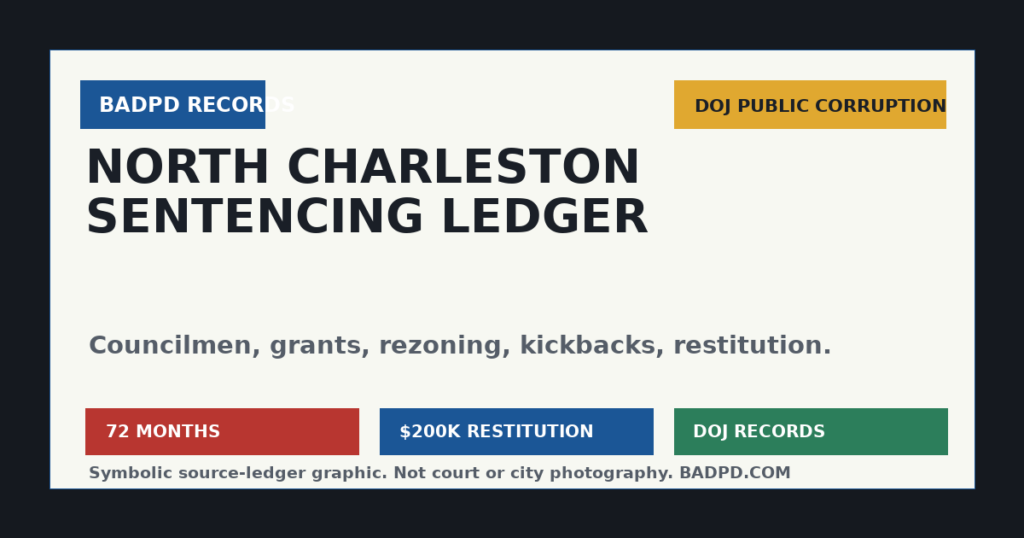
DOJ says Jerome Sydney Heyward, 63, a former North Charleston City Councilmember, was sentenced to six years in federal prison for extortion, bribery, and money laundering. The same release later states that U.S. District Judge Richard M. Gergel sentenced Heyward to 72 months of imprisonment, followed by three years of court-ordered supervision, and ordered him to pay $200,000 in restitution.
DOJ says Mike A. Brown, 47, a former North Charleston City Council Member, was sentenced to two years in federal prison for accepting a bribe from Aaron Hicks in exchange for supporting a rezoning application. DOJ’s related Hicks release says Hicks paid Brown at least $1,000 in cash.
DOJ says Michelle Stent-Hilton, 58, of North Charleston, and Donavan Laval Moten, 48, founder of Core4Success Foundation, were each sentenced to 18 months in federal prison for paying Heyward $20,000 kickbacks in exchange for his support of their applications for grant funds.
The source language matters. This is not a vague ethics problem. DOJ describes elected-official influence, city council action, rezoning, taxpayer funds, violence-reduction grant applications, kickbacks, laundering, and the intangible right of honest services. BadPD is keeping those labels tied to DOJ’s record instead of turning them into broader claims about every North Charleston official, every nonprofit, or every development proposal.
The Three Heyward Schemes In The DOJ Record
DOJ says Heyward was charged in three separate schemes. In the first, DOJ says he used his position as a North Charleston City Councilman to extort a businessman by soliciting payments in exchange for official action as a councilman. The June 30 release does not include every factual detail of that extortion scheme, so this article does not add unsourced names or amounts beyond the DOJ summary.
In the second scheme, DOJ says Heyward conspired with Brown and Aaron Charles-Lee Hicks to solicit and accept bribes from Hicks, who was working on behalf of a company with business before North Charleston City Council. The official record ties that scheme to support for rezoning of the Baker Hospital site.
In the third scheme, DOJ says Heyward conspired with Donavan Moten and Michelle Stent-Hilton to embezzle taxpayer funds from North Charleston. DOJ says Heyward agreed to support grant applications submitted on behalf of nonprofits for violence-reduction grants. In exchange, Moten and Stent-Hilton each agreed to pay Heyward $20,000. DOJ says Heyward then conspired with Rose Lorenzo to launder the funds to conceal the nature and source of the kickbacks.
Those three buckets are the accountability frame: private payments for official action, rezoning-related bribes, and taxpayer-funded grant kickbacks. The public interest is not only prison time. It is whether the city, taxpayers, grant reviewers, nonprofits, and residents can now see which decisions, payments, applications, and approval paths were affected.
The Related Sentencing Records
DOJ’s April 20 release says Sandino Savalas Moses, 51, a former North Charleston City Councilmember, was sentenced to two years of probation and 100 hours of community service for misprision of a felony. DOJ says Moses was on council when Sea Fox Boat Company’s rezoning application came before council. The release says Hason Fields paid Moses two bribes tied to Sea Fox rezoning support, and that Moses repaid the bribes when he realized Fields was trying to bribe him, but did not report Fields to law enforcement.
DOJ’s separate April 20 release says Aaron Charles-Lee Hicks, 38, of North Charleston, was sentenced to 15 months in federal prison, followed by two years of supervision, for his role in two schemes to bribe North Charleston councilmen. DOJ says Sea Fox hired Hicks as a consultant after proposing a North Charleston boat manufacturing facility that needed a zoning change. The release says Hicks accepted $30,000 in consulting fees, agreed to pay Heyward and Brown for influence and official action, paid Heyward $5,000, including $2,500 in cash on the date of the City Council vote, and paid Brown at least $1,000 in cash. Hicks was ordered to forfeit $30,000.
DOJ’s April 3 release says Hason Tatorian Fields, also known as Tory Fields, was sentenced to 12 months and one day in federal prison, followed by three years of supervision. DOJ says Fields conspired with others to pay bribes to Moses to secure support for rezoning of the Baker Hospital site.
The June 30 release says Rose Lorenzo pleaded guilty for her role in the conspiracy and that her sentencing would be scheduled later. That is a pending-record item, not a completed sentencing outcome in this source set. BadPD is not adding a sentence for Lorenzo because the DOJ release does not give one.
Why This Is A City Accountability Record
Public corruption cases often become a list of names and prison terms. That is not enough. The public record should show what government levers were being bought or influenced. In this case, DOJ’s records point to city council votes, rezoning applications, taxpayer-funded grants, nonprofit applications, and money movement designed to conceal kickbacks.
The Baker Hospital site rezoning record needs special attention because rezoning decisions shape land use, neighborhood impacts, industrial development, traffic, property expectations, and public trust. DOJ says Hicks, Heyward, Brown, Fields, and Moses appear in related rezoning conduct records. The city-level follow-up should be the meeting record, vote record, communications, consulting agreements, and whether any rezoning decision or related city action has been reviewed after the federal case.
The violence-reduction grant records also need follow-up. DOJ says Moten and Stent-Hilton paid Heyward kickbacks for support of their grant applications, and says the scheme involved taxpayer funds from North Charleston. That creates public-record questions about grant scoring, award files, payment ledgers, nonprofit eligibility, contract monitoring, and whether any public funds were clawed back, repaid, redirected, or audited.
BadPD is not asserting that every North Charleston grant, every nonprofit, every council vote, or every development application was corrupt. The source-supported point is narrower and more useful: DOJ says specific defendants used city influence, bribes, kickbacks, and laundering in named rezoning and grant contexts, and several sentencing outcomes are now public.
Records North Charleston Residents Can Track Next
The most useful next step is a document trail, not a rumor trail. For the rezoning side of the case, residents, reporters, and watchdogs can look for the public council agenda packets, minutes, vote sheets, committee records, staff reports, zoning-file attachments, planning correspondence, and any public comments tied to the Baker Hospital site or the Sea Fox proposal. DOJ has already identified the rezoning context; the open question is what the city record shows before, during, and after the votes.
For the grant side of the case, the public-interest records are different. The key files are grant solicitations, nonprofit applications, scoring sheets, award memoranda, council approvals, payment requests, invoices, reimbursement packets, monitoring notes, audit findings, and clawback correspondence. DOJ says the kickbacks involved support for violence-reduction grant applications and taxpayer funds from North Charleston. That makes the grant-management paper trail a central accountability record, especially for residents who want to know whether any public money reached the intended violence-reduction purpose.
The court records also matter because press releases summarize outcomes but do not replace judgments and docket files. The sentencing judgments should identify prison terms, supervision terms, forfeiture, restitution, special assessments, surrender dates, and any standard or special conditions. Restitution records should show who is owed money and how repayment is handled. Plea agreements and sentencing memoranda may also explain what defendants admitted, what facts the government relied on, and which facts were disputed or limited.
BadPD is keeping this ledger narrow because that is how public accountability stays useful. The public can ask for city records, grant records, and court records without claiming that every nearby project or nonprofit was tainted. The source set supports a concrete records checklist: the named defendants, the named rezoning matters, the named grant context, the named sentencing outcomes, the pending Lorenzo sentencing, and the government files that can prove what changed after the case.
Confirmed, Pending, Not Established
Confirmed by DOJ records
- Jerome Sydney Heyward was sentenced to 72 months in federal prison, three years of supervision, and $200,000 restitution.
- Mike A. Brown was sentenced to two years in federal prison for accepting a bribe from Aaron Hicks tied to a rezoning application.
- Michelle Stent-Hilton and Donavan Laval Moten were each sentenced to 18 months in federal prison for paying Heyward $20,000 kickbacks tied to grant applications.
- DOJ says the case involved the Baker Hospital site rezoning, violence-reduction grant applications, taxpayer funds, kickbacks, and money laundering.
- Aaron Charles-Lee Hicks was sentenced to 15 months in federal prison and ordered to forfeit $30,000.
- Hason Tatorian Fields was sentenced to 12 months and one day in federal prison.
- Sandino Savalas Moses was sentenced to two years of probation and 100 hours of community service.
- The FBI Columbia Field Office and South Carolina Law Enforcement Division investigated the case.
Pending or missing records
- Rose Lorenzo sentencing record.
- Final judgments, plea agreements, sentencing memoranda, and restitution payment schedules for every defendant.
- North Charleston council records, rezoning vote records, and Baker Hospital site communications tied to the federal case.
- Violence-reduction grant award files, scoring records, payment ledgers, clawback records, and audit records.
- City ethics, procurement, grant-management, or policy reforms adopted after the case.
Not established by this source set
- That every North Charleston council action, grant, nonprofit, or rezoning matter was corrupt.
- That any defendant has exhausted appeals or post-judgment motions.
- That restitution has already been fully paid.
- That all city records connected to the schemes have been released publicly.
- That every public official, consultant, applicant, or nonprofit near these events engaged in wrongdoing.
BadPD Bottom Line
The North Charleston case belongs in the BadPD accountability lane because DOJ records tie public office, rezoning, taxpayer grant funds, nonprofit applications, bribery, kickbacks, laundering, prison sentences, probation, forfeiture, and restitution into one city corruption ledger. The current source set is strong enough to publish, and the follow-up records are concrete: court judgments, city votes, grant files, restitution, Rose Lorenzo’s sentencing, and any post-case reform record.
BadPD will update this ledger if DOJ, court records, North Charleston public records, FBI/SLED statements, grant files, ethics records, audit records, city council minutes, restitution records, or later proceedings add confirmed details tied to these defendants or the Baker Hospital, Sea Fox, violence-reduction grant, Core4Success, or related public-corruption records.
Source Ledger
- DOJ USAO South Carolina sentencing release, June 30, 2026
- DOJ USAO South Carolina Sandino Moses sentencing release, April 20, 2026
- DOJ USAO South Carolina Aaron Charles-Lee Hicks sentencing release, April 20, 2026
- DOJ USAO South Carolina Hason Tatorian Fields sentencing release, April 3, 2026
Featured image is symbolic editorial artwork created for BadPD. It is not DOJ, FBI, SLED, North Charleston, court, defendant, council, nonprofit, grant, rezoning, Baker Hospital, Sea Fox, restitution, prison, or crime-scene photography.
Send receipts for the desk to research
Send corrections, missing records, police-accountability tips, good-cop public-service receipts, government/court/war leads, recall alerts, or property-tax help resources. Tips are leads only until BadPD verifies records.
Links, dates, agency names, docket numbers, bodycam IDs, recall numbers, forms, and official pages.
Every tip is a lead, not a fact. The desk checks records before publishing.
Use advertising inquiry when you want clearly labeled sponsor space or available ad placements on BadPD.