
Alabama Police Use-of-Force Civil Rights Briefing: How to Attend September 3
News Anchor voice
Ready when you are.
Public-record status, August 14, 2026: The U.S. Commission on Civil Rights published a Federal Register notice for an Alabama Advisory Committee briefing on police use of force. The online meeting is scheduled for September 3, 2026. Registration, listening access, oral comment, written comment, captioning, and accommodation instructions are confirmed in the notice.
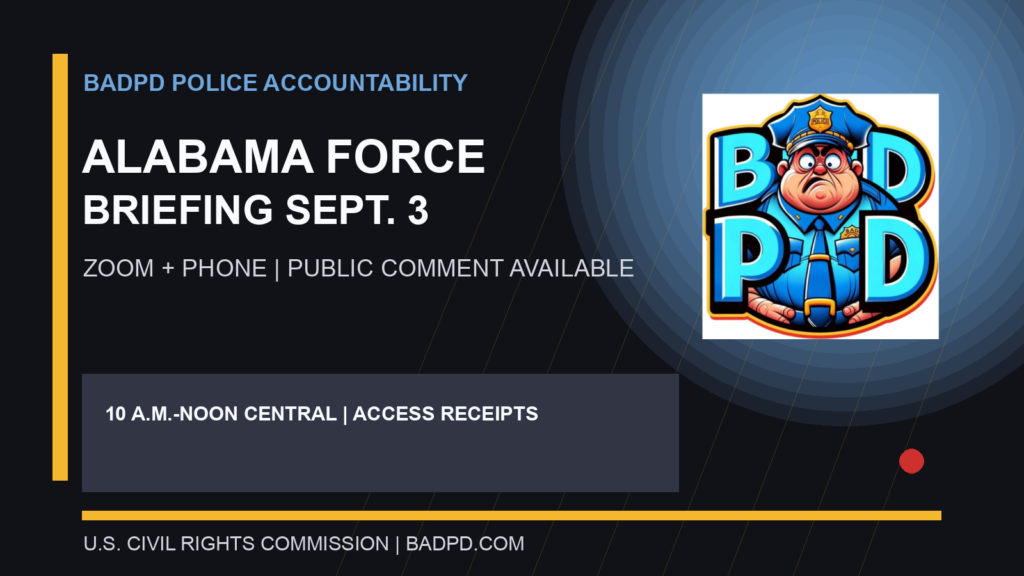
Alabama residents and other interested members of the public can attend a federal civil-rights briefing on police use of force without traveling. The Alabama Advisory Committee to the U.S. Commission on Civil Rights will hold the meeting by Zoom on Thursday, September 3, 2026, from 10 a.m. to noon Central time.
The Federal Register notice says the committee will examine civil-rights implications of police use of force in civilian encounters and detention. It is a public briefing, not a court hearing, disciplinary proceeding, or finding that a particular officer or agency violated the law.
How to attend
- Online registration: ZoomGov webinar registration.
- Telephone: 833-435-1820.
- Meeting ID: 165 134 0360#.
- Draft agenda: USCCR agenda file. The notice says a final agenda will be available before the meeting.
The notice says any interested member of the public may listen. An open-comment period will allow oral comments as time permits. Registration does not guarantee speaking time, so a person with evidence or a specific policy concern should also consider a concise written submission.
Before the meeting
Register early. Save the link and meeting ID. Check the final agenda near the meeting date. Test Zoom or the phone line before the start time. Ask for an aid now if you need one. The notice gives the Commission time to set that up.
Write down one main point. Put the key fact first. Add a date, place, agency, and public record if you have them. Say what you want the committee to study. Keep a copy of what you send. Do not post private health facts or a home address.
If you only want to listen, you may do that. If time runs out for oral remarks, the written-comment window remains. The notice gives the public 30 days after the meeting. Check the live notice for the right contact before you send a file.
Written comments and public records
Members of the public may submit written comments for 30 days after the meeting. The Federal Register notice identifies the committee contact and Regional Programs Coordination Unit. Because email addresses in the online notice may be protected from automated copying, participants should use the live official notice or the Alabama Advisory Committee page for the current contact rather than rely on an address copied into a third-party article.
The meeting falls under the Federal Advisory Committee Act. The notice says public minutes will include a list of people present. It also says meeting records will become available for inspection and reproduction and points readers to the federal advisory-committee database. Anyone sharing sensitive information should understand that a public comment may enter a public record.
Accessibility
Closed captioning will be available through the meeting platform. The notice asks people who need additional accommodations to contact the Commission at least 10 business days before the meeting. That lead time makes early registration important.
The Commission’s advisory committee meetings page provides current meeting information. Participants should check it and the Federal Register notice shortly before September 3 in case the time, agenda, or access instructions change.
How to make a useful accountability submission
A strong public comment separates a documented event from a broader claim. Include the agency, location, date, policy, public case number, and a link to any releasable record. Explain what rule or practice should change. Avoid publishing private victim information, medical details, home addresses, or unsupported accusations.
Useful policy questions can include how force is reported, whether detention facilities preserve video, when officers must render aid, how agencies review repeated complaints, whether disability and behavioral-health encounters receive specialized review, and whether discipline outcomes are publicly summarized. The committee can study patterns and recommend action; it cannot replace an emergency response, an attorney, an internal-affairs complaint, or a court deadline.
What this meeting can and cannot do
The U.S. Commission on Civil Rights studies civil-rights issues and advises federal officials. Its state advisory committees gather testimony and records. A briefing can expose policy gaps and create an official trail. It cannot by itself convict an officer, award damages, or compel a local department to adopt a recommendation.
That does not make participation symbolic. A dated federal record can force agencies and lawmakers to answer specific evidence. The value depends on whether the committee publishes what it heard, identifies disagreements, and follows the record into recommendations that the public can measure.
Sources and dates
- Federal Register meeting notice, dated August 12 and published August 14, 2026.
- U.S. Commission on Civil Rights Alabama Advisory Committee, accessed August 14, 2026.
- USCCR advisory committee meetings, accessed August 14, 2026.
- USCCR state advisory committees, accessed August 14, 2026.
Source Trail
This fallback trail lists external receipts detected in this article metadata or article body so older receipt hubs keep a consistent audit trail.
- www.federalregister.gov/documents/2026/08/14/2026-16674/notice-of-public-meeting-of-the-alaba…
- www.zoomgov.com/webinar/register/WN_xROEDSmkQlyoU_OSAJx6-A
- usccr.box.com/s/c2inhm7cb11taao6m3m3rgcq6n68wx0l
- www.usccr.gov/advisory-committees/alabama
- www.usccr.gov/meetings/advisory-committees-meetings
- www.usccr.gov/advisory-committees
Send receipts for the desk to research
Send corrections, missing records, police-accountability tips, good-cop public-service receipts, government/court/war leads, recall alerts, or property-tax help resources. Tips are leads only until BadPD verifies records.
Links, dates, agency names, docket numbers, bodycam IDs, recall numbers, forms, and official pages.
Every tip is a lead, not a fact. The desk checks records before publishing.
Use advertising inquiry when you want clearly labeled advertiser placement on BadPD.