
Abilene Drug-Conspiracy Seizure: BadPD Wants The Complaint, Warrant, Lab And Chain Ledger
Document Desk voice
Ready when you are.
BadPD source-check, July 6, 2026: DEA says three men were arrested and charged by federal complaint in Abilene, Texas after a months-long narcotics investigation and a June 24, 2026 residential search. This is an allegation-stage public-safety and courts article. A complaint is not a conviction, and every named defendant is presumed innocent unless and until guilt is proven beyond a reasonable doubt in court.
The public-safety issue is obvious from the alleged seizure list. The accountability issue is what comes next: the complaint, warrant affidavit, search inventory, lab-confirmation records, chain-of-custody ledger, firearm trace results, detention orders, forfeiture notices, and local-agency after-action records. Large press-release numbers are not the end of the public record. They are the beginning of the public record.
What DEA Says Happened
DEA’s July 3, 2026 Dallas Division release says Inez Jonathan Leal, 28, and Joseph Santos Carillo, 51, both from Abilene, Texas, and Luis Arturo Carrillo Jr., 28, from California, were charged by federal complaint on June 24, 2026. DEA says the complaint charges conspiracy to distribute and possession with intent to distribute methamphetamine.
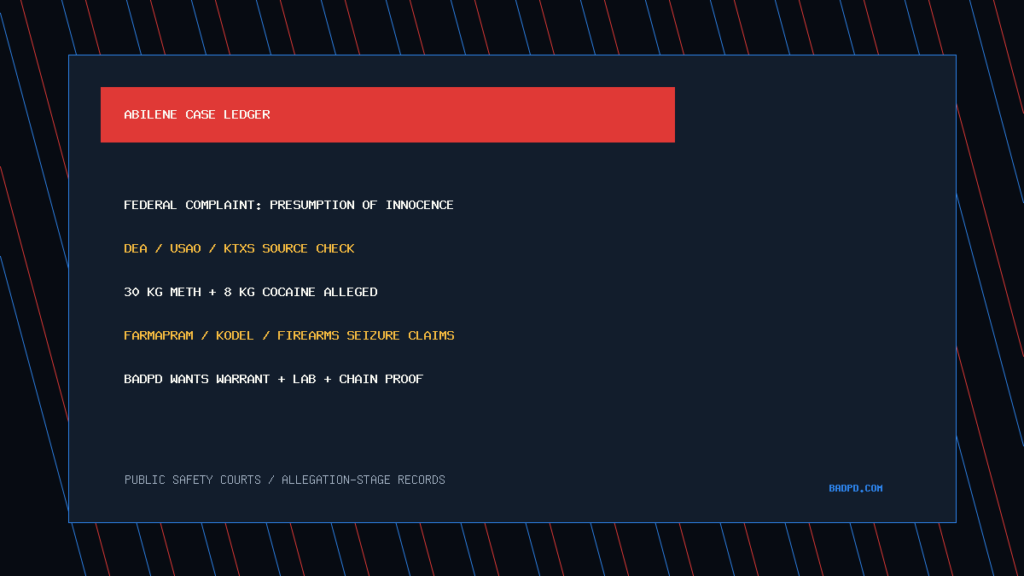
According to DEA, law-enforcement agents and officers initiated a joint investigation into alleged narcotics trafficking involving Leal, Joseph Carrillo, and Luis Carrillo. DEA says a residential search warrant was executed on June 24. During that search, agents allegedly seized approximately 8 kilograms of powdered cocaine, 30 kilograms of methamphetamine, about 17,670 alprazolam pills labeled as Farmapram, 93 bottles of cough syrup containing codeine labeled as Kodel, about 75 pounds of marijuana and THC products, and multiple firearms.
DEA says the defendants remain in custody pending further proceedings and that each faces a statutory maximum of up to life in federal prison if convicted. DEA identifies the investigating agencies as DEA’s Fort Worth District Office, the Texas Department of Public Safety, and the Abilene Police Department. The local KTXS report likewise frames the case as a federal complaint following a large narcotics and firearms seizure in Abilene and notes that the government’s allegations have not yet been tested in court.
Confirmed, Alleged, Pending, Limited
Confirmed: DEA published the release on July 3, 2026. KTXS published local coverage on July 4, 2026. The source record says the federal complaint was filed June 24, 2026, that three named men were charged, and that DEA, Texas DPS, and Abilene Police investigated.
Alleged: the drug weights, pill count, cough-syrup bottle count, firearms, and trafficking role descriptions are allegation-stage until supported by admissible evidence and tested in court. BadPD is not calling the defendants guilty. BadPD is treating the DEA and local reports as receipts of what the government says it found and what prosecutors now need to prove.
Pending: the criminal complaint itself, warrant affidavit, search-warrant return, property inventory, field-test records, lab-confirmation results, firearm-trace records, detention orders, discovery litigation, indictment status, plea/trial posture, forfeiture filings, and any suppression motion are not in the local package yet. Those records matter because they separate press-release claims from court-tested proof.
Limited: BadPD did not pull paid federal docket documents in this run. This article relies on DEA’s official release, KTXS local reporting, and official DEA drug-information pages for general controlled-substance context.
Why The Complaint And Warrant Records Matter
When law enforcement announces a large seizure, the public gets a headline. The court record has to do more. The complaint should identify the facts supporting probable cause. The warrant affidavit should explain why officers believed evidence would be found at the place searched. The search return should show what was actually taken. The chain-of-custody records should show who handled each item, when it moved, where it was stored, and how it was submitted for testing.
Those records matter for both sides. They matter to prosecutors because a case with large quantities and firearms still has to be proven with clean evidence. They matter to defendants because the government must be held to the rules. They matter to the public because communities should not have to choose between ignoring trafficking allegations and rubber-stamping government claims. The correct position is evidence, due process, and transparent records.
BadPD wants the warrant-return ledger because the alleged seizure list includes several different categories of controlled substances and firearms. Each category has a different evidence problem. Methamphetamine and cocaine need lab confirmation. Pills labeled Farmapram need identification, count, weight, packaging documentation, and testing. Bottles labeled Kodel need confirmation of contents and concentration. Marijuana and THC products need classification and weight records. Firearms need ownership, possession, operability, serial-number, and trace records.
The Public-Safety Stakes
DEA’s own drug scheduling page explains that controlled substances are placed into schedules based on medical use and abuse or dependency potential. That same DEA page lists cocaine and methamphetamine as Schedule II examples, and it gives examples for lower schedules including some codeine preparations and common benzodiazepine examples. That matters because the Abilene release alleges a mixed inventory rather than a single-substance case.
DEA’s methamphetamine fact sheet describes methamphetamine as a stimulant that speeds up the body’s system and can appear as a pill or powder. It describes addiction risk and serious overdose effects including death from stroke, heart attack, or organ problems caused by overheating. DEA’s cocaine fact sheet describes cocaine as a stimulant with strong addictive potential and notes serious physical risks including irregular heartbeat, convulsions, stroke, sudden cardiac arrest, and death.
BadPD is not publishing those drug facts to sensationalize the case. The point is to explain why an alleged seizure involving methamphetamine, cocaine, pills, codeine syrup, marijuana/THC products, and guns becomes a real community-risk case if the government proves it. Abilene residents deserve a clear court-tested record, not just a victory lap or a defense-free headline.
What The Public Should Be Able To Track Next
The first public record to track is the federal docket. Has a grand jury returned an indictment? Have detention hearings occurred? Did the defendants waive preliminary hearings? Did the court appoint counsel? Are there suppression motions challenging the search? Is there a protective order over discovery? Those are not technicalities. They are the ordinary path that turns a press release into a case with evidence, legal rulings, and accountability.
The second record is the warrant package. Search-warrant documents may remain sealed at first, but the public should watch whether they are later unsealed or summarized in public filings. A warrant package can show the investigative path: surveillance, controlled buys, informant statements, trash pulls, vehicle stops, phone evidence, package evidence, utility records, or other facts. It can also reveal whether the search was narrow, broad, or challenged.
The third record is the lab and chain proof. Press releases often use approximate weights before final lab testing. That is normal at the announcement stage, but court proof needs more precision. Which agency weighed the evidence? Which lab tested it? Were all units tested or sampled? Were pills confirmed as alprazolam? Was the cough syrup confirmed to contain codeine? Were the firearms tied to any specific person? Were fingerprints, DNA, phone records, or residence records used to link items to defendants?
The fourth record is the forfeiture ledger. Large drug cases often include cash, vehicles, weapons, phones, or other property. If forfeiture follows, the public should know what was seized, what was administratively forfeited, what was criminally forfeited, what was returned, and whether any innocent owner claims were filed. Forfeiture should never become a shadow punishment without public accounting.
Abilene Police And Local Accountability
DEA names Abilene Police as one of the investigating agencies. That makes the city part of the accountability record. If local officers participated in surveillance, search entry, perimeter security, evidence handling, interviews, transport, or local charges, the public should eventually be able to see what local resources were used and whether local policies were followed.
BadPD’s position is not anti-police and not pro-trafficker. The position is pro-record. If local officers helped remove dangerous drugs and firearms from the community while following the Constitution, that should be documented cleanly. If there are warrant problems, evidence-handling problems, or overstatements, those should be documented too. A serious case deserves serious paperwork.
Local officials should also answer whether the alleged Abilene seizure changes any local public-safety posture. Are there overdose-prevention notices tied to counterfeit pills? Were schools, parents, hospitals, or recovery groups notified about pill risks? Did the alleged supply connect to prior overdose clusters? Did local agencies use the case to improve drug-disposal, education, or community tip routes? The community impact should not end at booking photos.
A Cleaner Way To Cover Drug Cases
BadPD will not call people guilty based on a press release. That is the easy clickbait path. It is also legally and ethically weak. The better path is to publish the status, the source trail, the allegation-stage guard, and the records that need to be checked next.
That approach helps readers. It tells families what is known without pretending the court has already decided the case. It tells the community why the alleged seizure matters without turning a complaint into a conviction. It tells law enforcement that large numbers need clean proof. It tells defense counsel that BadPD is tracking due process, not just government talking points.
The Abilene case is exactly the kind of story where both public safety and civil process matter. If the government proves the allegations, the seizure numbers are serious. If the government cannot prove the allegations or if evidence was mishandled, the public needs to know that too. Either way, the next stage is the docket.
The BadPD Bottom Line
DEA says three men were charged by federal complaint after an Abilene investigation and a June 24 search tied to alleged methamphetamine, cocaine, alprazolam pills, codeine cough syrup, marijuana/THC products, and firearms. KTXS confirms the local Abilene frame and preserves the complaint-stage status. The case is important, but it is not court-proven yet.
BadPD wants the complaint, warrant affidavit, search return, lab reports, chain-of-custody ledger, firearm traces, detention orders, forfeiture filings, and docket updates. Public safety does not require blind trust. Public safety requires evidence that survives court and records that let the community see what really happened.
Source Trail
- DEA Dallas press release on Abilene drug-conspiracy seizure (July 3, 2026) – Primary official source for the complaint-stage charges, June 24 search, seizure list, investigating agencies, statutory exposure, custody status, and presumption-of-innocence notice.
- KTXS Abilene local report (July 4, 2026) – Local coverage confirming the Abilene frame, named defendants, alleged seizure categories, and that the complaint allegations have not yet been tested in court.
- DEA drug scheduling overview (Accessed July 6, 2026) – Official DEA reference explaining controlled-substance schedules, including Schedule II examples such as cocaine and methamphetamine and examples of Schedule IV and V substances.
- DEA methamphetamine fact sheet (Accessed July 6, 2026) – Official DEA public-health context on methamphetamine forms, use routes, addiction risk, and overdose effects.
- DEA cocaine fact sheet (Accessed July 6, 2026) – Official DEA public-health context on cocaine as a stimulant with addictive potential and serious cardiovascular and overdose risks.
Send receipts for the desk to research
Send corrections, missing records, police-accountability tips, good-cop public-service receipts, government/court/war leads, recall alerts, or property-tax help resources. Tips are leads only until BadPD verifies records.
Links, dates, agency names, docket numbers, bodycam IDs, recall numbers, forms, and official pages.
Every tip is a lead, not a fact. The desk checks records before publishing.
Use advertising inquiry when you want clearly labeled sponsor space or available ad placements on BadPD.