
CPSC August 6, 2026 Recall Roundup: Mowers, Bed Rails, Toys, Mattresses, and Scuba Gear
News Anchor voice
Ready when you are.
Status: Active CPSC recalls. Recall date: August 6, 2026. Last reviewed: August 7, 2026. Product counts are the approximate U.S. unit figures in the official notices. Check exact models and remedies at the linked CPSC pages.
CPSC August 6, 2026 Recall Roundup: Mowers, Bed Rails, Toys, Mattresses, and Scuba Gear
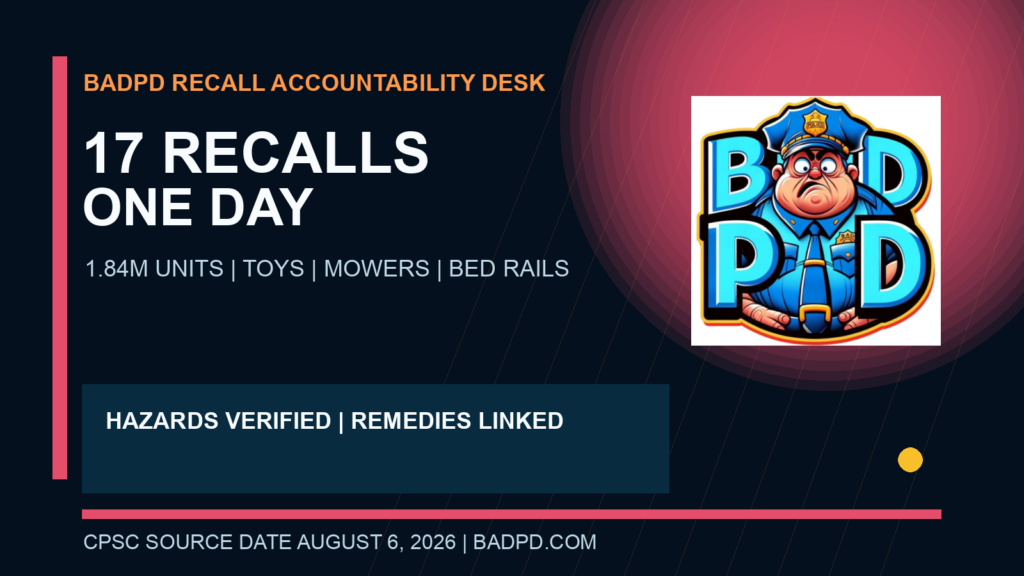
The Consumer Product Safety Commission posted 17 recalls on August 6 covering roughly 1.84 million U.S. units. The largest is a 1.77-million-unit attic-ladder recall, but the same release day also brought urgent warnings about mower blades that may not stop, unsafe infant products, accessible button batteries, loose high-powered magnets, adult bed-rail entrapment, unexpected vehicle acceleration, failing climbing-rope splices, and scuba regulators that can restrict airflow at depth.
The combined figure is a working total, not a sales count. It excludes non-U.S. units unless a notice says otherwise, and it can change if CPSC updates a notice. Always check the current agency page before acting.
Consumers should use the official CPSC page to match brand, model, date, color, label, and retailer. Similar-looking products may not be covered, while an older item may remain in a home long after the original purchase record is gone. Do not sell, donate, or give away a recalled product while deciding what to do.
Highest-priority checks
DR Power PRO MAX30 lawn mowers: blades may keep running
About 320 DR Power PRO MAX30 30-inch walk-behind mowers are being repaired because blades can operate without the blade-control system engaged or continue after the control is released. The manufacturer reported 19 incidents and no injuries. Stop using the mower and follow the CPSC repair instructions.
Louisville attic ladders: 1.77 million units
Spreader bolts on Louisville, Featherlite, Lite & Century attic stairway ladders with gas struts can break while in use. CPSC lists 11 bolt failures and one neck, head, and back injury. Consumers should stop use and register for a free repair kit through the official CPSC notice. BadPD also has a dedicated model and remedy guide.
PIXLABBY magnetic sliders: a child was hospitalized
About 860 silicone sensory magnetic fidget sliders can release high-powered magnets. CPSC and the seller received a report that a child accessed and swallowed two magnets and was hospitalized. Consumers should stop use and obtain the refund described in the official PIXLABBY recall.
Winston Porter and Seeday dressers: child injured
About 2,050 three-, four-, and five-drawer units are recalled because they can tip over when not anchored and violate the STURDY Act standard. CPSC reports one tip-over that injured a 3-year-old child. Stop use until the unit is secured away from children and follow the refund process.
Little Rawr teething toys: respiratory-distress report
About 2,180 silicone pull-string teething toys have strings smaller and longer than the toy standard permits. The firm received one report of strings reaching the back of a child’s throat and causing respiratory distress or choking. Take the toy away immediately and use the CPSC refund instructions.
Infant, child, and household recalls
OKK Easter LED headbands
About 25,200 headbands allow children to access lithium coin batteries, creating an ingestion, internal-burn, and death hazard. No incidents were reported. Consumers should stop use and request the documented refund through the OKK Trading recall.
BUSOHA magnetic fidget sliders
About 2,186 toys can release magnets that may attract inside the body and cause perforation, blockage, blood poisoning, or death. No incidents were reported. CPSC says to stop use and seek the BUSOHA refund.
Wnttmt baby walkers
About 1,310 walkers can pass through a standard doorway, fail to stop at a step edge, and allow a child to slip until the head becomes trapped. No incidents were reported. Stop use and follow the Wnttmt refund notice.
Voomf play-yard and crib mattresses
About 2,401 mattresses may fit certain play yards inadequately, creating an infant-entrapment risk; full-size crib mattresses also violate the flammability standard. CPSC received one inadequate-fit report and no injury report. Stop use and follow the Voomf refund instructions.
A2batt EEMB coin-battery chargers
About 4,930 chargers contain accessible rechargeable 2032 lithium coin batteries. The included batteries also were not in required child-resistant packaging, and the packaging lacked Reese’s Law warnings. No incidents were reported. Remove the batteries, secure them from children, and follow the A2batt disposal and refund steps.
Syera projecting finger lights
About 184 Space Astronaut LED finger-light sets sold on Temu allow children to access button cells. No incidents were reported. Consumers should stop use and follow the Syera refund notice.
KC Imports mini laser pointer keychains
About 9,600 laser and LED keychains have accessible button batteries and lack required Reese’s Law warnings. No incidents were reported. Stop use and use the official refund process.
Fitueyes Laziza dressers
About 150 dressers can tip if they are not anchored and violate the mandatory clothing-storage standard. No incidents were reported. Keep children away and follow the Fitueyes refund instructions.
Older-adult, recreation, and work-equipment recalls
Liuqibax adult bed rails
About 12,000 bed rails can trap a user within the rail or between the rail and mattress, creating an asphyxiation risk. They also lack required warning labels. No incidents were reported. Stop use and follow the Liuqibax refund notice.
Vanderhall Brawley GTS electric ROVs
About 210 vehicles can maintain speed or accelerate after the pedal is released. The company received one unexpected-acceleration report and no injuries. Owners should stop use and arrange the free repair.
Courant spliced Kalimba climbing ropes
About 1,050 ropes have spliced termination ends that can fail unexpectedly. Three failures and no injuries were reported. Climbers and arborists should stop use and obtain the free replacement rope.
Apeks second-stage scuba regulators
About 1,105 regulators can restrict airflow at depths beyond 45 meters, about 147 feet. No incidents were reported. Divers should stop use and take affected equipment to an authorized retailer for the free valve-spindle repair.
What consumers should do today
- Stop using any product that appears to match a notice.
- Open the CPSC page and compare the exact name, model, date, label, and seller.
- Photograph the product and label before destroying or returning anything.
- Use only the remedy and contact route linked by CPSC.
- Report an injury or dangerous failure at SaferProducts.gov.
Button and coin batteries require special care. Do not leave removed cells on a counter or in ordinary trash where a child can reach them. Follow local hazardous-waste or battery-recycling instructions. If a battery or high-powered magnet may have been swallowed, seek emergency medical help rather than waiting for symptoms.
Confirmed and pending
- Confirmed: CPSC posted 17 recalls dated August 6, 2026.
- Confirmed: The notices cover approximately 1.84 million U.S. units when their listed counts are combined.
- Confirmed: The official incident records include a hospitalized child after magnet ingestion, one dresser injury, one ladder injury, 19 mower-control incidents, three rope failures, and other events described above.
- Pending: Consumer-response rates, completed repairs or refunds, and any later incident or scope updates.
- Not established: A recall does not mean every unit has failed, and “no incidents reported” does not prove a product is safe to continue using after CPSC directs consumers to stop.
Source ledger
Every product name above links directly to its August 6 CPSC notice. The complete dated queue is also available through the CPSC recalls database. BadPD will update this roundup if CPSC expands a model list, changes a remedy, or posts additional incidents.
Send receipts for the desk to research
Send corrections, missing records, police-accountability tips, good-cop public-service receipts, government/court/war leads, recall alerts, or property-tax help resources. Tips are leads only until BadPD verifies records.
Links, dates, agency names, docket numbers, bodycam IDs, recall numbers, forms, and official pages.
Every tip is a lead, not a fact. The desk checks records before publishing.
Use advertising inquiry when you want clearly labeled advertiser placement on BadPD.