
Goliath Ventures Crypto Ponzi Plea: DOJ Says Investors Paid At Least $400M
Markets Desk voice
Ready when you are.
Status, July 1 source check: source-cleared for a BadPD financial-fraud and government-accountability ledger. DOJ’s June 30, 2026 Middle District of Florida release says Christopher Alexander Delgado, president and CEO of Goliath Ventures, pleaded guilty to conspiracy to commit wire fraud, wire fraud, and money laundering.
This is plea-stage accountability reporting, not sentencing-stage reporting. DOJ says sentencing is scheduled for October 8, 2026. The final sentence, restitution order, forfeiture orders, remission process, asset sales, and victim-payment ledger remain pending public records.
What DOJ Says The Goliath Ventures Plea Covers
DOJ says Goliath Ventures, formerly known as Gen-Z Venture Firm, was operated from at least January 2023 through at least January 2026 as a Ponzi scheme. The government says investors were solicited with false promises of monthly returns supposedly generated through cryptocurrency liquidity pools.
The alleged pitch used the language of modern finance. DOJ says victims were induced through personal referrals, professional marketing materials, luxury events, charitable sponsorships, and monthly payments of purported returns. Those visible signals were designed to make the venture look legitimate while, according to DOJ, investor money was mostly being used for earlier investor payments, principal returned to people who requested it, business gatherings, travel, and luxury spending.
The plea agreement says Delgado will plead guilty to Count One, conspiracy to commit fraud; Count Two, wire fraud; and Count Three, money laundering. The two fraud counts carry maximum penalties of 20 years each, and the money-laundering count carries a maximum of 10 years. The sentence is for the court to decide.
The Three Money Figures Need Separate Labels
This case has three large public numbers, and BadPD is not merging them into one loose headline. First, DOJ’s June 30 plea release says a companion civil asset forfeiture action has identified at least $400 million paid by investors to Goliath. That is the broadest investor-payment figure in the current release.
Second, DOJ’s Goliath Ventures case page says the complaint alleged Goliath obtained at least $328 million from victim investors. That is a complaint-stage case-page figure tied to allegations described on the victim/case page. Third, the plea agreement says Delgado agrees the overall loss to victims was at least $250 million. That is the plea-agreement loss floor for restitution and sentencing work.
Those numbers are related, but they are not interchangeable. Money paid into an investment operation, money obtained from victim investors, and legally recognized loss can differ because of withdrawals, purported returns, principal repayments, asset tracing, forfeiture, and later court findings. A defensible public ledger keeps each number attached to its source.
The Crypto Liquidity Pool Frame
The source record does not say cryptocurrency itself is fraud. It says this defendant pleaded guilty in a case where DOJ says cryptocurrency liquidity pools were used as the pitch. That distinction matters. Real decentralized finance products can be complex, risky, and legitimate. Fraud enters when promoters lie about what they are doing with investor money, fabricate returns, or use new money to pay old investors while calling it investment performance.
According to DOJ, Goliath represented that investor funds would be placed into cryptocurrency liquidity pools. DOJ says the money was primarily used for purported returns to earlier investors, returned principal, gatherings, holiday parties, luxury travel, and lifestyle spending. The plea agreement’s factual basis says the representations about liquidity pools were false and that investor funds were not invested as promised.
That is the investor-protection lesson. Technical jargon can make a fraud sound sophisticated. If investors cannot verify custody, wallet movement, trading activity, independent audit records, risk disclosures, redemption terms, and the source of monthly payments, a high-yield pitch can become a black box.
Assets, Forfeiture, And Victim Recovery
DOJ says Delgado agreed to forfeit 8 real properties, 11 vehicles, 30 watches, more than 50 luxury bags and wallets, at least 29 pieces of high-end jewelry, and several bank and cryptocurrency accounts. The plea agreement also lists real property, high-end vehicles, wire transfers, cryptocurrency, returned charitable donations, watches, handbags, jewelry, and other personal property.
The DOJ case page separately says the United States has filed a civil forfeiture complaint against 7 real properties and 11 vehicles allegedly purchased with proceeds of the charged wire-fraud scheme. The page says the complaint alleges about $17 million in victim investor funds were used to buy homes and office space and more than $2.5 million was used to purchase, lease, or pay off loans on 11 vehicles.
For victims, forfeiture is not the same thing as recovery. The plea agreement says forfeiture will not be treated as satisfaction of any fine, restitution, cost of imprisonment, or other penalty the court may impose. The public still needs court records showing what is sold, what liens or taxes reduce proceeds, what assets are abandoned or contested, how remission works, and how much money actually returns to victims.
Confirmed, Plea-Stage, And Pending
Confirmed by DOJ’s June 30, 2026 release
- Christopher Alexander Delgado pleaded guilty to conspiracy to commit wire fraud, wire fraud, and money laundering.
- DOJ identifies Delgado as president and CEO of Goliath Ventures, formerly Gen-Z Venture Firm.
- DOJ says Goliath was operated as a Ponzi scheme from at least January 2023 through at least January 2026.
- DOJ says the scheme involved false promises of monthly returns generated through cryptocurrency liquidity pools.
- DOJ says a companion civil asset forfeiture action identified at least $400 million paid by investors to Goliath.
- DOJ says sentencing is scheduled for October 8, 2026.
Confirmed by the plea agreement and case page
- The plea agreement says Delgado agrees the overall loss to victims was at least $250 million.
- The plea agreement says Delgado agrees to make full restitution to all victims of the offenses.
- The plea agreement lists categories of forfeitable assets, including real property, vehicles, cryptocurrency, luxury goods, watches, handbags, jewelry, and returned charitable donations.
- The DOJ case page lists Case No. 6:26-cr-158-GAP-NWH and the October 8 sentencing event before Judge Gregory A. Presnell.
- The DOJ case page links an IRS questionnaire route and victim-contact information for people who believe they are victims.
Pending records
- Final sentencing judgment, restitution amount, forfeiture orders, and any appeal notice.
- Asset-sale records, lien and tax reductions, remission process, and victim-distribution ledger.
- Any superseding or related charges involving other named defendants or co-conspirators.
- Victim-count, claim-validation, and recovery-status records.
- Cryptocurrency-account tracing records that can be released without compromising victims or ongoing investigations.
Why The Victim Page Matters
Large fraud cases often leave victims searching for the real government contact point. Here, DOJ maintains a case page for United States v. Christopher Alexander Delgado. The page tells potential victims to use an IRS online questionnaire if they have not already completed it, lists Goliathvictims@ci.irs.gov for IRS Criminal Investigation, and lists usaflm.orlvw@usdoj.gov for the U.S. Attorney’s Office Victim Witness Unit.
BadPD is not legal counsel and is not telling any reader how to file a claim. The public-service point is narrower: victims should use official routes, keep their own records, and treat random recovery offers with suspicion. Fraud victims are often targeted again by people promising recovery, tracing, or private access to seized assets.
The case page also says the criminal investigation is ongoing and that investigators are working to locate and seize additional property traceable to Goliath fraud. That means new source-backed updates may come from forfeiture filings, sentencing submissions, sale orders, remission notices, or related criminal records.
What Not To Infer
This article does not say every cryptocurrency project, DeFi protocol, liquidity pool, charitable sponsorship, investor event, or luxury presentation is fraudulent. It says DOJ announced a guilty plea by a named defendant in a specific Goliath Ventures case and linked a plea agreement that puts the loss floor at at least $250 million.
This article also does not identify victims or treat every person who attended an event, made a referral, received a purported return, or accepted a donation as a criminal participant. Those questions require individual records. The current source set supports a plea-stage ledger against Delgado and a recovery-focused watch list.
Finally, the existence of forfeitable assets should not be treated as proof that victims will be made whole. Luxury assets can be encumbered, depreciating, costly to maintain, tax-burdened, contested, or worth less at sale than headline purchase prices. Recovery needs records, not assumptions.
Records To Watch Next
The sentencing hearing is the first hard date. DOJ’s case page lists October 8, 2026 at 9:30 a.m. in Courtroom 5A before Judge Gregory A. Presnell. The final judgment should answer sentence length, supervised release, restitution, forfeiture, assessment, and appeal deadlines.
The second lane is forfeiture. The public should watch for consent orders, preliminary and final forfeiture orders, interlocutory sale orders, claim deadlines, lien resolutions, tax records, sale proceeds, and remission procedures. Asset photos and luxury lists are not enough. The recovery ledger starts when money is converted and distributed.
The third lane is victim notification. If the victim universe is large, the case should produce repeat notices, deadline reminders, contact updates, and possibly claims-administration records. Those notices should be easy to find, source-linked, and free from private recovery scams.
The fourth lane is related accountability. DOJ says co-conspirators were involved and that the investigation is ongoing. BadPD will not publish unsupported names, but any new indictment, plea, civil forfeiture filing, SEC/CFTC action, state action, or bankruptcy record should be added to the ledger with exact dates and case numbers.
Investor Records Checklist For This Case
For readers trying to understand this case, the useful documents are not social-media clips, event photos, or screenshots of luxury purchases. The core records are the information, plea agreement, factual basis, sentencing memorandum, victim-impact submissions, forfeiture complaint, sale orders, final judgment, restitution schedule, and any remission or distribution notices. Those records decide what is admitted, what is alleged, what is recoverable, and what remains unresolved.
The same checklist applies to future crypto-investment pitches. A real diligence file should show who controls the company, where investor funds are held, which wallets or custodians receive money, whether promised liquidity pools can be independently verified, who audits returns, how redemptions are paid, what happens if new investor money stops, and whether marketing materials match bank, blockchain, and tax records. If returns are being paid without transparent trading or yield records, the public should ask whether the money is coming from actual activity or from newer investors.
The Goliath case also shows why charitable sponsorships and luxury events need careful treatment. DOJ says those signals helped establish Goliath’s bona fides with investors. That does not make every charity, event host, attendee, or vendor a wrongdoer. It does mean public-facing credibility signals can be used inside a fraud pitch, and recovery records should separate innocent vendors or charities from people who knowingly joined the scheme.
BadPD’s follow-up standard is simple: attach case numbers, dates, source URLs, payment figures, asset status, and victim-notice routes. Do not treat lifestyle detail as proof by itself. Do not treat seizure as recovery. Do not treat a guilty plea as the end of the public ledger when sentencing, restitution, asset liquidation, and victim distribution remain unresolved.
Source Ledger
- DOJ Middle District of Florida Goliath Ventures plea release, June 30, 2026
- DOJ Goliath Ventures case and victim page, updated June 30, 2026
- Plea agreement in United States v. Christopher Alexander Delgado, filed June 23, 2026
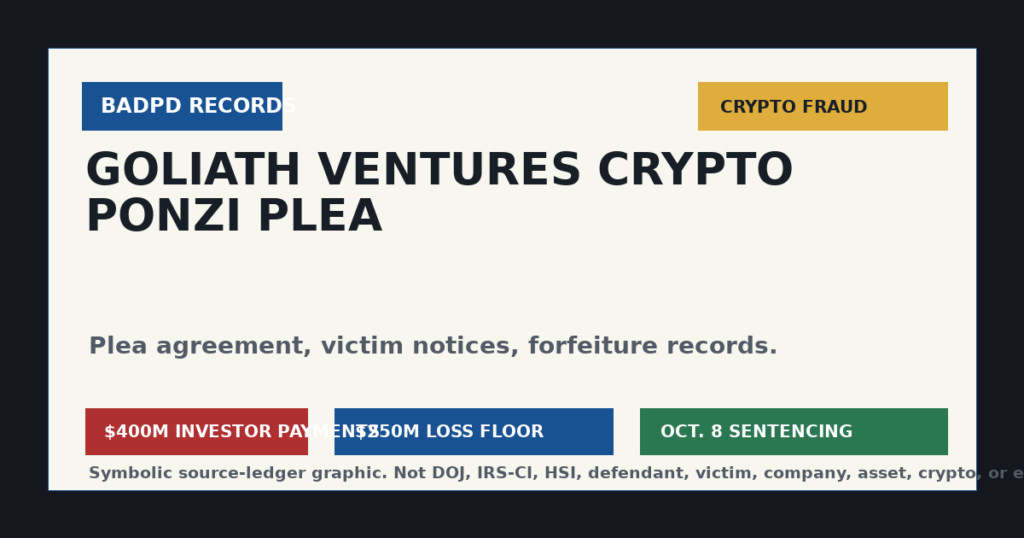
Featured image is symbolic editorial artwork created for BadPD. It is not DOJ, IRS-CI, HSI, defendant, victim, company, asset, home, vehicle, watch, bag, jewelry, crypto, event, charity, or evidence photography.
Send receipts for the desk to research
Send corrections, missing records, police-accountability tips, good-cop public-service receipts, government/court/war leads, recall alerts, or property-tax help resources. Tips are leads only until BadPD verifies records.
Links, dates, agency names, docket numbers, bodycam IDs, recall numbers, forms, and official pages.
Every tip is a lead, not a fact. The desk checks records before publishing.
Use advertising inquiry when you want clearly labeled sponsor space or available ad placements on BadPD.