FDA Allergy Recall Ledger: Bakr Cookie Dough Undeclared Soy Alert
2 sources
1,835 words
Pass
News Anchor voice
Ready when you are.
Status, June 27 source check: source-cleared for a BadPD FDA allergy-recall ledger. FDA posted Bear Stewart LLC’s allergy alert on June 26, 2026 for a single lot of Bakr Brown Butter Chocolate Chunk Ready To Bake Cookie Dough because the pouches may contain undeclared soy. BadPD is treating FDA as the recall authority. Target is included only as a product-identity and retail-context source because FDA says the recalled product was distributed through Target retail stores.
This is a practical harm-prevention post, not medical advice. People with a soy allergy or severe soy sensitivity should follow the FDA/company recall instructions and confirm product details directly from the official recall notice or the seller. The risk is not that every pouch is unsafe for every shopper. The risk is that a pouch labeled as Brown Butter Chocolate Chunk may contain soy because S’mores cookies were packed into the wrong pouch, according to the FDA-posted announcement.
What FDA says is recalled
FDA’s posted announcement says Bear Stewart LLC of Chicago, Illinois is voluntarily recalling a single lot of Bakr Brown Butter Chocolate Chunk Ready To Bake Cookie Dough pouches because the product may contain undeclared soy. FDA’s summary lists the product type as Food and Beverages, the topic as Allergens, the company announcement date as June 25, 2026, and the FDA publish date as June 26, 2026.
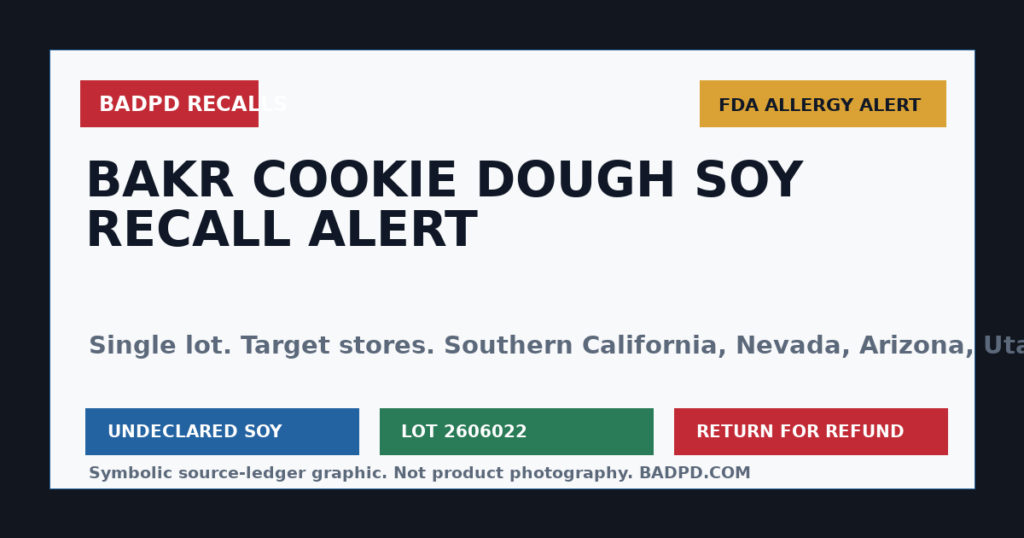
The recalled product is sold as an 8-ounce blue package in the frozen section. FDA says the recalled lot can be identified by lot number 2606022, located on the bottom left corner on the rear side of the pouch. The product name in the FDA notice is Bakr Brown Butter Chocolate Chunk Ready To Bake Cookie Dough. Consumers should not rely on a general brand name alone; the lot number is the critical identifier in this source set.
FDA says the recalled product was distributed in Southern California, Southern Nevada, Arizona, and Utah through Target retail stores starting on June 11, 2026. That makes the alert regionally specific, but not irrelevant outside those states. Frozen products can move after purchase, and households may travel with food or share it. The clean public instruction is to check the product name, package, lot number, and purchase channel.
Why undeclared soy matters
FDA’s notice says people who have an allergy or severe sensitivity to soy run the risk of a serious or life-threatening allergic reaction if they consume the affected product. That is why an allergen recall should not be treated as a minor label typo. The issue is whether the label gives a soy-allergic consumer enough information to avoid exposure.
BadPD is not giving medical guidance. The accountability issue is labeling and packaging control. If S’mores cookies were packed into Brown Butter Chocolate Chunk pouches, as the FDA-posted announcement says, the label no longer tells the whole risk story for soy-allergic consumers. A recall is the public correction mechanism, but the useful records are the lot scope, distribution scope, retailer notification, consumer notification, refund route, and whether the packaging process has been fixed.
FDA says no illnesses have been reported to date. That is good news, but it should not be used as a reason to ignore the recall. Allergy recalls are designed to prevent harm before an exposure becomes an emergency. The absence of reported illnesses is a status point, not proof that no affected pouch remains in a freezer.
Consumer action from the official notice
FDA says consumers who purchased Bakr Brown Butter Chocolate Chunk Ready To Bake Cookie Dough with lot number 2606022 are urged to return it to the place of purchase for a full refund. FDA lists Bear Stewart as the consumer contact and provides 1-800-697-BEAR for questions.
That wording matters. The notice does not tell consumers to guess based on taste, appearance, or whether the pouch looks normal. It tells them to identify the recalled lot and return it for a refund. For a frozen cookie dough product, the most likely missed location is a home freezer. Grocery recall alerts often fail when shoppers assume the item was already eaten or do not check frozen storage.
Retailers and delivery services should also treat this as a notification problem. FDA says distribution was through Target stores in the listed regions. If loyalty-card, pickup, delivery, or online purchase records can identify buyers, the public-interest question is whether those buyers receive direct notice quickly enough to prevent exposure.
Why this is more than a shelf tag
Food recalls often look small when the lot count is narrow, but an undeclared-allergen recall is only successful if the warning reaches the specific people who need it. A soy-allergic shopper may have made a buying decision based on the label, placed the pouch in a freezer, and planned to bake it days or weeks later. That lag is why a recall page, a store notice, and direct buyer outreach are different things. A page can exist while the product is still sitting in a home freezer.
The FDA notice gives enough information for immediate screening: brand, product name, package size, frozen-section placement, lot number, distribution regions, retailer path, and refund instruction. What it does not give is recovery data. It does not say how many pouches were made in lot 2606022, how many reached stores, how many were sold, how many were recovered, whether Target sent direct buyer alerts, or whether online pickup and delivery buyers were separately notified.
That missing recovery data is the public-accountability lane. A recall is not complete just because the official notice is posted. For a product that may have been bought through store, pickup, or delivery channels, retailer records may be able to identify some purchasers. If those systems exist, BadPD will watch for whether they were used. If they were not used, that is a separate consumer-safety question.
Packaging-control questions
FDA’s posted announcement says the recall was initiated after the company discovered that product containing soy was distributed in packaging that did not reveal soy. It also says subsequent investigation points to a temporary packaging-process issue where S’mores cookies were packed into Brown Butter Chocolate Chunk pouches. That is a concrete process failure, not a vague contamination concern.
The next useful records would be a narrow correction note: when the mispackaging occurred, how the lot was isolated, how the company confirmed no other lots were affected, what line-clearance or label-verification step failed, and whether the fix was employee retraining, equipment change, label-control change, batch-record review, or some other corrective action. Those records may never be fully public, but they are the difference between “a recall happened” and “the failure path was closed.”
For consumers, the immediate action remains simple: check the FDA notice and the pouch lot number. For regulators, retailers, and manufacturers, the accountability question is harder. Did the product-identity control fail only once, or did the same packaging process create a risk in adjacent products or lots? FDA’s current public notice does not expand the scope beyond lot 2606022, so BadPD is not expanding it either. It is flagging the question for follow-up only if new records appear.
How to read the Target source
The Target link in this ledger is not being used as the recall authority. The recall authority is the FDA-posted company announcement. Target is used only to preserve product and retail context for readers because FDA says the recalled product was distributed through Target retail stores in the listed regions. Retail product pages can change, disappear, show current inventory instead of recalled-lot status, or omit recall details.
That means readers should not treat the Target page as proof that a specific pouch is or is not recalled. The controlling details are in the FDA notice: product name, 8-ounce blue frozen package, lot number 2606022, distribution regions, and refund instruction. If Target posts its own recall notice, buyer notification, or recovery update later, that would become a stronger accountable source for the retailer side of the ledger.
Confirmed, reported, pending, and not established
Confirmed by FDA’s posted announcement
- FDA published the recall alert on June 26, 2026.
- Bear Stewart LLC announced a voluntary recall of one lot of Bakr Brown Butter Chocolate Chunk Ready To Bake Cookie Dough.
- The reason is possible undeclared soy.
- The recalled product is an 8-ounce blue frozen package.
- The recalled lot number is 2606022.
- FDA says the product was distributed through Target retail stores in Southern California, Southern Nevada, Arizona, and Utah starting June 11, 2026.
Reported by FDA/company announcement
- No illnesses had been reported to date at the time of the FDA-posted announcement.
- The company says the problem was caused by a temporary packaging-process issue in which S’mores cookies were packed into Brown Butter Chocolate Chunk pouches.
- Consumers are urged to return the recalled lot to the place of purchase for a full refund.
Pending
- Whether FDA or the company posts any expansion, correction, or termination notice.
- Whether Target or Bear Stewart publishes buyer-notification details, refund completion data, or a correction-plan summary.
- Whether any later illness or adverse-reaction report is tied to the recalled lot.
Not established by this source set
- How many pouches are included in lot 2606022.
- Whether every affected consumer received direct notice.
- Whether all recalled units have been removed from home freezers, retail inventory, or delivery channels.
- Whether any additional lots, stores, or states are affected beyond the FDA-posted announcement.
BadPD record demand
BadPD will watch for an FDA update, a company correction notice, or a retailer recall page that clarifies how many pouches were distributed, how many were recovered, whether direct buyer notification was sent, and whether the packaging-process failure was corrected. The recall should not be measured only by whether a page exists. It should be measured by whether soy-allergic consumers can identify and remove the recalled product before eating it.
The accountable path is clear: preserve the FDA notice, identify the product and lot, avoid treating an undeclared allergen as a generic consumer complaint, and track missing records. A single-lot recall can still matter when the affected product is frozen, recently sold, and marketed for home baking. The public needs the lot number, the region, the retailer path, and the refund instruction in one place.
BadPD will update this ledger if FDA expands the recall, reports illnesses, posts enforcement follow-up, or if Target or Bear Stewart publishes a clearer consumer-notification or recovery update.
For now, the practical record is narrow and specific: FDA-posted recall, Bakr Brown Butter Chocolate Chunk Ready To Bake Cookie Dough, 8-ounce blue frozen pouch, lot 2606022, undeclared soy, Target distribution in the listed regions, no reported illnesses as of the announcement, and return-to-place-of-purchase refund instructions. Any broader claim should wait for a broader official record.
Source ledger
- FDA recall alert, Bear Stewart/Bakr undeclared soy, published June 26, 2026
- Target product listing for Bakr Brown Butter Chocolate Chip frozen cookie dough
Featured image is symbolic editorial artwork created for BadPD. It is not FDA product photography and is not a depiction of the recalled pouch, Target store, Bear Stewart facility, or any consumer.
Send receipts for the desk to research
Send corrections, missing records, police-accountability tips, good-cop public-service receipts, government/court/war leads, recall alerts, or property-tax help resources. Tips are leads only until BadPD verifies records.
Links, dates, agency names, docket numbers, bodycam IDs, recall numbers, forms, and official pages.
Every tip is a lead, not a fact. The desk checks records before publishing.
Use advertising inquiry when you want clearly labeled sponsor space or available ad placements on BadPD.