
DOJ Says PSOB Death-Claim Decisions Tripled: $96M Finalized, Claim And Scam Guide
News Anchor voice
Ready when you are.
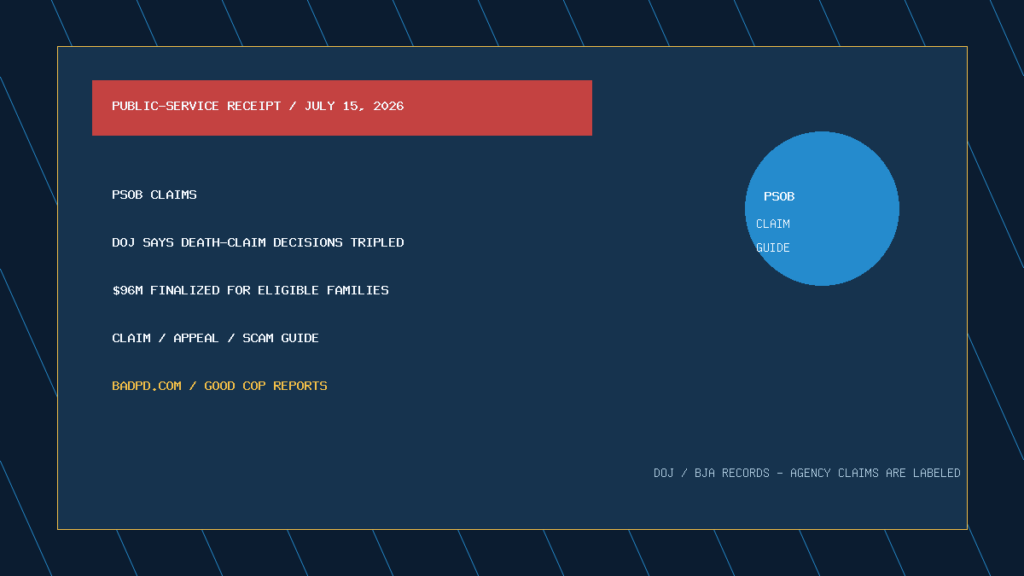
BadPD public-service receipt, July 15, 2026: The Department of Justice says its Public Safety Officers’ Benefits (PSOB) Program finalized more than three times as many death-claim determinations in the last four weeks as it did in the preceding nine months, while finalizing more than $96 million in benefit claims for eligible surviving families of fallen public safety officers. That is a meaningful service result if it is sustained, but it is important to report the source accurately: these are DOJ-reported performance figures, not an independently audited monthly scorecard and not a promise that every pending family will receive a benefit.
PSOB is not a vague public-relations program. The official Bureau of Justice Assistance pages identify death benefits for eligible survivors of public safety officers who die from a qualifying line-of-duty injury, disability benefits for qualifying catastrophic line-of-duty injuries, and education benefits for eligible family members. The program receives more than 1,200 applications a year, according to DOJ. Behind each application can be a family navigating grief, an agency gathering records, or an officer dealing with a career-ending injury. A faster decision is a real public-service outcome only when it preserves evidence, due process, and accurate eligibility review.
This BadPD guide separates what is confirmed in the program materials from the Justice Department’s performance claim, then lays out the official claim portal, the two-part application process, appeal deadlines, and the agency’s fraud warning. It is a good-government receipt, not a blank check. The public deserves to see a federal office clear a backlog, and it deserves a durable record showing whether that improvement continues.
What DOJ Reported On July 15
DOJ’s July 15 release states that, over the prior four weeks, the Office of Justice Programs finalized more than three times the number of PSOB death-claim determinations handled during the previous nine-month period. The same release says more than $96 million in benefits claims were finalized for eligible surviving families of fallen public safety officers. DOJ says the Associate Attorney General directed OJP four weeks earlier to add resources for applicant outreach, evidence gathering, claim review, and determinations.
That is the confirmed scope of the agency announcement. It does not publish the underlying start and end counts, the number of claims awaiting each stage, median time to a decision, approval and denial rates, appeal outcomes, or a claim-by-claim payment ledger. Those missing numbers do not erase the reported progress. They define the next accountability question: can OJP publish a recurring, privacy-protective dashboard that lets families, Congress, and the public verify whether the surge reduced wait times without reducing review quality?
The careful description is therefore simple. DOJ says it tripled a specific category of determinations in a four-week period and finalized $96 million for eligible surviving families. BadPD has verified that statement against the dated DOJ release. We have not found an independent audit of that comparison in this reporting pass. A federal press release is a receipt of the agency’s claim; it is not a substitute for the underlying operational data.
What PSOB Covers, And What It Does Not Automatically Decide
PSOB’s official program page describes three main lanes. Death benefits can be available to eligible survivors of public safety officers whose death was directly and proximately caused by a qualifying line-of-duty injury. Disability benefits may be available to qualifying officers permanently and totally disabled because of a catastrophic line-of-duty injury. Education benefits can help eligible spouses and children. Each lane has its own eligibility requirements, documents, and review process. Applying is not a guarantee of approval, and a public announcement about improved processing does not change the facts required in an individual claim.
The program covers more than one kind of public-safety work. The DOJ release identifies law-enforcement officers, firefighters, and other public safety officers and their families; the official program materials provide the controlling eligibility information. Families and agencies should use the program’s current instructions rather than rely on news summaries, social-media screenshots, or a third party promising a shortcut. BadPD does not provide legal advice or decide eligibility. The point of this guide is to make the verified public route easier to find and harder for scammers to imitate.
How The Official Claim Process Works
The official online portal is MyPSOB. The BJA benefits page says the death-benefit application has two parts: Part A is completed by the applicant or an authorized representative, and Part B is completed by the employing agency. The same two-part pattern applies to disability claims, with the officer or authorized representative completing Part A and the employing agency completing Part B. The system generates a customized list of required documents based on the answers provided.
That shared responsibility matters. A family may be gathering personal records while an agency holds employment, incident, or official documentation. A claim can stall when either side assumes the other has completed the required step. The official BJA page says applicants must submit the relevant parts and required documents before an application is complete. A practical record-keeping approach is to save the submission confirmation, claim number, upload list, dated copies of communications, and the name of any agency contact handling Part B. Do not send sensitive material through an unverified social-media account or text message.
For help using the official process, BJA directs PSOB claimants to AskPSOB@usdoj.gov or 1-888-744-6513. Check the live official program page for current hours and instructions before relying on any copied contact detail. A legitimate staff email should use an @ojp.usdoj.gov or @usdoj.gov domain, according to BJA’s fraud alert.
Appeals: The 33-Day Windows Matter
The official benefits page says a claimant whose claim is denied at the PSOB Office level can seek two levels of administrative appeal: first to a Hearing Officer, then to the BJA Director. It states that claimants have 33 days to appeal the initial denial and another 33 days to appeal to the BJA Director. A denial letter and the live program instructions should be read closely because deadlines, delivery methods, and record requirements matter. Missing an administrative deadline can create an avoidable barrier to review.
Keeping the process accessible is part of good public service. A family should not need a Washington insider to locate a portal, understand which application part belongs to the agency, or learn that there is a review path. At the same time, no one should promise that an appeal will succeed. An appeal is a formal opportunity to challenge or supplement a decision under the program rules. The strongest public-resource reporting gives people the verified route and explains what remains case-specific.
Scam Defense: Use The Official Channel, Not Texts Or Payment Demands
BJA has issued a specific fraud warning about people falsely claiming to be agency representatives. Its instruction is blunt: do not send personally identifiable information, Social Security numbers, bank-account information, or money in response to those claims. BJA says it discourages PSOB claimants from communicating with representatives over text and directs people to its official email and telephone channels instead.
That warning deserves prominent placement because benefit backlogs and grieving families are a predictable target. A real claim is not a reason to hand over a banking password, pay a supposed processing fee, or move the conversation to an unverified encrypted account. Save screenshots, preserve the phone number or email address, and use the official program channel to check whether a message is legitimate. BJA also points people to the Federal Trade Commission’s ReportFraud process for suspected scams. The safest verification step is to start from the official BJA PSOB page, not from a link delivered by an unknown sender.
A Good-Service Receipt Needs Ongoing Receipts
It is fair to recognize government work that helps families obtain decisions faster. Public safety officers and first responders take serious risks, and eligible survivors should not be trapped in a needless administrative maze. It is equally fair to demand proof that the improvement is real, durable, and not achieved by moving difficult claims out of sight. The relevant accountability test is not whether DOJ can issue one strong headline; it is whether the program can maintain clear intake, evidence requests, determinations, appeals, and payment practices month after month.
BadPD’s requested public scorecard is modest and privacy-protective. OJP should publish recurring totals for applications received, claims completed, claims pending by stage, median age of pending claims, approval and denial counts, appeal counts and disposition, and aggregate benefit amounts. It should explain changes in staffing or process, distinguish death, disability, and education lanes, and report how agencies are meeting their Part B responsibilities. No family’s personal records need be exposed for the public to see whether a surge actually improved service.
The same standard should apply to employing agencies. An agency that praises a fallen officer or injured responder in public should be capable of returning its official part of a benefits application promptly and accurately. Agencies should name a responsible records contact, preserve relevant records, give families a dated receipt for submitted material, and explain what remains outstanding. Families should not have to chase a bureaucracy alone while a public announcement celebrates a faster process.
Confirmed, Reported, Pending, And Missing
Confirmed: PSOB is an official BJA program with death, disability, and education benefit pathways; it uses MyPSOB; death and disability applications use applicant/officer and employing-agency components; the official materials describe two administrative appeal levels and 33-day windows; and BJA warns against impersonator texts and requests for personal or bank information.
Reported by DOJ: more than three times as many PSOB death-claim determinations were finalized during the identified four-week period as in the prior nine months, and more than $96 million in benefits claims were finalized for eligible surviving families. BadPD treats those as dated agency-reported performance figures.
Pending or case-specific: every individual claimant’s eligibility, evidence, decision, payment, and appeal. A published performance increase does not settle any particular claim. The current number of pending claims, exact throughput data, median wait times, approval rate, denial reasons, and appeal results were not supplied in the DOJ release reviewed for this report.
BadPD Bottom Line
The Justice Department’s reported PSOB surge is the kind of public-service receipt worth documenting: an agency says it put resources into outreach, evidence gathering, and review, then reports a sharp rise in death-claim determinations and $96 million finalized for eligible surviving families. Families need that work to be real, because a benefit system is failing when a legitimate claim becomes another prolonged emergency.
The accountability condition is just as important. DOJ and BJA should keep publishing the operational numbers that show whether the improvement lasts. Until then, claimants and agencies have a verified official path: use MyPSOB, complete both required application components, preserve records, watch the 33-day appeal windows, and reject anyone asking for sensitive information or money through an unverified text. Good public service deserves credit. It also deserves a ledger.
Source Trail
- DOJ: Justice Department triples PSOB claims processed (July 15, 2026) – Department announcement reporting its four-week death-claim determination comparison and $96 million finalized for eligible surviving families.
- BJA Public Safety Officers Benefits Program (Accessed July 15, 2026) – Official program description, MyPSOB claim portal, help contact, and program fraud warning.
- BJA PSOB benefits and application instructions (Accessed July 15, 2026) – Official death, disability, education, documentation, online submission, and two-level appeal instructions.
- BJA fraud alert on impersonators (August 17, 2023; accessed July 15, 2026) – Official warning not to send personal information, bank details, or money to impersonators; confirms official contact routes.
Send receipts for the desk to research
Send corrections, missing records, police-accountability tips, good-cop public-service receipts, government/court/war leads, recall alerts, or property-tax help resources. Tips are leads only until BadPD verifies records.
Links, dates, agency names, docket numbers, bodycam IDs, recall numbers, forms, and official pages.
Every tip is a lead, not a fact. The desk checks records before publishing.
Use advertising inquiry when you want clearly labeled advertiser placement on BadPD.