
No, Xi Did Not Say China And America Are Allies. The Current Receipt Says Strategic Stability.
News Anchor voice
Ready when you are.
Status: Developing receipt-check package. This is source-linked analysis built from current public readouts, wire reporting, and policy analysis. It is not a final finding.
Desk thesis: The current public record supports a narrow read: Xi used cooperation and partner language, while also warning on Taiwan. It does not support a current public alliance claim.
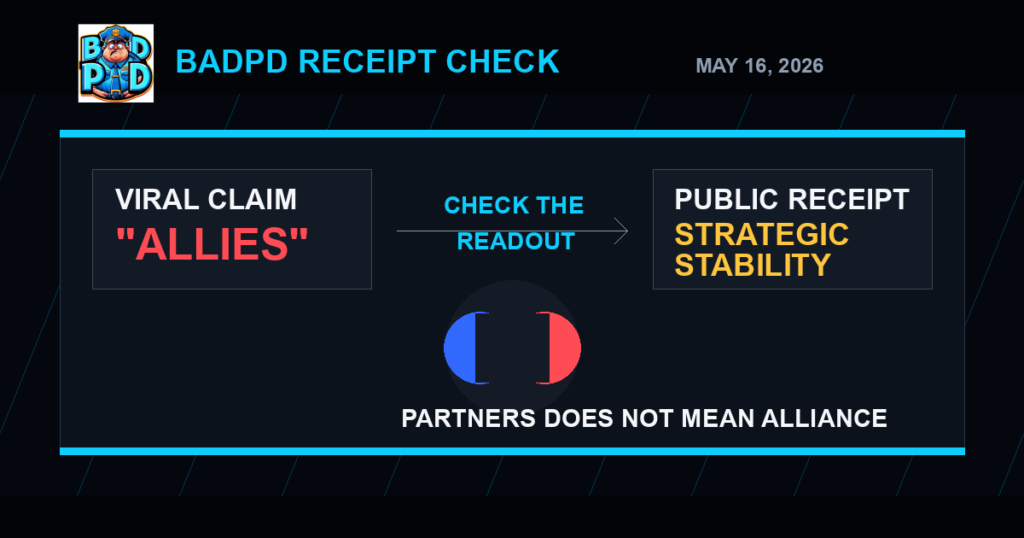
Current public receipts show Xi used strategic-stability and partner language during Trump China visit. That is not the same thing as an alliance.
The Short Answer
The short answer is that the public record is narrower than the loudest captions. Xi public language around President Trump China visit points to strategic stability, partner language, cooperation, managed competition, Taiwan risk, and follow-up channels. That is a major story by itself. It does not need to be inflated into an alliance claim to matter.
BadPD is pushing this as a receipt package because the wording is already being softened, stretched, recycled, or flattened online. A real phrase can become a fake post when the date disappears, when the speaker changes, or when a careful diplomatic word gets upgraded into a stronger word that was not actually used.
What This Desk Is Checking
This is the anchor fact-check for the package. It separates three words that are being blended online: partner, rival, and ally.
The desk standard is simple: if a social post says Xi used alliance language, the post needs a current source and an exact quote.
The record also needs the warning attached to it. A friendly banquet line does not erase the Taiwan section of the same summit record.
This item stays open for correction if a fuller transcript appears. BadPD will update if the current evidence changes.
The Current Public Record
The current Chinese government wording is strategic stability, cooperation as the mainstay, competition within proper limits, manageable differences, and expected peace. That is not a signed alliance.
The May 14 banquet language says the two countries should be partners rather than rivals. That is warmer than rivalry language, but it still does not carry the weight of alliance language.
The May 15 private meeting readout describes understandings on trade stability, practical cooperation, concerns, and coordination on international and regional issues. It is the latest direct public Xi wording from the visit that BadPD has found.
The Taiwan warning is part of the same public record. China said the issue is the most important one in China-U.S. relations and warned that mishandling it could lead to clashes or conflict.
The White House version emphasized Hormuz, Iran, fentanyl, trade, business access, investment, and purchases. China public statements did not mirror every White House detail with the same specificity.
Older partners-and-friends wording from October 2025 exists, but a post using that wording in a May 2026 context needs to say it is older. Removing the date changes the reader understanding.
Confirmed, Not Confirmed, Missing
Confirmed: Trump visited China from May 13 to May 15, 2026. Xi and Trump held formal talks, a banquet, and a private meeting. Chinese public records describe a constructive China-U.S. relationship of strategic stability. They also include partner/rival language and a Taiwan warning.
Not confirmed: BadPD has not found a current public Xi statement saying the United States and China need to be allies. The current record does not show a formal alliance announcement, treaty commitment, or signed public security pact.
Missing: The public still needs any fuller transcript, signed text, implementation documents, purchase schedules, Hormuz-related commitments, trade-board details, Taiwan arms decisions, and corrections from either government if any public readout left out material terms.
Why The Word Choice Matters
Ally, partner, competitor, rival, and adversary are not interchangeable. In ordinary speech they can blur together. In foreign policy they can move markets, shape war planning, influence voter trust, and give politicians a way to claim more success than the paperwork proves. BadPD is not letting the strongest word win just because it makes the better caption.
A country can be a trading partner while still being a strategic competitor. Two governments can coordinate on shipping lanes while clashing over Taiwan. Leaders can praise each other in public and still disagree behind closed doors. The public needs the full shape of that tension, not a one-word slogan.
Source Trail
- Chinese Foreign Ministry: Xi-Trump talks, May 14 – Official Chinese record of the formal talks, including strategic-stability language and the Taiwan warning.
- Chinese Foreign Ministry: Xi banquet toast, May 14 – Official Chinese record of the friendly banquet language, including partners rather than rivals.
- Chinese Foreign Ministry: Zhongnanhai private meeting, May 15 – Official Chinese record of the latest public Xi wording from the private meeting.
- Xinhua: Wang Yi briefing, May 16 – China state-media publication of the post-summit foreign-ministry explanation.
- AP: Takeaways from Trump trip to China – Independent wire framing of Taiwan, strategic stability, trade, Iran, and Trump praise.
- Al Jazeera: U.S. and China disagree on what they agreed on – Comparison of White House claims and Chinese public statements on Iran and Hormuz.
- CBS News: Trump wraps China visit – Reported Trump comments on Iran, oil, Boeing, Taiwan, Jimmy Lai, and future Xi visit.
- Reuters via Investing.com: New positioning in ties – Reuters-syndicated report describing the strategic-stability framework as cooperation with measured competition.
- RTHK: October 2025 partners and friends wording – Older Busan-era wording that can be confused with the May 2026 Beijing language.
Receipt Notes
BadPD is not treating Beijing, Washington, AP, Reuters, CBS, Al Jazeera, Xinhua, a think tank, or a social account as final authority. Each source is one receipt. The standard is to compare the receipts, name the gaps, and keep the article open when later documents arrive.
The desk language matters because a government can use soft words for hard leverage. A summit can be friendly in ceremony and still contain serious pressure over Taiwan, shipping lanes, trade access, energy, sanctions, and war risk.
Readers should watch the verbs. Officials can discuss, support, welcome, express interest, agree in principle, agree to consult, agree to establish a channel, or sign enforceable text. Those are different actions. BadPD will not collapse them into one word because that helps a politician sell a win.
Social posts often reward the cleanest emotional version of an event. Foreign-policy documents are rarely clean. They are built from compromise, omission, ambiguity, and public positioning. That is why exact dates and source names matter.
This package is about public-power accountability. It is not anti-Chinese people, anti-American people, or anti-anyone as a group. It is scrutiny of governments, officials, policies, and claims that can affect civilians who had no seat at the table.
If a later transcript shows that Xi used alliance language, BadPD should update the article and show the quote. If no transcript appears, the public should treat alliance captions as unsupported until proven.
The same rule applies to Trump claims. A White House readout is an official claim, not automatic proof. When China public statements do not match every detail, the gap becomes part of the story instead of something to smooth over.
The practical follow-up is implementation. If Hormuz traffic changes, if China buys more U.S. oil, if farm orders materialize, if Boeing sales are signed, or if Taiwan arms policy shifts, those receipts can change the story. Until then, the paperwork is still thin.
What To Watch Next
Watch for a fuller transcript, direct Chinese confirmation of any White House-specific claim, a written U.S.-China statement, trade-board membership details, oil or agricultural purchase data, Boeing contract filings, shipping-lane changes around Hormuz, and any Taiwan arms-sale decision after the summit. Those are the receipts that would move this from summit theater to measurable policy.
Also watch the social layer. If posts keep using allies, alliance, or friends without dates and links, BadPD will treat that as a misinformation lead. The correction is not complicated: name the source, show the exact words, date the quote, and keep the warning language attached.
Featured image is symbolic editorial artwork created for BadPD. It is not a depiction of the summit, a private meeting, a classified document, a victim, a suspect, or any real scene.
Additional receipt discipline: BadPD is not treating Beijing, Washington, AP, Reuters, CBS, Al Jazeera, Xinhua, a think tank, or a social account as final authority. Each source is one receipt. The standard is to compare the receipts, name the gaps, and keep the article open when later documents arrive. For this article, that rule points back to the desk thesis: The current public record supports a narrow read: Xi used cooperation and partner language, while also warning on Taiwan. It does not support a current public alliance claim.
Additional receipt discipline: The desk language matters because a government can use soft words for hard leverage. A summit can be friendly in ceremony and still contain serious pressure over Taiwan, shipping lanes, trade access, energy, sanctions, and war risk. For this article, that rule points back to the desk thesis: The current public record supports a narrow read: Xi used cooperation and partner language, while also warning on Taiwan. It does not support a current public alliance claim.
Additional receipt discipline: Readers should watch the verbs. Officials can discuss, support, welcome, express interest, agree in principle, agree to consult, agree to establish a channel, or sign enforceable text. Those are different actions. BadPD will not collapse them into one word because that helps a politician sell a win. For this article, that rule points back to the desk thesis: The current public record supports a narrow read: Xi used cooperation and partner language, while also warning on Taiwan. It does not support a current public alliance claim.
Additional receipt discipline: Social posts often reward the cleanest emotional version of an event. Foreign-policy documents are rarely clean. They are built from compromise, omission, ambiguity, and public positioning. That is why exact dates and source names matter. For this article, that rule points back to the desk thesis: The current public record supports a narrow read: Xi used cooperation and partner language, while also warning on Taiwan. It does not support a current public alliance claim.
Additional receipt discipline: This package is about public-power accountability. It is not anti-Chinese people, anti-American people, or anti-anyone as a group. It is scrutiny of governments, officials, policies, and claims that can affect civilians who had no seat at the table. For this article, that rule points back to the desk thesis: The current public record supports a narrow read: Xi used cooperation and partner language, while also warning on Taiwan. It does not support a current public alliance claim.
Additional receipt discipline: If a later transcript shows that Xi used alliance language, BadPD should update the article and show the quote. If no transcript appears, the public should treat alliance captions as unsupported until proven. For this article, that rule points back to the desk thesis: The current public record supports a narrow read: Xi used cooperation and partner language, while also warning on Taiwan. It does not support a current public alliance claim.
Additional receipt discipline: The same rule applies to Trump claims. A White House readout is an official claim, not automatic proof. When China public statements do not match every detail, the gap becomes part of the story instead of something to smooth over. For this article, that rule points back to the desk thesis: The current public record supports a narrow read: Xi used cooperation and partner language, while also warning on Taiwan. It does not support a current public alliance claim.
Additional receipt discipline: The practical follow-up is implementation. If Hormuz traffic changes, if China buys more U.S. oil, if farm orders materialize, if Boeing sales are signed, or if Taiwan arms policy shifts, those receipts can change the story. Until then, the paperwork is still thin. For this article, that rule points back to the desk thesis: The current public record supports a narrow read: Xi used cooperation and partner language, while also warning on Taiwan. It does not support a current public alliance claim.
Additional receipt discipline: BadPD is not treating Beijing, Washington, AP, Reuters, CBS, Al Jazeera, Xinhua, a think tank, or a social account as final authority. Each source is one receipt. The standard is to compare the receipts, name the gaps, and keep the article open when later documents arrive. For this article, that rule points back to the desk thesis: The current public record supports a narrow read: Xi used cooperation and partner language, while also warning on Taiwan. It does not support a current public alliance claim.
Additional receipt discipline: The desk language matters because a government can use soft words for hard leverage. A summit can be friendly in ceremony and still contain serious pressure over Taiwan, shipping lanes, trade access, energy, sanctions, and war risk. For this article, that rule points back to the desk thesis: The current public record supports a narrow read: Xi used cooperation and partner language, while also warning on Taiwan. It does not support a current public alliance claim.
Additional receipt discipline: Readers should watch the verbs. Officials can discuss, support, welcome, express interest, agree in principle, agree to consult, agree to establish a channel, or sign enforceable text. Those are different actions. BadPD will not collapse them into one word because that helps a politician sell a win. For this article, that rule points back to the desk thesis: The current public record supports a narrow read: Xi used cooperation and partner language, while also warning on Taiwan. It does not support a current public alliance claim.
Additional receipt discipline: Social posts often reward the cleanest emotional version of an event. Foreign-policy documents are rarely clean. They are built from compromise, omission, ambiguity, and public positioning. That is why exact dates and source names matter. For this article, that rule points back to the desk thesis: The current public record supports a narrow read: Xi used cooperation and partner language, while also warning on Taiwan. It does not support a current public alliance claim.
Additional receipt discipline: This package is about public-power accountability. It is not anti-Chinese people, anti-American people, or anti-anyone as a group. It is scrutiny of governments, officials, policies, and claims that can affect civilians who had no seat at the table. For this article, that rule points back to the desk thesis: The current public record supports a narrow read: Xi used cooperation and partner language, while also warning on Taiwan. It does not support a current public alliance claim.
Additional receipt discipline: If a later transcript shows that Xi used alliance language, BadPD should update the article and show the quote. If no transcript appears, the public should treat alliance captions as unsupported until proven. For this article, that rule points back to the desk thesis: The current public record supports a narrow read: Xi used cooperation and partner language, while also warning on Taiwan. It does not support a current public alliance claim.
Additional receipt discipline: The same rule applies to Trump claims. A White House readout is an official claim, not automatic proof. When China public statements do not match every detail, the gap becomes part of the story instead of something to smooth over. For this article, that rule points back to the desk thesis: The current public record supports a narrow read: Xi used cooperation and partner language, while also warning on Taiwan. It does not support a current public alliance claim.
May 17 update: Xinhua defined the phrase, and it still is not “allies”
Xinhua added a newer May 17 state-media receipt that sharpens the language BadPD has been tracking. The headline says the Xi-Trump meeting charted a course for “constructive strategic stability” in China-U.S. ties. More importantly, Xinhua says Xi defined that phrase as stability with cooperation as the mainstay, moderate competition, manageable differences, and promises of peace.
That is useful because it gives the public a more detailed China-side definition of the current phrase. It still does not say China and America are allies. It does not say the two governments are friends in a security-alliance sense. It says cooperation, competition, managed differences, and peace language inside a state-media framework that is trying to sell the summit as stabilizing.
The BadPD correction stays the same but gets stronger: if a viral post says Xi recently called America an ally, the post needs a current direct quote and date. The newer May 17 China-side receipt points to constructive strategic stability, not alliance language.
New receipt added: Xinhua, May 17: Xi-Trump meeting charts course for constructive strategic stability.
May 20 update: Taiwan answered the bargaining-chip problem again
AP added the next receipt in the Trump-Xi lane on May 20: Taiwan President Lai Ching-te publicly defended U.S. arms purchases and said Taiwan’s future cannot be decided externally. That matters because Trump treated Taiwan arms as a live issue after the China summit, while Beijing continues to frame Taiwan as the relationship’s central pressure point.
This strengthens the original BadPD read. The current public record is still not “America and China are allies.” It is strategic stability language, Taiwan pressure, trade bargaining, and a contested arms-sale decision. Viral posts that recycle warmer Xi language without this Taiwan receipt are giving readers a trimmed record.
New receipt: AP: Taiwan’s president speaks after Trump-Xi arms-sale comments.
Send receipts for the desk to research
Send corrections, missing records, police-accountability tips, good-cop public-service receipts, government/court/war leads, recall alerts, or property-tax help resources. Tips are leads only until BadPD verifies records.
Links, dates, agency names, docket numbers, bodycam IDs, recall numbers, forms, and official pages.
Every tip is a lead, not a fact. The desk checks records before publishing.
Use advertising inquiry when you want clearly labeled sponsor space or available ad placements on BadPD.