
Reflecting Pool Algae Contract Ledger: $14.7M Blue Coating, $1.7M Nanobubbles, And The Records Still Missing
News Anchor voice
Ready when you are.
BadPD update, June 23, 2026: the Lincoln Memorial Reflecting Pool story is not just a green-water meme. It is a public-money story, a procurement story, a science-versus-spin story, a policing story, and a records-withholding story. The press has bounced between algae jokes, vandalism claims, donor ties, warranty statements, and government one-liners. The only sane way through it is to build a ledger: what is confirmed, what is alleged, what is disputed, what records are missing, and which side owes receipts.
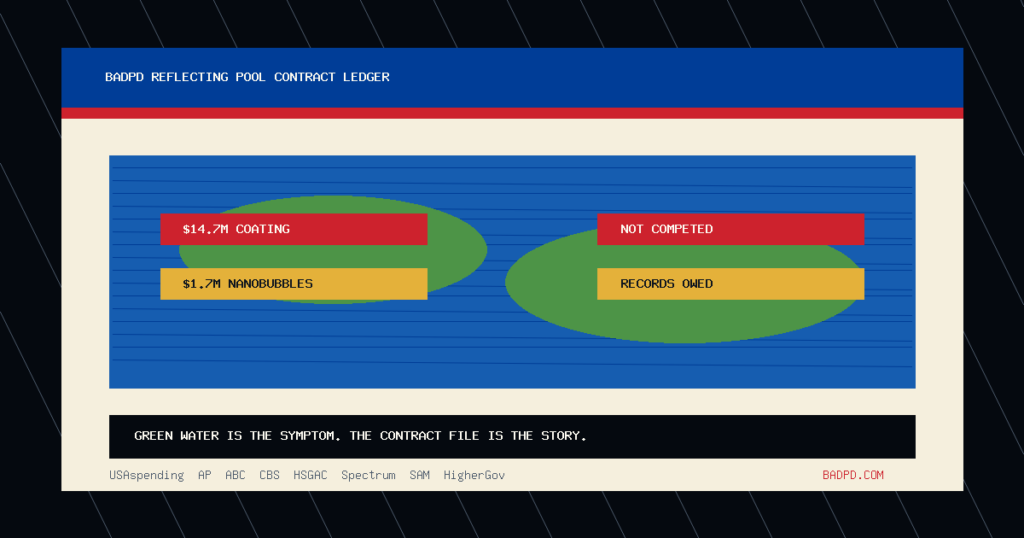
The bottom line is already ugly enough without inventing facts. USAspending's award data for the coating contract identifies National Park Service contract 140P2026C0028 for "NAMA 291052 Paint Lincoln Reflecting Pool," signed April 3, 2026, with $14,652,521.24 obligated to Atlantic Industrial Coatings LLC. The USAspending API fields list the solicitation as "only one source," competition as "not competed," one offer received, no set-aside used, firm fixed price, and urgency as the reason for other-than-full-and-open competition under FAR 6.302-2. USAspending's separate award data for 140P2026C0031 lists the "Lincoln Reflecting Pool Nano Bubble" contract to Green Water Solutions LLC at $1,740,255.50, also "only one source," "not competed," one offer, and urgency under FAR 6.302-2.
That is the accountability spine: two urgent/no-bid-style lanes, more than $16 million combined by the current public contract figures, a visible algae/peeling problem, an anti-algae promise in the coating narrative, a water-treatment company saying its system is science-based, an administration blaming vandals and chemicals without a full public evidence package, and public agencies still not releasing a clean document set.
This article does not claim bribery, kickbacks, or a greased wheel as established fact. If influence or favoritism happened, the communications, market research, justifications, vendor-selection record, invoices, change orders, and conflict disclosures should show it. If influence did not happen, those same records should clear it. The problem is that taxpayers are staring at green water and peeling material while the records needed to settle the question remain scattered or unpublished.
What Is Confirmed By Public Records
Confirmed by USAspending award data: Atlantic Industrial Coatings LLC received contract 140P2026C0028 for the Reflecting Pool painting/coating work. The listed description is "NAMA 291052 Paint Lincoln Reflecting Pool." The public award data identifies the Department of the Interior and National Park Service as the awarding and funding agency, the Denver Service Center contracting office, Washington, D.C. as the place of performance, and Atlantic Industrial Coatings of New Canton, Virginia as the recipient. The total obligation and award value are listed at $14,652,521.24.
Confirmed by the same award data: the latest transaction lists one offer, "only one source," "not competed," no set-aside, firm fixed price, and urgency under FAR 6.302-2 as the other-than-full-and-open competition justification. A contract-data mirror, HigherGov, reports the same award as up to $14.7 million, sole source/not competed, one bid received, and complete as of early June, with the potential award increasing from about $13.1 million to about $14.65 million.
Confirmed by USAspending award data for the water-treatment side: Green Water Solutions LLC received contract 140P2026C0031, described as "NAMA 291052 Lincoln Reflecting Pool Nano Bubble," signed April 13, 2026, with $1,740,255.50 obligated. The latest transaction fields again list "only one source," one offer, "not competed," no set-aside, firm fixed price, and urgency under FAR 6.302-2. That makes the nanobubble lane part of the same public-money story, not a footnote.
Confirmed by AP, ABC, CBS, and Spectrum reporting: after the project was treated as a showcase renovation, the pool experienced algae and visible coating or liner problems. AP reported on June 23 that National Guard members and U.S. Park Police patrolled the deck while federal workers and contractors used chemicals and ozone nanobubbles. AP also reported that the problems most likely require draining the pool again for liner repairs, and that AP observed pieces of liner or coating material in the water.
Confirmed by ABC reporting: the cost of repainting/coating ballooned above $14.65 million, Green Water Solutions received about $1.74 million for the nanobubble system, and the combined project is set to cost more than $16 million. ABC also reported contract-language describing the coating system as waterproof, antimicrobial, anti-algae, and suitable for continuous submersion. That performance language is central because the public now sees algae and peeling.
Confirmed by CBS reporting: Green Water Solutions is owned by or tied through federal contracting documents to JJ Cafaro Investment Trust; CBS identified John J. Cafaro through FEC filings as president and CEO of that trust and reported his political donation history. CBS also reported White House pushback that the contract was awarded by Interior and that the White House did not pick the vendor. Cafaro told a local newspaper, according to CBS, that Trump did not know about his company's Reflecting Pool work and that he would not discuss it with Trump. Those denials matter. They do not erase the need for records.
Confirmed by a Senate Permanent Subcommittee on Investigations letter dated May 14, 2026: Ranking Member Richard Blumenthal asked Atlantic Industrial Coatings for records about the no-bid contract, cost increases, whether the company had similar prior work, how it learned about the opportunity, whether there was a competitive process, any agreements with federal entities, cost estimates, formal review of the color change, and any Trump Organization work since 2010. That letter is not a verdict. It is a public record showing that procurement questions existed before the algae embarrassment went fully viral.
What Is Alleged Or Claimed
President Trump has blamed vandalism, alleged a long gash in the coating, alleged illegal chemicals or fertilizer were placed into the water, and said multiple people were arrested or under suspicion. AP reported on June 23 that he had not publicly backed up those claims and that even if some cutting or peeling occurred, that would not by itself explain the algae bloom. Spectrum reported an Interior spokesperson said five people were arrested on vandalism charges, five more were issued federal citations, and 14 police reports were filed related to vandalism; AP reported Park Police had not immediately answered AP's questions about arrests or charges, and D.C.'s Metropolitan Police Department said it was not involved.
Atlantic Industrial Coatings told CBS that the areas needing repair were a very small part of the seven-acre project and did not indicate liner failure. The company said repairs would have to wait until the pool is drained and would be performed under warranty. That is a defense worth including, but it also triggers a record demand: publish the warranty terms, inspection reports, repair logs, surface-preparation records, cure data, quality-control photos, product data sheets, and the technical explanation for why any area failed or appeared to fail so quickly.
Interior's public line, as reported by ABC, CBS, and Spectrum, has been that algae was residual or part of the startup process, that nanobubble technology killed the algae, and that National Park Service teams were vacuuming dead algae from the pool bottom while also using hydrogen peroxide. Greenwater/Green Water has described its NanoBubble Ozone Technology as environmentally conscious and science-based. That may be true. If it is true, the agency and vendor should publish the water-chemistry logs, treatment schedule, turbidity readings, algae counts, dissolved-oxygen data, ozone system settings, and before/after performance metrics.
Critics and some outlets have moved fast toward corruption language because the project involved no-bid/urgent awards, donor ties, Trump personal interest, and prior Trump-property work claims. That suspicion is understandable, but BadPD should keep the line clean: suspicious facts are not proof of bribery. Suspicious facts are a reason for subpoenas, FOIA requests, inspector-general review, and public release of the selection file.
Rip All Sides, Starting With The Administration
The administration owns the first bucket because the project was sold as beautification, speed, and competence before the public could see the long-term result. If the president selected the blue color himself, as AP and CBS reporting describe, then the color choice is no longer cosmetic trivia. It is part of the decision file. Who evaluated whether a blue coating would make algae more visible? Who evaluated how the coating would look under real water, sunlight, sediment, and tourist conditions? Who signed off on changing the appearance of one of the most photographed civic sites in the country?
Trump and the White House also owe receipts for the vandalism narrative. If vandals cut a 300-foot gash or introduced damaging chemicals, publish the incident numbers, dates, camera angles, charge status, lab testing, damage photos, and which damage corresponds to which act. If federal prosecutors have only a handful of citations to review, as Spectrum reported a U.S. attorney's office spokesperson said, then do not let political messaging inflate minor touch-the-liner conduct into a sabotage story that absorbs the contract failure question.
The administration cannot ask the public to believe both that this was a brilliantly executed fast renovation and that any visible failure is somebody else's sabotage unless it provides the evidence chain. Right now, the record says urgent contracting, rapid work, visible defects, algae, and a lot of blame-shifting. The cure is not another post. The cure is the contract file.
Rip Interior And NPS
Interior and the National Park Service are the public stewards here. The Reflecting Pool is not a private backyard pool, a hotel amenity, or a campaign prop. It is a national landmark. NPS should be able to answer basic questions in public without hiding behind vague maintenance language.
NPS should publish the full justification and approval for other-than-full-and-open competition for both contracts, market research, vendor comparison notes, technical evaluations, acquisition plan, any brand-name or unique-technology findings, all modifications, change orders, invoices, payment status, warranty terms, inspection photos, daily reports, safety reports, environmental permits, discharge permit records, and communications with White House staff about color, deadline, scope, vendor choice, or public messaging.
The urgency justification deserves special scrutiny. A July 4 or semiquincentennial deadline may explain why officials wanted speed, but speed is not a magic eraser for competition, quality control, technical review, or public documentation. If urgency was created by political timing, that is not the same as disaster urgency. If the agency believes FAR 6.302-2 fits, publish the specific facts used to reach that conclusion.
NPS also owes a public science memo. Algae has plagued the pool for decades; AP notes the problem is not new. That makes the system design especially important. If algae is predictable, the public should know how the coating and nanobubble system were expected to handle it, what assumptions were made about stagnant supply lines, what startup treatment was expected, and why the public was promised a clean visual result before the system had stabilized.
Rip The Coating Contractor
Atlantic Industrial Coatings is not guilty of wrongdoing merely because something looks bad on TV. The company has said the needed repairs are small relative to the project and fall under warranty. Fine. Publish the receipts.
If the product is fit for continuous submersion and anti-algae performance was part of the contract narrative, then the company should explain why visible pieces were observed in the water and what caused the failure points. Was it surface prep? Cure time? Weather? Water chemistry? Improper fill timing? Physical damage? Product selection? Edge detail? Substrate condition? A design change? A warranty issue? The answer should not be a press sentence. It should be a technical package.
The Senate letter raised questions about prior federal contract history and similar projects. The company can answer those questions cleanly. If it has comparable work, list it. If it does not, explain why this project was still within its expertise. If its proposal included the final cost from the beginning, publish the cost basis. If the price changed because scope changed, publish the modification history.
This is not about dunking on a contractor. It is about a contractor taking public money on a national landmark through an urgent/not-competed pathway and then owing the public a higher level of transparency when the visible outcome turns into algae, repair work, and federal patrols.
Rip The Nanobubble Vendor
Green Water Solutions deserves the same source-clean treatment. CBS reports it as the recipient of a $1.7 million no-bid water-cleaning contract, identifies the ownership trail through JJ Cafaro Investment Trust, and reports political donations and a Trump-property-work lane. CBS also reports White House denial of involvement in vendor selection and Cafaro's denial that he discussed the pool work with Trump. Those facts belong together.
A donor tie does not prove corruption. A denial does not end the inquiry. The way to resolve the question is to release the procurement file and performance data. The vendor should publish the system design capacity, engineering assumptions, installation date, commissioning checklist, treatment schedule, sensor data, ozone dosage, maintenance plan, expected timeline for visible clearing, and any limitations. If the system is working and the green material is dead algae being vacuumed, show the metrics.
The company should also disclose all federal, political, and Trump-affiliated touchpoints relevant to the award. If there were no improper contacts, a clean contact log helps clear the air. If there were contacts, the public deserves to know who asked what, when, and why.
Rip The Press
The press needs to stop treating this as either comic algae content or a fully solved corruption story. It is neither. The strongest version is records-led: contract data, vendor selection, source of urgency, technical design, visible performance, warranty claims, vandalism evidence, arrest/citation records, water chemistry, and taxpayer cost.
Some coverage is doing that work. AP is separating unverified vandalism claims from observed algae/peeling and agency nonanswers. ABC is quantifying the combined cost and contract language. CBS is connecting the Green Water Solutions award to donor/ownership records and official denials. Spectrum is tracking agency claims about arrests, citations, hydrogen peroxide, and prosecutor review. That mix is useful because it forces every side into a source lane.
The bad coverage lane is the one that jumps from funny images to final answers. A green pool does not prove a bribe. A donor tie does not prove a bribe. A vandalism citation does not prove sabotage caused the algae. A warranty statement does not prove the liner was fine. A government tweet does not prove the science worked. Each claim needs the record underneath it.
Rip The Critics Too
Critics should not get sloppy just because the optics are absurd. If the allegation is corruption, name the statute, name the communication, name the payment, name the official act, or say it is a procurement concern pending records. If the allegation is waste, attach the cost baseline and explain what comparable work should cost. If the allegation is incompetence, attach the technical failure record.
The best criticism here is not personal insult. It is: the government used urgent/noncompetitive pathways for public landmark work; costs rose; one contractor had no obvious comparable federal history according to congressional concern; another award involved a donor-linked company and prior Trump-property work reports; the promised visual result visibly failed or destabilized; the administration blamed vandals without a full public evidence package; and agencies still have not published the files that would settle the dispute.
That is plenty. It is also harder to dismiss than name-calling.
Rip The Onlookers And Vandalism Lane
If someone physically cut, peeled, dumped chemicals, or damaged the pool, they should be charged based on evidence. Public property is not a stress toy. The fact that the project has procurement problems does not make vandalism acceptable.
But the government cannot use minor touching, curiosity, or protest-adjacent behavior to fog the bigger record. AP reported that David Hearn, a former Olympic canoe racer, said he briefly touched a still-attached piece of coating out of curiosity and was detained for hours. AP also reported it was not immediately apparent what violation someone might commit by reaching into the pool, and that Park Police did not immediately answer AP's questions about arrests or charges. Spectrum later reported Interior's broader arrest/citation claim. Those two records need reconciliation.
Release the incident table: person, date, alleged conduct, citation or charge, bodycam or surveillance source, damage amount if any, and case status. If the serious vandalism claim is real, prove it. If the cases are mostly minor touch/citation events, stop using them as a shield for contract scrutiny.
What Records Must Be Released Now
First: the full justification and approval documents for both contracts, including urgency findings, who drafted them, who signed them, and what alternatives were considered.
Second: market research and vendor selection records for Atlantic Industrial Coatings and Green Water Solutions, including all companies considered, all offers received, why only one source was used, and how price reasonableness was determined.
Third: all contract modifications, invoices, payments, change orders, daily work logs, inspection reports, deficiency notices, warranty communications, product data sheets, safety/environmental records, and final acceptance documents.
Fourth: all White House, Interior, NPS, contractor, and vendor communications about color selection, deadline pressure, public messaging, vendor recommendations, political or personal relationships, Trump Organization work, and any direct or indirect vendor advocacy.
Fifth: all water-quality and performance records: algae sampling, turbidity, dissolved oxygen, ozone system settings, hydrogen peroxide use, maintenance schedule, commissioning checklist, system capacity, supply-line flushing records, and treatment results.
Sixth: all vandalism and policing records: incident reports, arrest/citation lists, charge status, Park Police statements, National Guard role, camera evidence, damage photos, lab results for alleged chemicals, and prosecutor intake status.
Seventh: independent review. The Interior inspector general, congressional oversight committees, or another independent public body should examine whether urgency was legitimately invoked, whether price and vendor selection were reasonable, whether political influence played any role, and whether the public statements match the technical record.
BadPD Accountability Position
BadPD's position is simple: taxpayers paid for a public landmark fix that is now visibly in dispute. The government cannot handwave that away with algae jokes, vandalism claims, or vendor press statements. The contractors cannot rely on warranty language without publishing the technical basis. Critics cannot claim a kickback without records. The press cannot ping-pong between spectacle and certainty.
The clean line is this: the Reflecting Pool needs a public contract ledger, a public science ledger, a public repair ledger, and a public enforcement ledger. If the project was clean, those records should defend it. If it was rushed, politically steered, technically weak, overpriced, or spun after the fact, those records will show that too.
Until those records are released, this is not just algae. It is a $16 million-plus accountability test sitting in the middle of Washington, turning green in public.
Source Trail
- USAspending API: Atlantic Industrial Coatings award 140P2026C0028 (Award signed April 3, 2026; retrieved June 23, 2026) – Primary federal award data showing $14,652,521.24, one offer, only one source, not competed, firm fixed price, and urgency under FAR 6.302-2.
- USAspending award page: Atlantic Industrial Coatings (Award signed April 3, 2026; checked June 23, 2026) – Public USAspending page for the Reflecting Pool coating award.
- USAspending API: Green Water Solutions award 140P2026C0031 (Award signed April 13, 2026; retrieved June 23, 2026) – Primary federal award data showing $1,740,255.50 for the Nano Bubble contract, one offer, only one source, not competed, firm fixed price, and urgency under FAR 6.302-2.
- USAspending award page: Green Water Solutions (Award signed April 13, 2026; checked June 23, 2026) – Public USAspending page for the Reflecting Pool Nano Bubble award.
- AP: National Guard and U.S. Park Police patrol Reflecting Pool as coating peels (June 23, 2026; accessed June 23, 2026) – Current report on patrols, unsubstantiated vandalism claims, algae, peeling/liner observations, chemicals, ozone nanobubbles, and arrest/citation uncertainty.
- ABC News: Reflecting Pool renovations to cost more than $16 million (June 19, 2026; accessed June 23, 2026) – Cost and contract-language report for the $14.65M coating lane and $1.74M nanobubble lane.
- CBS News: Company owned by Trump donor won $1.7M no-bid cleaning contract (Updated June 22, 2026; accessed June 23, 2026) – Report on Green Water Solutions, JJ Cafaro Investment Trust, FEC/donor trail, White House denial of selection role, Cafaro denial, Atlantic warranty statement, and Interior residual-algae explanation.
- Spectrum News: Trump says Reflecting Pool repairs to begin immediately (Updated June 22, 2026; accessed June 23, 2026) – Report on vandalism/citation claims, hydrogen peroxide, nanobubble treatment, Atlantic warranty statement, and prosecutor review of citations.
- Senate HSGAC Permanent Subcommittee letter page (May 14, 2026; accessed June 23, 2026) – Official committee page for Ranking Member Blumenthal letter to Atlantic Industrial Coatings.
- Senate HSGAC PDF letter to Atlantic Industrial Coatings (May 14, 2026; accessed June 23, 2026) – Official oversight letter requesting records on cost, vendor selection, prior similar work, color-review records, and Trump Organization work.
- HigherGov mirror: Atlantic Industrial Coatings contract 140P2026C0028 (Last modified June 15, 2026; accessed June 23, 2026) – Contract-data mirror confirming not competed/sole-source/one-bid fields and value increase to about $14.65M.
- SAM.gov opportunity: Paint Lincoln Reflecting Pool (Checked June 23, 2026) – SAM opportunity lane tied to the Reflecting Pool painting/coating procurement.
- SAM.gov opportunity: Nano Bubble system (Checked June 23, 2026) – SAM opportunity lane tied to the Reflecting Pool Nano Bubble procurement.
- Green Water Services company page (Checked June 23, 2026) – Company self-description used only as a vendor-claim receipt, not as independent proof of performance.
- Guardian: Reflecting Pool to be drained again as Trump claims vandalism arrests (June 22, 2026; accessed June 23, 2026) – Secondary context on draining, vandalism claims, and visible project failure.
Send receipts for the desk to research
Send corrections, missing records, police-accountability tips, good-cop public-service receipts, government/court/war leads, recall alerts, or property-tax help resources. Tips are leads only until BadPD verifies records.
Links, dates, agency names, docket numbers, bodycam IDs, recall numbers, forms, and official pages.
Every tip is a lead, not a fact. The desk checks records before publishing.
Use advertising inquiry when you want clearly labeled sponsor space or available ad placements on BadPD.