
NEH DOGE Grants Ruling Ledger: Court Says Mass Humanities Cuts Violated The Constitution
News Anchor voice
Ready when you are.
BadPD rebuild source-check, June 22, 2026; source dates May 7, 2026 through May 8, 2026: BadPD had a 213-word breaking-check page about a federal judge ruling that the Trump administration's cancellation of humanities grants was unconstitutional. The old URL returned a 410/noindex hold and did not give readers the court record, the constitutional claims, the DOGE authority problem, or the AI-screening details. This rebuild keeps the same slug and turns the page into a government-power ledger.
This is a public-money and constitutional-accountability story. It is not a generic arts-funding fight. The court record says federal officials terminated more than 1,400 National Endowment for the Humanities grants through a process driven by DOGE officials who lacked statutory authority, used an ideological filter, and relied in part on ChatGPT-generated rationales without defining the term they were screening for. If true, that is the exact kind of government shortcut that BadPD should track: public money, public power, opaque criteria, and rights affected at scale.
The article below separates what the court decided, what plaintiffs say, what reporting adds, what remains pending, and what records should be preserved for readers, grantees, journalists, and oversight committees.
What The Court Decided
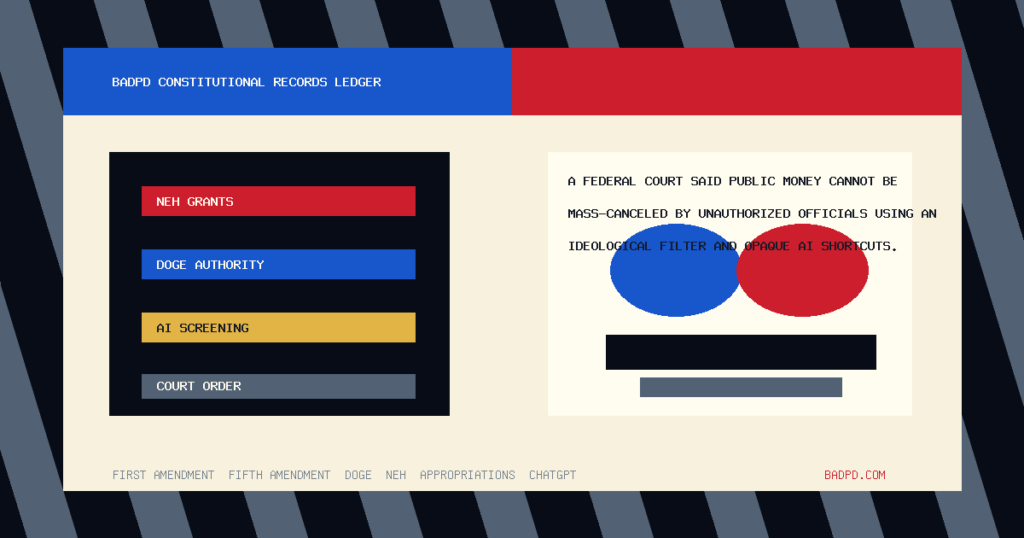
The primary receipt is the Southern District of New York opinion and order dated May 7, 2026. U.S. District Judge Colleen McMahon concluded that plaintiffs were entitled to judgment as a matter of law on claims that the government's mass termination of NEH grants violated the First Amendment, violated the equal-protection component of the Fifth Amendment, and was ultra vires because DOGE officials exercised decisive authority over selecting and terminating NEH grants without statutory authority.
That matters because it is not only a policy disagreement. The court did not simply say a federal agency made a messy administrative choice. The opinion treated the mass cancellation as constitutionally defective and beyond the legal authority of the officials driving it.
The opinion describes the mass termination as grant termination notices sent between April 1 and April 3, 2025. The public reporting and plaintiff statements describe the number of affected grants as more than 1,400 and the funding amount as more than $100 million in congressionally appropriated funds. The Authors Guild says the order required rescission of every termination notice and restoration of affected grants. Publishers Weekly similarly reported reinstatement of more than 1,400 NEH grants representing more than $100 million.
BadPD's framing is simple: if Congress appropriated money for a statutory grant program, and if awards were already made through the program, the executive branch cannot silently replace the legal process with a political spreadsheet and a chatbot prompt.
Why DOGE Authority Was Central
The court's ultra vires finding is the power-map part of the story. The opinion says DOGE officials, not the NEH chair or anyone else at NEH acting through the statutory process, exercised decisive authority over grant terminations. The opinion says DOGE had no statutory authority to terminate NEH grants.
That is not just legal vocabulary. It is a separation-of-powers warning. Federal programs may be inefficient, outdated, ideological, excellent, wasteful, or necessary. But when Congress creates a statutory process, officials have to use the legal process to change it. A cost-cutting office cannot simply grab the steering wheel and cancel grants because the political winds changed.
The Civil Rights Litigation Clearinghouse case page identifies the case as Authors Guild v. National Endowment for the Humanities, docket 1:25-cv-03923 in the Southern District of New York. It summarizes the challenge as a case over the Trump administration's April 2025 termination of more than 1,400 NEH grants. That docket context matters because the ruling did not arrive from nowhere. It followed litigation over whether the administration defunded projects because they did not align with its cultural and political ideology.
BadPD wants the authority chain attached in plain English. Who created the grant program? Congress. Who had statutory responsibilities inside NEH? The chairperson and National Council process. Who allegedly made the termination choices? DOGE officials, according to the court. That gap is the accountability story.
The First Amendment Lane
The court found a First Amendment violation. The opinion says the mass termination targeted grants based on viewpoints expressed in funded projects and characteristics associated with those viewpoints. It calls the case a textbook example of unconstitutional viewpoint discrimination.
The AP report hosted by the Free Speech Center at MTSU summarizes the ruling in public-facing terms: the judge said officials canceled grants based on DEI and violated the First Amendment and Fifth Amendment equal-protection right, and that DOGE lacked lawful authority. The AP report also says the judge permanently barred the administration from terminating the grants.
The First Amendment issue is not that the government must fund every idea forever. It does not. The issue is that once Congress establishes a grant program to support humanities work under statutory standards, government officials cannot allegedly use viewpoint-based filters to punish disfavored ideas after awards were made.
BadPD should keep that distinction clear. This article is not saying every grant was wise, necessary, or above criticism. It is saying the court found the termination method unconstitutional. The next public question is whether the government appealed, complied, delayed, or tried to recreate the same cuts through a different path.
The Fifth Amendment Lane
The court also found a violation of the equal-protection component of the Fifth Amendment. The opinion links that to targeting based on viewpoints and protected characteristics, including projects associated with diversity, equity, inclusion, race, gender, sexuality, and similar categories.
This lane needs careful language. BadPD should not turn the ruling into a protected-class attack or a lazy DEI culture-war slogan. The court's point was about government discrimination and constitutional constraints. The public question is whether officials used categories and viewpoints as disqualifiers in a program that Congress designed to support diverse humanities inquiry.
The MLA page summarizes the ruling as declaring the April 2025 terminations unlawful, unconstitutional, ultra vires, and without legal effect. It also says ACLS, AHA, and MLA continue to pursue appeal-related relief for NEH offices and programs. That means the grant-restoration piece and the agency-capacity piece are related but not identical. One court order can restore grants while another appellate lane continues over broader agency dismantling.
A good public ledger should not collapse those lanes. Grant terminations, office/program cuts, staff capacity, and future appropriations are separate questions. They all matter, but each needs its own records.
The ChatGPT / AI Screening Lane
The AI portion is the receipt that makes this more than a standard grant-law dispute. The court opinion describes DOGE official use of ChatGPT to generate DEI rationales. It says the official did not define DEI for ChatGPT, was unsure how ChatGPT understood the term, and did not ask ChatGPT to factor in purpose, methodology, or scholarly significance.
The opinion says ChatGPT-generated determinations were folded into spreadsheets used to identify grants for termination. It also notes that abbreviated grant descriptions involving history, culture, identity, Jewish thought, Chinese religious repression, and other subjects could be flagged under this review. The court criticized the government effort to distance itself from the AI output.
This matters far beyond NEH. If agencies use AI to screen public benefits, grants, contracts, immigration files, criminal-risk flags, welfare eligibility, school discipline, or police records, the public deserves to know the prompt, data source, review process, human approver, audit trail, error rate, appeal path, and legal authority. A chatbot cannot become a secret constitutional filter.
BadPD's position is not anti-AI. AI can help organize records and speed research. But using AI to help terminate congressionally approved grants based on undefined ideological criteria is a public-accountability alarm. The tool is not the decision-maker. Humans are. Humans must own the criteria, preserve the prompt, and answer for the result.
What Plaintiffs Say Was Restored
The Authors Guild statement calls the ruling a complete victory and says the court ordered reinstatement of every NEH grant terminated by DOGE. It says the court certified the Authors Guild lawsuit as a class action covering approximately 1,400 affected grantees. It also says the ruling held that the mass cancellation violated the First Amendment and Fifth Amendment and was carried out without statutory authority.
The MLA page and plaintiff-organization statements emphasize the larger humanities infrastructure: scholars, students, colleges, universities, associations, state humanities councils, libraries, and local organizations in all 50 states. That is the public-service angle. These grants are not only elite-campus line items. Some fund archives, local history, public humanities programs, libraries, museums, research, preservation, and work that local communities may never replace if the money disappears.
That does not mean every grant should be immune from criticism. It means the criticism and any cancellation have to go through lawful channels, with reasons, records, and appeal rights. The public should be able to inspect grants, debate priorities, and demand accountability without letting an unauthorized process destroy the file.
What Is Confirmed, Alleged, Pending, Disputed
Confirmed by court record: The May 7, 2026 SDNY opinion found the mass termination of NEH grants violated the First Amendment, violated the equal-protection component of the Fifth Amendment, and was ultra vires because DOGE officials exercised decisive authority without statutory authority. The opinion describes ChatGPT use in the termination process and criticizes the lack of defined criteria.
Confirmed by plaintiff and reporting source mix: Authors Guild, MLA, AP/Free Speech Center, Civil Rights Litigation Clearinghouse, and Publishers Weekly all describe more than 1,400 affected grants and more than $100 million in funds. The Authors Guild says the order required rescission of termination notices and restoration of affected grants.
Government position as reported: AP reported government lawyers argued the cuts were lawful efforts to implement Trump administration directives, eliminate grants associated with DEI, and reduce discretionary spending. Reporting at publication time said it was not immediately clear whether an appeal was planned. Other reporting after publication may update that lane and should be checked before a follow-up.
Pending: government compliance proof, any appeal notices or stays, updated docket entries, restoration timeline, individual grantee payment status, NEH staffing/program capacity, whether termination letters were actually rescinded, and whether affected state or local humanities councils received funds.
Not proven by this article: This article does not prove every individual grant was valuable. It does not prove every plaintiff suffered the same harm. It does not prove final appellate outcome. It proves the old BadPD page was too thin and that the public record supports a serious constitutional-accountability ledger.
Records BadPD Wants Next
BadPD should download and archive the full SDNY docket entries for Authors Guild v. National Endowment for the Humanities and the related ACLS/AHA/MLA action. Priority records are the complaint, summary-judgment briefs, Local Rule 56.1 statements, deposition excerpts for DOGE officials, exhibits showing AI prompts or spreadsheets, the permanent-injunction text, judgment, any notice of appeal, and any stay motion.
BadPD should request or locate NEH compliance records showing which grants were restored, when notices were rescinded, whether payments restarted, whether grantees received arrears, and whether any grant remained blocked for a separate lawful reason.
BadPD should request the AI governance trail: prompts used, model version if recorded, grant descriptions submitted, human-review rubric, spreadsheet fields, decision authority, audit logs, and who approved final termination lists. If the government claims privilege or exemption, it should cite it and release segregable material.
BadPD should also create a state-by-state and local-impact follow-up. If more than 1,400 grants were affected, readers need to know which state councils, libraries, museums, public-history projects, writers, archives, and local programs were disrupted. That turns a national court story into a useful public-service map.
Compliance Is The Next Story
A court victory is not the same thing as restored money in a grantee's account. The next BadPD update should track compliance in concrete terms. Did NEH send rescission letters to every grantee whose termination notice was unlawful? Did the agency restore project periods or deadlines? Did it pay funds that were delayed? Did any grantee lose staff, matching funds, event space, research travel, publication windows, or partner commitments because the funds were cut off for more than a year?
Those details matter because public agencies can technically comply while leaving people functionally harmed. A grant restored on paper after the project window has collapsed is not the same as a grant restored in time to do the work Congress funded. If the government appeals, seeks a stay, or narrows compliance, that should be tracked against the court order and against each class of affected grantees.
BadPD should also ask whether NEH published a central compliance page. A central page should list affected grant numbers, current status, restored amount, project period, agency contact, and whether grantees must take any action. If no public page exists, that absence is itself a transparency problem.
Local Impact: Why This Is Not Abstract
The plaintiff sources emphasize that the affected work touched all 50 states. That is why this belongs in the same BadPD ecosystem as property-tax help, civil-rights resources, recall ledgers, and local police records. Federal grant decisions can look abstract from Washington, but the disruption lands locally: a library cancels programming, a museum pauses an exhibit, an archive loses digitization staff, a scholar drops a project, a state humanities council loses capacity, or a local history program misses a public deadline.
BadPD should build a follow-up table by state with grant title, recipient, city, original amount, termination date, restoration status, local partner, and public value. That table would help readers see whether their own community lost access to history, archives, literacy programming, museum work, tribal/community records, or public education projects.
This does not require readers to agree with every project. It requires the government to show the record. If public money was awarded through a lawful process, then canceled through an unlawful process, residents deserve to know who was hit and whether the fix actually fixed the harm.
Oversight Questions For Congress And Inspectors General
The opinion's DOGE findings should trigger oversight questions beyond NEH. Who authorized DOGE personnel to direct or effectively direct grant terminations? What written delegation, if any, existed? Which agencies used similar processes? Were other grant programs screened through ChatGPT or similar tools? Were prompts preserved? Were outputs reviewed by subject-matter experts? Were rejected projects given appeal rights or explanations?
Congressional appropriations power is not a paperwork detail. It is one of the checks that prevents public money from being redirected by informal actors. If an office outside a statutory agency can mass-cancel grants without legal authority, the same pattern could be attempted in education, housing, health, research, civil-rights enforcement, disaster recovery, or public-safety grants.
BadPD should ask inspectors general to preserve emails, spreadsheets, prompts, model outputs, Teams/Slack messages, meeting notes, and directives tied to DOGE grant reviews. If officials used personal devices, outside accounts, or temporary workspaces, those records should still be identified and preserved under federal records rules.
The AI Rule BadPD Will Apply
BadPD is going to treat AI-in-government stories under a simple records rule: no secret prompts for public power. If AI contributes to a government decision that affects money, liberty, safety, benefits, immigration status, licensing, public employment, education, or criminal enforcement, the public needs an audit trail.
That audit trail should include the model or system used, the data entered, the exact prompt or rubric, the human reviewer, the final decision authority, the appeal process, and the error-correction path. If the government says the tool was only advisory, then the record should show who made the final decision and how they evaluated the tool's output.
The NEH ruling is therefore a warning label for every future AI shortcut. AI can summarize. AI can triage. AI can help people read large records. But it cannot become the unreviewed constitutional filter between a lawful grant and a termination letter.
Why This Rebuild Matters
A 213-word noindex page does not serve readers or search quality. A source-backed ledger does. This article now gives readers the court document, the plaintiffs' explanation, the docket context, the AP summary, and the industry cross-check. It also marks the records still owed.
The broader BadPD rule is the same whether the actor is a police department, a governor, a school district, a federal grant agency, or DOGE: public power needs public proof. If officials use public money and public authority, they must show the legal basis, the criteria, the record, and the accountability path.
The next update should not be another one-paragraph outrage post. It should be compliance: did the government restore the grants, did anyone appeal, did the AI records become public, and did affected local programs survive the disruption?
Source Trail
- Southern District of New York 143-page opinion and order (May 7, 2026; archived June 22, 2026) – Primary court record finding the NEH mass grant terminations violated the First Amendment, Fifth Amendment equal-protection component, and were ultra vires because DOGE had no statutory authority.
- Authors Guild plaintiff statement (May 7, 2026; archived June 22, 2026) – Plaintiff-side receipt describing reinstatement order, class certification for approximately 1,400 affected grantees, and the relief ordered.
- Civil Rights Litigation Clearinghouse case page (accessed June 22, 2026) – Docket-context source identifying Authors Guild v. National Endowment for the Humanities, case 1:25-cv-03923, and summarizing claims over mass termination of NEH grants.
- Modern Language Association lawsuit page (updated May 2026; archived June 22, 2026) – Plaintiff-organization source summarizing ACLS/AHA/MLA litigation, restoration fight, and appeal lane for NEH offices and programs.
- AP report via Free Speech Center at MTSU (May 8, 2026; archived June 22, 2026) – Accessible AP report summarizing the ruling, more than $100 million in grants, DOGE authority, AI-use criticism, and uncertain appeal posture at publication time.
- Publishers Weekly industry report (May 2026; archived June 22, 2026) – Publishing-industry source cross-checking the reinstatement order, 1,400-plus grants, and more than $100 million in congressionally appropriated funds.
Send receipts for the desk to research
Send corrections, missing records, police-accountability tips, good-cop public-service receipts, government/court/war leads, recall alerts, or property-tax help resources. Tips are leads only until BadPD verifies records.
Links, dates, agency names, docket numbers, bodycam IDs, recall numbers, forms, and official pages.
Every tip is a lead, not a fact. The desk checks records before publishing.
Use advertising inquiry when you want clearly labeled sponsor space or available ad placements on BadPD.