ABC Trading Toy Recall Puts Accessible Button Batteries Back In The Child-Safety Lane
4 sources
2,232 words
Pass
News Anchor voice
Ready when you are.
Status, June 30 update: existing BadPD article updated from the official CPSC recall file and related button-battery safety records. CPSC recall number 26-497 covers about 84,700 ABC Trading children’s toys because the button-cell battery compartments can be accessed by children, creating a risk of serious injury or death from battery ingestion.
This is public-safety recall reporting, not medical, legal, product-use, refund, import, retail, or certification advice. The official CPSC notice controls product-specific instructions. BadPD is updating this post because the prior article was already live, and the correct action is to improve the existing package rather than publish a duplicate.
What CPSC Confirmed
CPSC says ABC Trading recalled three children’s toy lines: Toy Headbands, model 6300RP; Electronic Pet Cage-Dinosaur Tribes, model 8266 (ZH998-22); and My Pet Bird Cute Bird Tribes, model ZH998-23. The agency says the products contain button-cell batteries and that the battery compartments can be easily accessed by children.
The hazard statement is direct. If a child accesses and swallows a button-cell battery, the battery can cause serious injuries, internal chemical burns, or death. CPSC says the recalled toys violate the mandatory toy standard. That makes this a compliance and notification problem, not just a household cleanup reminder.
CPSC reports no incidents or injuries in the notice. That status must stay attached to the article. The absence of reported injuries does not make the recall low value, but it does limit what can be claimed. BadPD is not alleging a child injury from these toys; it is preserving the official record that CPSC says the products violate the toy standard and create a serious ingestion hazard.
Products, Stores, And Sale Window
The Toy Headbands are described as plastic headbands with a pink bow with white polka dots and a small push button on top of the bow to activate lights. The Electronic Pet Cage-Dinosaur Tribes product is described as a silver plastic cage with a blue bottom containing a red dinosaur and a yellow egg. The My Pet Bird Cute Bird Tribes product is described as a plastic cage with a pink top and bottom containing a blue bird.
CPSC says the recalled toys were sold at TOYZ and Joissu Product stores nationwide from November 2022 through October 2025 for between $5 and $9. The importer is ABC Trading Inc. of Vernon, California. The products were manufactured in China.
That long sale window is why store-level recall proof matters. A product sold from late 2022 into late 2025 can sit in toy bins, closets, party supplies, resale boxes, or gift piles long after the retail visit is forgotten. For this kind of recall, public notice is useful, but retailer pull records and customer-facing store notices are the receipts that show the warning reached beyond an agency page.
Remedy And Contact Path
CPSC says consumers should stop using the recalled toys immediately, remove the button-cell batteries, dispose of or recycle the batteries under local hazardous-waste procedures, and dispose of the toys. The notice says consumers should email a photo of the disposed toy in the trash to recallabc@gmail.com to receive a full refund of the retail price.
The notice lists ABC Trading’s phone contact as 323-581-3688, Monday through Friday, 9:30 a.m. to 6 p.m. Pacific time. BadPD is not giving refund advice; the source point is that the recall remedy depends on consumers recognizing specific products and completing the photo/refund path.
For families, caregivers, schools, child-care providers, churches, thrift shops, and resale sellers, the useful records are product photos, model names, model numbers, store purchase records if available, disposal proof, and any refund correspondence. For retailers and importers, the useful records are stop-sale notices, inventory pull counts, customer notice scripts, refund counts, and any certification or testing records tied to the toy standard.
Why Button Batteries Get A Separate Accountability Lane
CPSC’s button-cell and coin-battery safety materials explain why these recalls are treated as high consequence. Button or coin batteries can lodge in a child’s body and cause severe internal injuries. Federal requirements under Reese’s Law and related rules focus on child-resistant battery compartments, warning labels, and packaging because the hazard can be severe before an adult realizes what happened.
The ABC Trading recall is different from a warning about a toy that simply breaks. CPSC says children can access the battery compartment. That is the point the public needs to test against product records: who designed the battery compartment, who tested it, who certified the product, who imported it, who stocked it, and who made sure affected units were pulled after the recall?
The eCFR regulatory text and CPSC business guidance are used here as context, not as an independent legal finding about ABC Trading beyond the recall notice. The confirmed finding in this package is narrower: CPSC says these recalled toys violate the mandatory toy standard and pose a serious ingestion risk.
Why A Store Pull Record Matters
A recall notice is only the start of the public-safety trail. The harder question is whether the notice reached the places where the toys were sold, stored, gifted, resold, or used. CPSC identified TOYZ and Joissu Product stores as the retail channel in the recall notice. The next accountability layer is the store file: when each location received the warning, when any remaining units were pulled from shelves, whether point-of-sale systems blocked later sales, and whether employees had clear instructions for customers who came back with recalled toys.
This matters because the recall covers a low-cost children’s product. A $5 to $9 toy may not come with durable purchase records in a household. Buyers may not remember the exact store. Toys may move through birthday parties, classrooms, church events, child-care rooms, yard sales, resale bins, or donations. The lower the price and the longer the sale window, the more important it is for retailers and importers to keep practical records that show how many units were sold, how many remained in stock, and how the warning was pushed beyond the first press release.
A complete store record would not need to prove injury. It would need to prove effort. That means dated stop-sale notices, register-block screenshots or logs, inventory counts, employee communications, customer-facing recall signs, refund instructions, and proof that any returned or disposed products were handled under the recall path. Those records are useful to the public because they move the recall from a paper notice to a real-world safety operation.
Records A Complete Recall File Should Show
The official CPSC notice gives the public enough information to identify the recall, but it does not answer every operational question. A fuller file should show the importer and retail chain of custody. It should identify purchase orders, shipment batches, distribution dates, stores that received the affected toys, and any remaining inventory after the recall was announced. If the product was sold nationwide through named stores, the public record should be able to show whether the recall response was nationwide too.
The testing and certification file is also important. CPSC says the products violate the mandatory toy standard because the button-cell battery compartments can be accessed by children. That raises basic compliance questions: what pre-sale testing was done, which standard was tested against, who held the children’s product certificate, who reviewed the battery compartment design, and whether any later inspection found the same hazard in related products. BadPD is not making a separate legal conclusion from those questions. The point is that those are the documents that would confirm how the failure passed through the import and retail pipeline.
The refund file matters as well. CPSC describes a photo-based refund path: consumers dispose of the toy and send a photo to the recall email address. That kind of remedy depends on clear intake records. A useful corrective-action record would track how many people contacted the company, how many refund requests were completed, whether any emails bounced or went unanswered, whether non-English notices were needed, and whether consumers reported finding the same models after the recall date. Those are the practical receipts that separate a live recall from a notice that slowly disappears from view.
What Families And Resellers Need To Match
The safest public-facing approach is to match the product against the official CPSC notice rather than against memory alone. The notice names the product lines, model numbers, seller window, importer, and remedy. Families and caregivers should use the official notice to compare the toy description and model details. Resellers, thrift shops, donation centers, school supply rooms, party organizers, and child-care providers should be especially cautious about cheap electronic toys that may have moved through several hands after purchase.
For recordkeeping, the useful facts are simple: the toy name, model number if visible, where it was found, whether the battery was removed, when the disposal photo was sent if a refund was requested, and any response from the firm. Those notes are not a substitute for CPSC instructions. They are a way to avoid losing track of an item that was already identified as part of a serious child-safety recall.
The same caution applies to online or local resale listings. This source set does not prove that recalled units are currently being resold. It does show that about 84,700 units were distributed through a long sale window. Any resale platform, seller, or donation handler that encounters matching products should check the official recall notice and keep records of removal. The public interest is straightforward: recalled toys with accessible button-cell batteries should not keep cycling through the secondhand market after the hazard is public.
Compliance Questions For Importers And Retailers
For importers, the public question is not whether a press release exists. It is whether the importer can document the decisions that happened before and after the recall. Before the recall, the file should show product testing, supplier controls, certificates, and design review. After the recall, it should show corrective action, retailer notification, consumer outreach, refund processing, and disposal instructions. If those records exist, they make the safety response easier to audit. If they do not exist, the public is left relying on a single notice with little proof of follow-through.
For retailers, the key question is whether safety information moved fast enough from the importer and CPSC to the store floor. A store can do more than remove stock. It can train staff, post notices, keep customer-service scripts, preserve return/refund logs, and review whether similar button-battery toys remain on shelves. Those steps are not extra paperwork for its own sake. They are how a recall reaches people who bought small children’s products months or years earlier.
For regulators and lawmakers, the recall is another reminder that button batteries deserve a durable public ledger. When a battery compartment is accessible to a child, the risk can be severe and time-sensitive. Public records should make it easier to see which firms repeatedly appear in button-battery recalls, which retailers carry affected products, whether corrective actions are completed, and whether consumer warnings are reaching families before a child is harmed.
Confirmed, Pending, Not Established
Confirmed by CPSC
- CPSC recall number 26-497 was posted May 21, 2026.
- The recall covers about 84,700 ABC Trading toy headbands and electronic pet-cage toys.
- The named products are Toy Headbands model 6300RP, Electronic Pet Cage-Dinosaur Tribes model 8266 (ZH998-22), and My Pet Bird Cute Bird Tribes model ZH998-23.
- CPSC says the toys contain button-cell batteries and that the battery compartments can be easily accessed by children.
- CPSC says the products violate the mandatory toy standard.
- CPSC reports no incidents or injuries in the recall notice.
- CPSC lists TOYZ and Joissu Product stores nationwide as sellers from November 2022 through October 2025.
Pending records
- Store-level stop-sale, register-block, and inventory pull proof.
- Customer notification records from TOYZ, Joissu Product, ABC Trading, and any distributors.
- Refund completion counts and disposed-product photo counts.
- Testing, certification, import, and children’s product certificate records.
- Any later CPSC incident update, enforcement record, civil penalty record, or corrective-action update.
Not established by this source set
- That any child has been injured by these specific recalled toys.
- That every ABC Trading toy is affected; the source set concerns the named models.
- That TOYZ, Joissu Product, ABC Trading, or any distributor knowingly sold noncompliant products after notice.
- That every affected unit remains in circulation.
- That every buyer has received or completed the refund remedy.
BadPD Bottom Line
This recall belongs in the child-safety accountability lane because the hazard is severe, the products are toys, the sale window is long, and CPSC says the battery compartments can be accessed by children. The next public records should show how the warning moved from CPSC’s website to actual store shelves, customers, caregivers, and refund records.
BadPD will update this package if CPSC posts enforcement records, incident updates, refund data, store-pull evidence, or additional related recalls involving ABC Trading, the named sellers, or the same product models.
Source Ledger
- CPSC, ABC Trading children's toys recall 26-497, May 21, 2026
- CPSC, button cell and coin battery business guidance, accessed June 30, 2026
- CPSC, button cell and coin battery safety center, accessed June 30, 2026
- eCFR, 16 CFR Part 1263, button cell or coin battery consumer products, accessed June 30, 2026
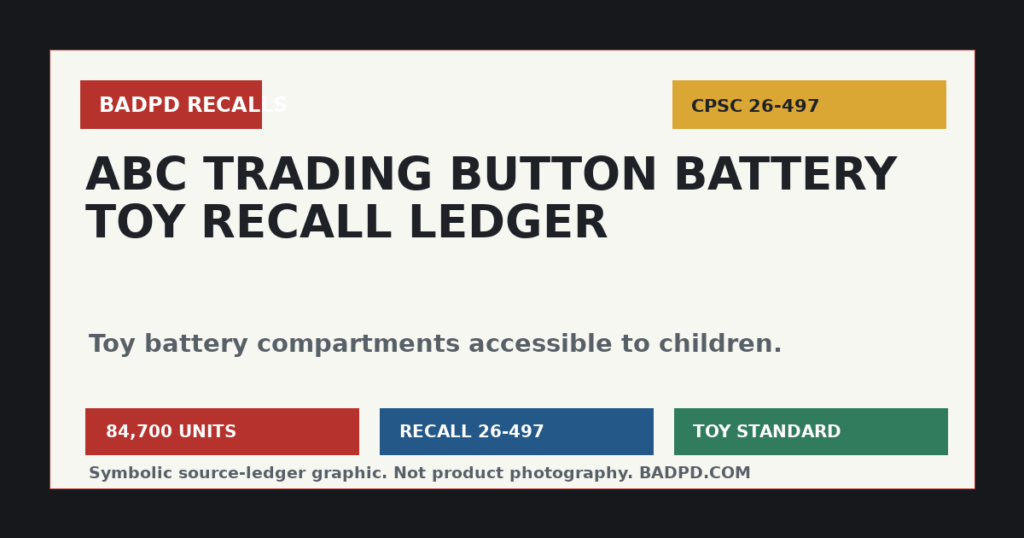
Featured image is symbolic editorial artwork created for BadPD. It is not CPSC, ABC Trading, retailer, toy, battery, child, injury, medical, refund, store, testing, certification, or product photography and is not a depiction of any specific recalled unit.
Send receipts for the desk to research
Send corrections, missing records, police-accountability tips, good-cop public-service receipts, government/court/war leads, recall alerts, or property-tax help resources. Tips are leads only until BadPD verifies records.
Links, dates, agency names, docket numbers, bodycam IDs, recall numbers, forms, and official pages.
Every tip is a lead, not a fact. The desk checks records before publishing.
Use advertising inquiry when you want clearly labeled sponsor space or available ad placements on BadPD.