
Tomball ISD Property-Tax Fraud Charge Raises Cash-Control Questions After $996K Allegation
Document Desk voice
Ready when you are.
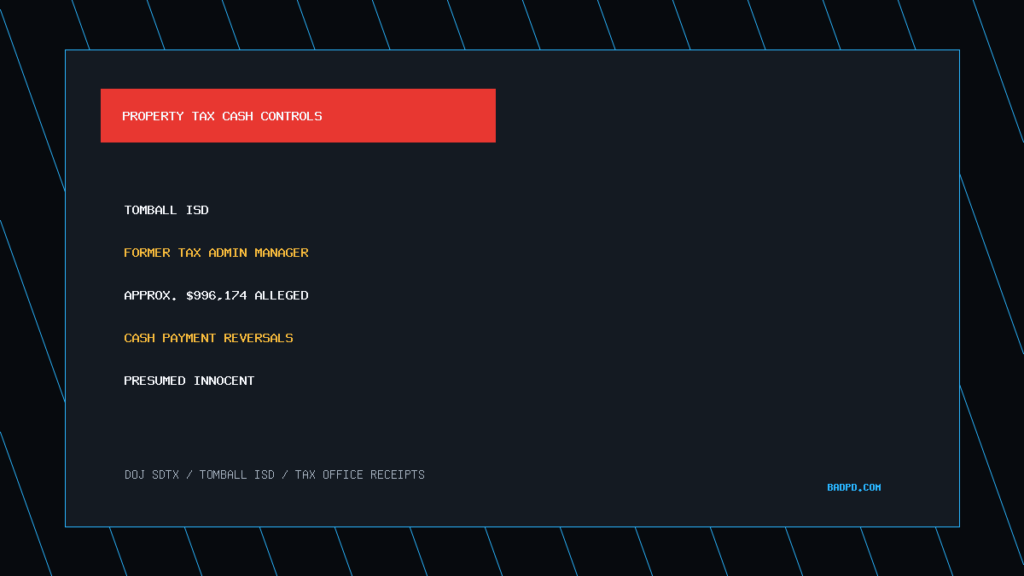
BadPD source-check, July 4, 2026: the U.S. Attorney’s Office for the Southern District of Texas says a former Tomball Independent School District property-tax administration manager has been charged with wire fraud after allegedly stealing approximately $996,174 from the district. This article is a charge-stage accountability brief. Kristi Williams is presumed innocent unless and until proven guilty through due process of law.
The reason this belongs on BadPD is not only the dollar amount. The alleged scheme sits inside the property-tax payment process, the same place where homeowners are told to trust public offices, payment software, receipts, batches, deposits, and tax-office staff. If a taxpayer walks in with cash and the internal control system can allegedly be reversed by one manager until nearly $1 million is gone, the public deserves a hard look at the cash-handling controls, audit trail, software permissions, deposit reconciliation, and board oversight.
What DOJ Says Was Charged
The DOJ release, dated Friday, July 3, 2026, says a 50-year-old Tomball resident was charged with wire fraud after allegedly stealing approximately $996,174 from Tomball ISD. The release identifies the defendant as Kristi Williams and says she is set to make an initial appearance before U.S. Magistrate Judge Richard W. Bennett on July 13 at 10 a.m.
According to DOJ’s description of the criminal information, Williams was manager of Property Tax Administration at Tomball ISD from January 2018 until November 2023. DOJ says she oversaw collection of local property taxes. The alleged mechanism is specific: when a taxpayer paid in cash, an employee would place the cash in an envelope and record the payment in specialized software as part of a batch. When the cash batch hit a certain threshold, either $15,000 or $20,000, the batch was closed and Williams was expected to deposit the money into Tomball ISD bank accounts. DOJ alleges Williams used the software to reverse payments and kept the money for personal use.
If convicted, Williams faces up to 20 years in federal prison and a possible $250,000 maximum fine. DOJ says the FBI conducted the investigation and Assistant U.S. Attorney John Lewis is prosecuting. DOJ also states the necessary legal guardrail: a criminal information is a formal accusation, not evidence, and a defendant is presumed innocent unless convicted through due process.
Why Property-Tax Cash Controls Matter
Property taxes are not voluntary tips. They are government bills backed by penalties, interest, liens, and foreclosure consequences. A homeowner who pays should not have to wonder whether the public-office system can quietly reverse a cash payment after the money leaves their hands. If a system allows that to happen without immediate independent reconciliation, the issue is not only the alleged defendant. It is the control environment.
Tomball ISD’s own tax office page shows multiple payment methods: online credit card or e-check, phone payments, mail payments, and a drop box. The district says the drop box is for checks only, no cash. The page lists a payment portal and says tax payments can be made through the tax payments website. The public-facing system therefore already recognizes that payment method matters. Cash carries different custody risks than e-checks or card transactions because physical money must be counted, batched, secured, deposited, and matched to software records.
BadPD’s question is simple: what independent control stopped one person from both controlling the software reversal path and benefiting from cash before bank deposit? In a public tax office, the answer should be more than trust.
This Is Also A Homeowner-Records Story
The federal allegation is about district money, but homeowners are the people who need clean records first. A property-tax payment is not just a receipt. It is proof that a homeowner stayed current with a government bill that can affect escrow records, mortgage servicing, penalties, interest, title work, and tax-sale risk. If a cash payment was recorded and then reversed, the public needs to know whether that reversal only affected district accounting or whether any taxpayer account ever showed a bad balance because of it.
That is why Tomball ISD should make the taxpayer-facing cleanup plain. The district should tell residents whether account histories were reviewed, whether any taxpayer was ever marked unpaid because of a payment that was later reversed, whether any penalty or interest was corrected, whether notices went out, and whether people who paid in cash have a simple way to request their ledger history. The answer may be that no taxpayer accounts were harmed. If so, the district should show the audit trail that proves it.
Controls That Should Be Visible
BadPD is looking for basic controls that any public office handling cash should be able to explain in ordinary language. Who can reverse a tax-office payment? Can the same person receive cash, close a batch, change the software record, and prepare the deposit? Does every reversal require a second approval? Are reversal reports reviewed daily by someone outside the tax office? Are bank deposits matched to each closed batch by amount, date, and employee ID? Does the software keep immutable logs, or can records be changed without a visible exception report?
None of those questions require the district to prejudice the criminal case. They are governance questions. They ask whether taxpayer money was protected by process, not personality. A school district can support prosecutors, respect the defendant’s legal rights, and still tell taxpayers what controls have been strengthened since the alleged conduct period ended in November 2023.
The Financial-Excellence Claim Now Needs A Control Footnote
Tomball ISD’s October 2025 finance department release says the district had demonstrated exceptional financial stewardship, earned statewide and national recognition, and maintained high standards of fiscal responsibility. The release says the Finance Department includes payroll, accounts payable, purchasing, accounting, benefits, federal programs, the tax office, budget, risk management, and textbooks. It also quotes district leadership emphasizing transparency, accountability, and taxpayer dollars being used wisely.
Those claims may be true in many areas. Awards, reports, bond ratings, and financial staff certifications can matter. But the DOJ charge now adds a specific, source-backed question to the public file: did the district’s award-winning financial-control environment detect and prevent cash-payment reversal abuse fast enough? If the alleged conduct ran for years, the district should explain what controls existed, when red flags appeared, who reviewed reversed cash payments, and what has changed.
BadPD is not saying the awards were fake. We are saying awards are not the same thing as cash-control proof. A district can have clean-looking reporting and still have a weak point inside a manual cash process. Taxpayers deserve both: good financial reports and transaction-level controls strong enough to catch a missing cash deposit before the loss approaches seven figures.
Confirmed, Alleged, Pending, Disputed
Confirmed: DOJ Southern District of Texas published a July 3, 2026 press release announcing a wire-fraud charge. The release names Kristi Williams, Tomball ISD, the alleged approximate amount of $996,174, the property-tax administration role, the January 2018 to November 2023 employment window, the July 13 initial appearance date, the FBI investigation, and the maximum possible statutory penalties.
Confirmed from district sources: Tomball ISD operates a tax office, a public property-tax payment portal, and multiple tax-payment methods. The district’s official tax page says online card/e-check payments can be made through the tax payments website, phone payments can be made through a jurisdiction code, mail payments go to the Tomball ISD Tax Office, and the drop box is for checks only, no cash. Tomball ISD also publishes financial reports, investment reports, and tax-rate visualization materials.
Alleged: the theft, the use of payment software to reverse cash payments, and the keeping of funds for personal use are allegations from the criminal information as summarized by DOJ. They are not findings of guilt. Williams is presumed innocent unless convicted.
Pending: the criminal information or docket attachments, initial appearance, plea or trial posture, defense response, audit findings, insurance recovery, restitution record, district internal investigation, software-access logs, cash-batch reversal logs, deposit reconciliation records, board briefings, taxpayer notification, and any changes to district payment controls after November 2023.
Disputed or limited: BadPD has not located a public defense statement in the source trail used here. The DOJ release does not prove every operational failure BadPD is asking about. It gives enough to ask the control questions, not enough to declare every missing answer.
Records BadPD Wants
BadPD wants the criminal information, docket entries, any indictment or superseding filings, Tomball ISD internal audit records, cash-payment reversal reports from 2018 through 2023, deposit-batch records, bank reconciliation reports, tax-office software permissions, user-access logs, exception reports, insurance claims, restitution calculations, termination or separation records, board agenda items discussing suspicious financial activity, and any report the district provided to federal investigators.
We also want public-facing taxpayer records: whether affected taxpayers received corrected receipts or account notices, whether any property-tax account showed a reversal that could have affected delinquency status, whether penalties or interest were ever triggered because of a reversed payment, and whether homeowners were told how to verify their payment history.
What Tomball Taxpayers Can Check Now
If you paid Tomball ISD property taxes in cash between 2018 and 2023, do not assume this article proves your account was affected. Instead, use it as a reason to verify records. Check your payment history through the official Tomball ISD Tax Office portal or contact the tax office. Save receipts, account screenshots, cash-payment proof, envelopes, bank withdrawal records, and any notices related to reversals, delinquency, penalties, or corrected balances.
If you see a discrepancy, document it before making accusations online. Ask the district for the payment history, batch history if available, receipt record, and any reversal record attached to your account. If a public-records route is needed, ask for records by date range, account number, payment type, payment amount, reversal date, user ID, and deposit batch.
The Accountability Standard
BadPD’s standard is not complicated: every public tax office that accepts cash needs independent checks strong enough to stop a single employee from reversing payments and pocketing money. A manager should not be able to approve, reverse, conceal, and personally benefit from cash without a separate control catching it quickly. Reversals should be reviewed by someone outside the cash custody chain. Cash batches should match bank deposits. Exceptions should be logged. Large reversal patterns should trigger audit alerts.
The district does not have to litigate the criminal case in the press. It does have to answer operational questions. Were cash payments still accepted after the alleged problem was discovered? Were software permissions changed? Were daily deposits reconciled differently? Were taxpayers notified to check their accounts? Was the board briefed in public or closed session? Was insurance notified? Were audit procedures changed? Those are public governance questions even while the criminal case proceeds.
The bottom line: DOJ has alleged a nearly $1 million property-tax cash fraud inside a school district tax office. The defendant is presumed innocent. The public still deserves the records that show how cash moved, how software reversals were controlled, how the district caught the problem, and what has changed to protect taxpayers now.
Source Trail
- DOJ Southern District of Texas press release (July 3, 2026) – Official charge announcement identifying Kristi Williams, Tomball ISD, alleged $996,174 theft, property-tax role, cash-payment reversal method, initial appearance date, possible penalties, and presumption of innocence.
- Tomball ISD Tax Office payment methods (Accessed July 4, 2026) – Official district page showing tax office payment routes, online/phone/mail/drop-box options, and no-cash drop-box policy.
- Tomball ISD Tax Office payment portal (Accessed July 4, 2026) – Official tax office portal identifying Tomball ISD Tax Office and property-tax search/payment functions.
- Tomball ISD financial reports page (Accessed July 4, 2026) – Official district financial transparency page listing monthly financial reports, investment reports, staff salary/FTE counts, and tax-rate visualization.
- Tomball ISD finance department recognition release (October 17, 2025) – Official district release describing the finance department, tax office role, operational volume, awards, bond ratings, and accountability/transparency claims.
Send receipts for the desk to research
Send corrections, missing records, police-accountability tips, good-cop public-service receipts, government/court/war leads, recall alerts, or property-tax help resources. Tips are leads only until BadPD verifies records.
Links, dates, agency names, docket numbers, bodycam IDs, recall numbers, forms, and official pages.
Every tip is a lead, not a fact. The desk checks records before publishing.
Use advertising inquiry when you want clearly labeled sponsor space or available ad placements on BadPD.