
Arizona Tax Refund Fraud Plea: Regina Durkin $7.7M IRS Credit Case
Document Desk voice
Ready when you are.
Status, July 1 source check: source-cleared for a tax-fraud, pandemic-relief, courts, and government-accountability ledger. The controlling case source is the U.S. Department of Justice Office of Public Affairs release dated June 26, 2026, which says Regina Durkin of New River, Arizona pleaded guilty to one count of conspiracy to file false claims.
DOJ says Durkin and others conspired to defraud the United States by submitting false quarterly employment tax returns to the IRS. DOJ says the refund claims were based on the Employee Retention Credit and the paid sick and family leave credit, pandemic-era credits intended to aid struggling businesses. DOJ says the companies were not in operation at the time, had no employees, and paid no wages.
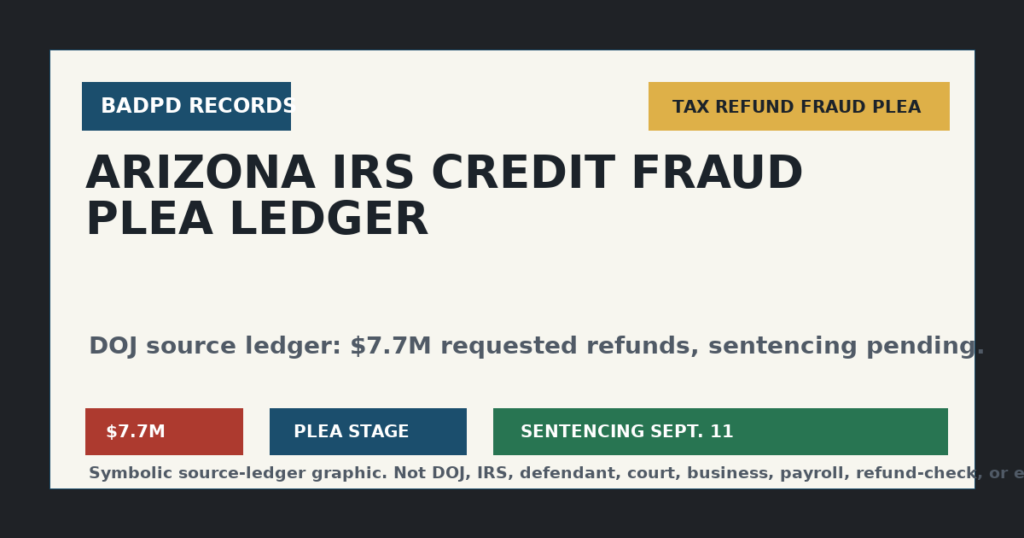
The amount matters. DOJ says Durkin and others submitted fourteen fraudulent claims to the IRS that requested over $7.7 million in tax refunds. That is taxpayer money. It is not a paperwork dispute in the abstract. A false claim against a relief program can pull resources away from legitimate businesses, add enforcement costs, slow reviews for compliant filers, and increase pressure on taxpayers who have to prove they were eligible.
Durkin is scheduled to be sentenced on September 11, 2026. DOJ says she faces a maximum penalty of ten years in prison. That is a statutory maximum, not a prediction of the sentence. A federal district judge will decide any sentence after considering the sentencing guidelines and statutory factors.
What DOJ Confirms
- Regina Durkin, of New River, Arizona, pleaded guilty to one count of conspiracy to file false claims.
- DOJ says Durkin and others conspired to defraud the United States by submitting false quarterly employment tax returns to the IRS.
- DOJ says the claims sought refunds based on the Employee Retention Credit and the paid sick and family leave credit.
- DOJ says the companies tied to the claims were not in operation, had no employees, and paid no wages.
- DOJ says fourteen fraudulent claims requested over $7.7 million in tax refunds.
- DOJ says sentencing is scheduled for September 11, 2026.
- DOJ identifies IRS Criminal Investigation as the investigating agency.
- DOJ release number is 26-704.
Pending Records
- Final sentence.
- Final judgment.
- Restitution amount, if ordered.
- Collection, forfeiture, or recovery records.
- Public records identifying the other alleged participants, if any are charged or resolved separately.
- Whether any claims were paid, blocked, recovered, or credited back before sentencing.
- Any appeals, post-judgment motions, or later case updates.
Not Established
- That Durkin has already been sentenced.
- That all money requested was paid out.
- That all money, if any was paid, has been recovered.
- That every co-conspirator has been named publicly.
- That every ERC or paid-leave-credit claimant is suspect.
- That businesses with legitimate eligibility problems should ignore IRS correction or withdrawal guidance.
Why This Belongs On BadPD
Pandemic-relief fraud is a public-accountability story because the programs were designed to move money quickly during an emergency. Quick relief creates a permanent enforcement tradeoff. The government can move fast and accept some risk, or move slowly and leave eligible people and businesses waiting. When false claims exploit those channels, the public needs more than a press-release headline. It needs to know the exact benefit program, the source status, the next court date, the missing recovery records, and the difference between a pleaded scheme and a completed restitution ledger.
The IRS Employee Retention Credit page says the ERC is complex and requires careful review before applying. It warns employers to be wary of advertisements telling them to apply for money when they may not qualify. It says anyone who incorrectly claims the credit may have to pay it back and may owe penalties and interest. That context matters because the Durkin release says the refund claims were based on ERC and paid-leave credits.
The IRS ERC FAQ says not every business is eligible and that eligibility depends on specific facts and circumstances. It also lists ERC scam tactics, including aggressive claims that a business qualifies before any discussion of its tax situation and pressure based on claims that every business qualifies. The same page says people can report tax-related illegal activity involving ERC claims, improper or abusive tax schemes, and preparers who deliberately prepare improper returns.
The IRS eligibility checklist says ERC applied to employers that kept paying employees during qualifying COVID-19 pandemic periods, including businesses affected by government orders, businesses with required gross-receipt declines during certain periods, or recovery startup businesses meeting specific limits. The same checklist begins with a basic gate: whether the taxpayer operated a trade, business, or tax-exempt organization and had employees and paid wages during the relevant period. DOJ’s Durkin release says the companies in this case were not operating, had no employees, and paid no wages. That is why the IRS context is directly relevant to the public-interest frame, even though DOJ remains the case source.
The Eligibility Contrast
What makes the Durkin record useful is the basic eligibility contrast. DOJ says the companies were not operating, had no employees, and paid no wages. IRS ERC guidance repeatedly turns on whether an employer existed in the relevant sense, paid qualifying wages, and met a qualifying COVID-era condition. That does not decide every hard ERC case, but it does explain why payroll records, wage records, business-operation records, and eligibility documentation matter. A refund claim built around wages needs wage proof.
This also matters for honest businesses. A business that legitimately struggled through the pandemic should not be treated as suspicious just because bad claims exist. The public-interest problem is the opposite: fraud cases can make legitimate claimants wait longer and can make confusing IRS rules harder for small employers to navigate. That is why BadPD should separate official court facts from general suspicion. The court record is about Durkin and the claims DOJ describes. It is not a blanket accusation against small businesses, payroll companies, preparers, or ERC claimants.
The Three Watch Lanes
There are three record lanes to watch. The first is the criminal docket. That will show the judgment, sentence, restitution, and any appeal. The second is the tax-administration lane. IRS public updates may show broader ERC enforcement, withdrawal programs, disallowance work, or scam warnings. The third is the money lane. If the government says more than $7.7 million was requested, the public should eventually know what was paid out, what was stopped, what was forfeited, what was ordered as restitution, and what was actually recovered.
The current DOJ release does not answer those money-lane questions. That is not a reason to ignore the case. It is a reason to label the missing records clearly. A plea proves a criminal-status change. It does not prove taxpayer money has been made whole. It does not prove the IRS has unwound every related claim. It does not prove other participants have been publicly resolved.
The accountability frame is also different from a partisan press-release frame. The release includes DOJ language about the National Fraud Enforcement Division and a federal task force to eliminate fraud, waste, and abuse. BadPD can cite that as the government’s stated enforcement structure, but the article should not turn it into a campaign ad. The public issue is narrower and more durable: did a taxpayer-funded relief system pay or nearly pay false claims, and can the public later verify what was recovered?
Public-Service Context
For readers who are worried about an ERC claim, the responsible route is official confirmation, not social-media advice. IRS pages point to official eligibility materials, withdrawal and correction paths, and scam-reporting resources. A post like this should help readers find those sources while preserving the core legal distinction: Durkin has pleaded guilty in this specific case, while other taxpayers’ eligibility depends on their own facts, records, and IRS rules.
The IRS tax-scams page warns taxpayers about unexpected messages or social-media posts promising big refunds and points people to fraud and scam reporting resources. That warning is not a Durkin case fact. It is context for why refund-promises, ERC pitches, and one-size-fits-all claims should be checked against official IRS guidance before a taxpayer signs or files anything.
BadPD is not giving tax advice. Eligibility is official-confirmation-needed. A business owner, payroll provider, preparer, or employee should use IRS resources and qualified advice for their own facts. The BadPD job is to keep the record clear: what DOJ says happened in this case, what IRS says about the credit in general, what is still pending, and what proof should exist after sentencing.
Sentencing Questions
The September sentencing file should answer more than the prison-time question. A useful judgment should clarify whether restitution is ordered, whether restitution is tied to the requested-refund figure or a narrower loss figure, whether any money was actually disbursed by the IRS, and whether the court imposes financial conditions during supervised release. If forfeiture is ordered, the forfeiture record should be separated from restitution because forfeited assets do not always equal victim or taxpayer repayment.
BadPD should also check whether the docket identifies business entities, preparers, return filers, bank accounts, payroll records, or other records that explain how the fourteen claims were structured. The current DOJ release gives enough to publish the plea-stage ledger, but not enough to map the full operation. If future records name entities or participants, those names should be tested against court documents before publication. The phrase “and others” is not a license to guess.
The post-sentencing update should also compare Durkin’s case against the IRS public warning record. IRS pages discuss improper ERC claims, aggressive promoters, withdrawal options, disallowance letters, documentation, and scam reporting. If the Durkin case later shows a promoter, preparer, payroll company, or third-party filer role, that would change the public-accountability frame. If it does not, BadPD should keep the article focused on the defendant, the false-claims plea, the refund requests, and the missing recovery proof.
There is a taxpayer-service angle too. The more the government publicizes enforcement, the more it should also make correction paths understandable for people who made mistakes without criminal intent. A hard fraud case and an honest eligibility mistake are not the same thing. Public trust improves when DOJ and IRS can show both sides clearly: prosecution for deliberate false claims, and usable official guidance for taxpayers trying to correct noncriminal errors.
Follow-Up Calendar
The case should be checked again after September 11, 2026. The follow-up should compare the final sentence, restitution, forfeiture, and recovery records against the $7.7 million requested-refund figure. It should also check whether any related defendants, businesses, preparers, promoters, or claim processors appear in public court records. Until then, the accurate status is plea confirmed, sentencing pending, recovery record missing.
- September 11, 2026: sentencing scheduled.
- After sentencing: check judgment, sentencing memorandum if public, restitution, forfeiture, supervised-release terms, and any press release from DOJ or IRS-CI.
- After judgment: check appeal notices, collection records, and related case filings.
- Ongoing: watch for IRS or DOJ updates on ERC enforcement, improper claims, promoter cases, and pandemic-relief credit recovery.
Source Ledger
- DOJ OPA Regina Durkin plea release, June 26, 2026
- DOJ Fraud Enforcement News listing, accessed July 1, 2026
- IRS Employee Retention Credit page
- IRS Employee Retention Credit FAQ
- IRS ERC eligibility checklist
- IRS tax scams page
Source status note: DOJ controls the Durkin plea facts. IRS pages are official context for ERC eligibility, warnings, correction paths, and tax-scam reporting. No third-party reporting or social posts are used as standalone facts.
Featured image is symbolic editorial artwork created for BadPD. It is not DOJ, IRS, Regina Durkin, New River, a court, a business, a payroll record, a tax return, a refund check, or evidence photography.
Send receipts for the desk to research
Send corrections, missing records, police-accountability tips, good-cop public-service receipts, government/court/war leads, recall alerts, or property-tax help resources. Tips are leads only until BadPD verifies records.
Links, dates, agency names, docket numbers, bodycam IDs, recall numbers, forms, and official pages.
Every tip is a lead, not a fact. The desk checks records before publishing.
Use advertising inquiry when you want clearly labeled sponsor space or available ad placements on BadPD.