
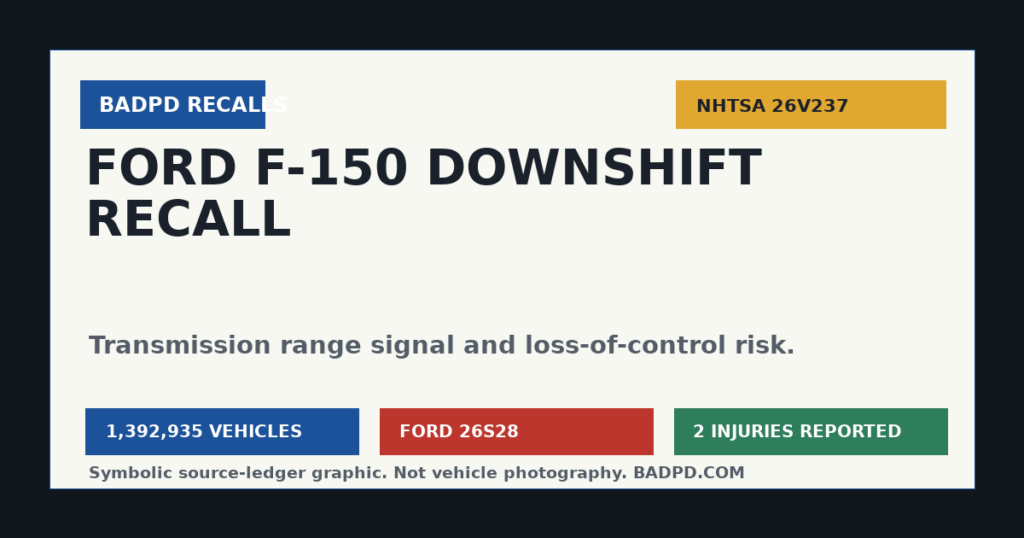
Ford F-150 Downshift Recall: NHTSA 26V237 Covers 1,392,935 Trucks
News Anchor voice
Ready when you are.
Status, July 1 source check: source-cleared for a BadPD public-safety recall ledger. The official campaign is NHTSA 26V237 / Ford 26S28. Ford says 1,392,935 2015-2017 Ford F-150 trucks equipped with a 6-speed automatic transmission may experience a transmission range sensor signal problem that can cause a temporary unintended downshift into second gear.
This is recall-record accountability reporting, not vehicle repair, driving, towing, resale, warranty, reimbursement, legal, insurance, or purchase advice. The official NHTSA, Ford, VIN, OASIS, dealer, diagnostic, repair-order, warranty, and recall-completion records control whether a specific truck is included, repaired, reimbursable, closed, or still open.
What NHTSA And Ford Records Confirm
Ford’s Part 573 report lists 2015-2017 Ford F-150 vehicles built from March 12, 2014 through August 18, 2017. The affected trucks are equipped with a 6-speed automatic transmission. Ford says the vehicles were not produced in VIN order, so model year alone is not enough to determine inclusion.
The defect description is narrow but serious. Some vehicles may experience an intermittent selection signal from the Transmission Range Sensor, or TRS, to the Powertrain Control Module, or PCM. That signal problem can produce a temporary, unintended downshift into second gear.
The safety consequence is loss-of-control risk. Ford states that an unexpected downshift to a lower gear can cause an abrupt wheel-speed reduction for a short duration. In some situations, the rear tires could slide until vehicle speed slows. NHTSA’s acknowledgment letter summarizes the consequence as unexpectedly downshifting into second gear that may result in a loss of vehicle control, increasing crash risk.
Ford estimates that 1% of the recalled population has the defect. The involved component listed in the Part 573 is the PCM calibration, with part-number families FL3A-14C204-*, GL3A-14C204-*, and HL3A-14C204-*. Ford identifies itself as the OEM component manufacturer in the federal report.
Cause, Warning Signs, And Remedy
Ford says the cause is degradation of electrical connections in the transmission lead frame from thermal cycling and vibration. That degradation can cause the PCM to momentarily detect incorrect TRS signal positions. A faulty TRS signal can then lead to an unintended downshift.
The warning section is limited. Ford says that in some cases of TRS degradation, a driver may notice an illuminated malfunction indicator light or wrench light in the instrument cluster. That does not mean every driver will get a useful warning before the event. It also does not mean the defect is harmless when the truck is towing, traveling on wet pavement, or operating at highway speed.
The remedy is a dealer PCM calibration update at no charge. Ford’s Part 573 adds an important condition: if an affected truck previously exhibited certain diagnostic trouble codes related to the condition before the software is installed, dealers will replace the lead frame under the corresponding extended warranty program. That lead-frame language matters because it separates a software calibration from a possible hardware-related service path when the truck already has certain diagnostic evidence.
Dealer notification was expected on April 15, 2026. Interim owner letters were expected from April 27 through May 1, 2026. NHTSA API records accessed July 1, 2026 say interim letters were mailed May 1, 2026. Remedy owner letters are expected from July 13 through July 17, 2026, and the acknowledgment letter says final remedy availability was anticipated in July 2026. VINs became searchable on NHTSA.gov on April 15, 2026.
The Investigation Record
The Part 573 chronology starts with NHTSA. On October 30, 2024, NHTSA provided Ford with Vehicle Owner Questionnaires that were potentially related to unintended downshift events on 2015-2017 F-150 vehicles equipped with the 6R80 6-speed automatic transmission. Ford’s Critical Concern Review Group opened its investigation the next day.
From November 2024 through February 2025, Ford reviewed information from previous investigations, including transmission concerns tied to thermal cycling, vibration, and electrical-connection degradation over time in service. Ford says high-mileage transmissions can experience different failure modes and consequences because of aging subcomponents, and that TRS-related faults can produce a maximum unintended downshift from sixth gear to second gear.
NHTSA’s Office of Defects Investigation opened Preliminary Evaluation PE25002 on March 21, 2025. Ford submitted a two-part response in April and May 2025. On January 30, 2026, NHTSA elevated the matter to Engineering Analysis EA26001 and provided Ford with additional VOQs. Ford says it also evaluated reports involving trucks towing trailers and trucks operating on wet surfaces.
As of April 2, 2026, Ford says it was aware of 444 warranty claims, 121 field reports, 105 customer service reports, and 316 VOQs in the United States potentially related to the concern. Ford says those records were received between April 24, 2015 and November 3, 2025, and represented 891 VINs.
The incident-status sentence requires careful wording. Ford says it is aware of two injuries and one accident potentially related to this concern. BadPD is not converting that into a court finding, causation finding, or claim about any specific crash. The source-supported wording is that Ford reported one accident and two injuries as potentially related in the Part 573 recall chronology.
Why This Belongs In The Accountability Lane
A sudden downshift recall is not just a consumer inconvenience. The source record describes an abrupt rear-wheel-speed reduction and possible rear-tire slide. That is a direct loss-of-control pathway. It also affects a high-volume truck platform used for commuting, family travel, towing, construction, farming, business fleets, municipal use, and resale.
The NHTSA timeline is also material. This was not a manufacturer-only discovery story. ODI provided VOQs in October 2024, opened PE25002 in March 2025, elevated the matter to EA26001 in January 2026, and the Ford field action followed in April 2026. That federal investigation path should stay attached to the public record because it shows how owner complaints, warranty data, field reports, agency escalation, and manufacturer action connected.
The pending July remedy-letter window is another accountability point. Interim letters alert owners to a safety risk, but they do not prove that a specific truck has received the calibration update, that the lead-frame condition was checked where diagnostic trouble codes existed, or that the campaign has closed. Until the final remedy letter and dealer instructions are visible in the public source set, completion should be treated as pending at the record level.
What Owners, Fleets, And Buyers Need In The File
The useful record chain is concrete: VIN lookup, campaign 26S28 / 26V237 status, dealer or OASIS confirmation, whether the PCM calibration was installed, whether any related diagnostic trouble codes existed before the update, whether lead-frame replacement applied under the extended warranty path, and whether the campaign is closed.
Fleets and resale desks should avoid relying on a generic “software updated” note. A truck can be used for towing or assigned to multiple drivers before a final remedy letter arrives. The record should identify the campaign number, date of repair, software calibration status, diagnostic-code history where available, and whether any lead-frame action was performed or denied.
Buyers should also avoid model-year assumptions. The campaign covers 2015-2017 F-150 trucks equipped with the relevant 6-speed automatic transmission and production range, but Ford says VIN order does not determine inclusion. The controlling answer is VIN-specific recall status, not a sales ad, trim description, or broad model-year label.
Completion Records To Demand
The public source set reviewed here does not yet include a final remedy-owner letter, a dealer technical bulletin, or a quarterly completion report. That is normal for a campaign whose Part 573 schedule points to final remedy letters in mid-July 2026, but it also means the public should avoid treating the recall as closed before the completion paperwork exists. The NHTSA API confirms that interim letters were mailed May 1, 2026; interim notice is not the same as completed repair.
When the final remedy file posts, the strongest record would show the dealer process for the PCM calibration, how Ford expects dealers to identify the diagnostic trouble codes that trigger the lead-frame replacement path, and how the campaign closes in OASIS after the calibration or lead-frame work. A simple owner-letter sentence saying the software is available will not answer those operational questions by itself.
Quarterly reports should also matter here. The campaign population is nearly 1.4 million trucks. Completion data should eventually show how many trucks were remedied, how many were unreachable, how many were removed from the population, and whether Ford amended the population after VIN filtering or repair validation. If NHTSA posts model-year, state, fleet, or remedy-type detail later, that would help separate software-only completions from trucks that needed additional lead-frame work.
Because the chronology includes one accident and two injuries as potentially related, later files should be read for changes in incident status. The correct source posture is neither panic nor minimization. The official record already contains a loss-of-control mechanism, a federal investigation path, and incident counts. Any later court, claim, ODI, warranty, or repair-order material should be added with exact dates and the same potentially related versus confirmed-causation labeling used here.
Confirmed, Pending, Not Established
Confirmed by NHTSA/Ford records
- NHTSA 26V237 / Ford 26S28 is an official safety recall.
- The campaign covers 1,392,935 2015-2017 Ford F-150 trucks equipped with a 6-speed automatic transmission.
- The stated defect is intermittent TRS selection signal to the PCM, potentially causing temporary unintended downshift into second gear.
- The stated risk is abrupt wheel-speed reduction, possible rear-tire slide, loss of vehicle control, and increased crash risk.
- Ford reports 444 warranty claims, 121 field reports, 105 customer-service reports, 316 VOQs, and 891 VINs potentially related to the concern.
- Ford reports one accident and two injuries potentially related to the concern.
- The remedy is a PCM calibration update, with lead-frame replacement under the corresponding extended warranty program if certain diagnostic trouble codes existed before software installation.
- VINs became searchable on NHTSA.gov on April 15, 2026.
Pending records
- Final remedy-owner letter expected July 13-17, 2026.
- Dealer bulletin and technical instructions if posted in NHTSA files.
- Quarterly completion reports.
- Any later ODI, PE25002, EA26001, VOQ, warranty, claim, crash, injury, court, or repair-order updates.
- Public completion data separating software-only closeouts from lead-frame replacement cases.
Not established by this source set
- That every 2015-2017 F-150 is included.
- That any specific VIN has the defect without official VIN and diagnostic confirmation.
- That the final remedy letter has already been mailed or posted.
- That every affected truck has already received the PCM calibration update.
- That lead-frame replacement applies to every recalled truck.
- That a court or agency has made a final causation finding on the reported accident and injuries.
BadPD Bottom Line
NHTSA 26V237 belongs in the BadPD public-safety accountability lane because it combines a high-volume truck recall, a direct loss-of-control risk, a federal investigation path, and a source record that includes warranty claims, field reports, VOQs, one accident, and two injuries as potentially related. The records to watch are final remedy notices, dealer instructions, completion reports, diagnostic-code handling, lead-frame replacement data, and any later ODI or claim record tied to PE25002, EA26001, Ford 26S28, or NHTSA 26V237.
BadPD will update this ledger if NHTSA or Ford posts final remedy-owner letters, dealer bulletins, technical instructions, quarterly completion reports, amended Part 573 records, ODI documents, VOQs, warranty records, claim records, court records, or repair-order evidence tied to this campaign.
Source Ledger
- NHTSA Part 573 Safety Recall Report, campaign 26V237, submitted April 14, 2026
- NHTSA acknowledgment letter, campaign 26V237, April 16, 2026
- NHTSA API recall record, 2015 Ford F-150, accessed July 1, 2026
- NHTSA API recall record, 2016 Ford F-150, accessed July 1, 2026
- NHTSA API recall record, 2017 Ford F-150, accessed July 1, 2026
Featured image is symbolic editorial artwork created for BadPD. It is not NHTSA, Ford, dealer, owner, truck, crash, injury, transmission, diagnostic, warranty, repair-order, PCM, TRS, lead-frame, or OASIS photography and is not a depiction of any specific recalled vehicle.
Send receipts for the desk to research
Send corrections, missing records, police-accountability tips, good-cop public-service receipts, government/court/war leads, recall alerts, or property-tax help resources. Tips are leads only until BadPD verifies records.
Links, dates, agency names, docket numbers, bodycam IDs, recall numbers, forms, and official pages.
Every tip is a lead, not a fact. The desk checks records before publishing.
Use advertising inquiry when you want clearly labeled sponsor space or available ad placements on BadPD.