Ford F-150 DRL Recall: NHTSA 26V373 Covers 91,198 Prior Repairs
News Anchor voice
Ready when you are.
Status, June 30 source check: source-cleared for a BadPD vehicle-safety recall ledger. The official campaign is NHTSA 26V373 / Ford 26C28. It covers certain 2018-2020 Ford F-150 vehicles previously repaired incorrectly under NHTSA 20V097 / Ford 20C03.
This is recall-record accountability reporting, not vehicle repair, driving, resale, insurance, lighting, legal, warranty, reimbursement, or purchase advice. The official NHTSA and Ford VIN records control whether a specific truck is included, open, repaired, or closed.
What NHTSA And Ford Records Confirm
Ford’s June 9, 2026 Part 573 report lists 91,198 potentially involved vehicles and an estimated defect percentage of 100% within the defined recall population. The vehicle line is 2018-2020 Ford F-150, with production dates from January 10, 2017 through September 10, 2019.
The Part 573 report says affected vehicles may not have received the Body Control Module, or BCM, software remedy for Ford recall 20C03 / NHTSA 20V097. Ford says certain vehicles had the prior repair recorded as successfully completed, but the correct software update remedy may not actually be installed on the vehicle.
The underlying condition is a lighting noncompliance and visibility risk. When the Daytime Running Lamps are illuminated and the Master Lighting Switch is manually rotated from the Autolamp position to the Headlamps On, or low-beam, position, the DRLs may remain activated instead of dimming to parking lamps as required by FMVSS 108. Ford says the increased photometric intensity from the DRL when combined with the low-beam headlamp function may reduce the visibility of other drivers and increase crash risk.
NHTSA’s June 15 acknowledgment letter states the same core issue in public terms. Ford is recalling certain 2018-2020 F-150 vehicles previously repaired incorrectly under 20V097. Dealers will reprogram the BCM software free of charge. Owner notification letters are expected to be mailed July 6, 2026, Ford’s number is 26C28, and VINs involved in the recall are expected to become searchable on NHTSA.gov on July 6, 2026.
Why This Recall Is A Records Story
The safety issue is not only that a daytime-running-lamp condition exists. That was already the subject of the 2020 recall. The current accountability issue is that a prior recall repair can be marked complete while the software state may not match the intended remedy. That creates a real-world records problem for owners, buyers, dealers, fleet managers, auction platforms, insurers, and regulators.
If a truck’s older 20V097 / 20C03 record shows closed, that may not be enough for a vehicle in the new 26V373 population. The durable proof is a current VIN lookup, a repair order naming 26C28 or 26V373, and a service record showing that the BCM software was reprogrammed and validated under the current campaign. BadPD is not making a finding about any specific dealership, truck, owner, or prior repair. The federal filing itself says the intended prior software remedy may not have been applied for the defined population.
The Part 573 chronology makes the records gap especially important. Ford says a concern about incomplete software recall remedies reached its Critical Concern Group in November 2024. A cross-functional team began auditing software field service actions that used Ford service tools. Ford told NHTSA in December 2024 that some vehicles did not show a match between the service-tool software state and the field service action software release. In March 2025, Ford says discrepancies were identified during the transition between the legacy IDS field service tool and the newer FDRS service tool, along with gaps in historical data.
By April 16, 2026, Ford’s Critical Concern Review Group determined that several field service actions implemented with the IDS tool may have been closed without the remedy being installed. The VINs in the verification activity include vehicles confirmed to contain incorrect software and vehicles with a closed field service action where the software version could not be confirmed because of record gaps. That is the public-interest core: a closed recall record is weaker than a verified software-state record.
Owner Letter And VIN Timing
The schedule in the Part 573 report says dealer notification is expected from July 6 through July 8, 2026. Remedy owner letters are expected to begin July 6 and be completed by July 10, 2026. The date when VINs are planned to be searchable is July 6, 2026.
NHTSA API records accessed by BadPD on June 30, 2026 show the 26V373 recall in the recall history for 2018, 2019, and 2020 Ford F-150 vehicles. Those API records also preserve the older 20V097 recall context. The public should keep those two records separate: 20V097 is the earlier F-150 DRL/BCM software recall, while 26V373 is the 2026 campaign addressing vehicles that Ford says were previously repaired incorrectly or could not be verified through the software-state record.
The 2026 remedy description says owners will be instructed to take the vehicle to a Ford or Lincoln dealer to have BCM software updated. It also says software part numbers will be validated using the Software Validation Form in the Professional Technician System before the field service action is closed. That validation step is the receipt that matters. A vague service note saying a recall was checked is less useful than a repair order naming the campaign and confirming the updated and validated software part numbers.
What The 2020 Recall Adds
The older 20V097 / Ford 20C03 record matters because the 2026 recall is built on top of it. NHTSA API records for the 2018-2020 F-150 describe the 2020 campaign as involving trucks equipped with high-series LED headlamps with Autolamp functionality. In that older campaign, the DRLs could remain activated instead of dimming to parking lamps when the Master Lighting Switch was manually rotated from Autolamps to Headlamps On. NHTSA’s API summary says those vehicles failed to comply with FMVSS 108 and that DRL that cannot dim may reduce visibility for other drivers, increasing crash risk.
Ford’s 2026 report says the software service package will have the intended remedy for 20C03 / 20V097. That wording is important because it frames the current campaign as a remedy-completion and validation problem, not a brand-new unrelated lighting theory. For a public records desk, the question is simple: which trucks were previously marked complete, which software state did they actually have, which VINs are in the 2026 population, and which records prove the new software validation was done?
Dealer Records That Should Exist
The practical accountability file starts at the service lane. A complete dealer record should identify the VIN, the open campaign, the date of service, the software package applied, and the Software Validation Form result before the field service action is closed. The record should not blur 20C03 and 26C28 into a generic “lighting recall checked” note. The 2026 campaign exists because the older closure record may not prove the correct software state for trucks in the defined population.
For dealers, this is also a communication issue. A service writer, technician, and customer should be able to distinguish the earlier 2020 recall from the 2026 remedy-completion campaign. If a truck arrives with paperwork showing the old recall was closed, the current record still needs to answer whether 26V373 / 26C28 is open, whether the new BCM software work was performed, and whether the validation form showed the intended software part numbers. Without that record, the owner is left with a historical closeout, not a current software-state receipt.
BadPD is not alleging dealer misconduct from the source set. The point is narrower and document-based: Ford told NHTSA that software field service action records had gaps and mismatches. The public follow-through should show how those gaps are corrected at the service counter and how final repair records avoid creating another closed-but-not-verified software file.
Fleet, Auction, And Resale Exposure
F-150 trucks often move through commercial fleets, municipal fleets, construction businesses, family ownership, auctions, trade-ins, and private resale. That means a current recall does not stay inside the first owner’s mailbox. A useful accountability package should make the campaign visible anywhere a truck changes hands. The relevant record for a buyer, seller, fleet manager, or auction platform is not a verbal statement that a lighting recall was “done years ago.” It is a dated VIN result and a repair order that names the current campaign.
Because the 2026 filing says VINs are planned to become searchable on July 6, 2026, there is a timing gap between the public Part 573 report and practical VIN confirmation for some users. During that gap, the model-year and population facts are useful for awareness, but they should not be turned into a claim that a specific truck is affected without official VIN confirmation. Once the VIN tool is live, the public-interest record becomes completion status: open, repaired, validated, or still pending.
For fleets and resellers, the stronger internal control is to preserve before-and-after records. The before record shows the truck’s recall status when the file was checked. The after record shows the 26C28 service appointment, BCM software update, validation result, and final closeout. That record sequence matters more than a generic statement that “all recalls are handled,” because this campaign was created to deal with a software remedy that could be recorded as complete without the intended state being verified.
Completion Reports And Public Follow-Up
NHTSA’s acknowledgment letter reminds Ford that quarterly completion reports and later annual status reports are required. Those reports are not just regulatory paperwork. They are the public’s best high-level check on whether the recall moved from a mailed notice to completed software updates. For a 91,198-vehicle campaign, the numbers should eventually show how many vehicles were notified, how many were remedied, how many were unreachable, and how the completion rate changes after owner letters and dealer notifications go out.
The next useful documents are the final owner notification letter, any dealer bulletins, technical instructions for the BCM software update, and any follow-up communications. Those documents should show the plain-language owner warning, the dealer repair workflow, and how the software validation step is documented. If Ford later identifies related software-remedy gaps in other campaigns, this F-150 record should be read alongside those filings because the chronology describes a broader audit of software field service actions.
Public recall accountability is strongest when the file connects all three layers: the federal campaign number, the VIN-level service record, and the fleetwide completion reports. NHTSA 26V373 has all three available or pending. The confirmed facts are already enough for a BadPD source ledger, but the completion and communication records will determine whether the remedy is visible beyond the initial filing.
Confirmed, Pending, Not Established
Confirmed by NHTSA/Ford records
- NHTSA 26V373 / Ford 26C28 is an official recall campaign.
- The campaign covers certain 2018-2020 Ford F-150 vehicles.
- Ford lists 91,198 potentially involved vehicles.
- Ford says the vehicles may not have received the BCM software remedy for 20C03 / 20V097 even though the repair was recorded as completed.
- The underlying noncompliance concerns DRLs remaining activated instead of dimming to parking lamps as required by FMVSS 108.
- Ford says the condition may reduce visibility of other drivers and increase crash risk.
- Ford says it is not aware of any reports of accident or injury related to this condition.
- The planned dealer notification window is July 6 through July 8, 2026.
- The planned remedy owner notification window is July 6 through July 10, 2026.
- The date VINs are planned to be searchable is July 6, 2026.
Pending records
- Quarterly completion reports and later annual reports required by NHTSA’s acknowledgment letter.
- Dealer bulletin and owner-letter copies after final distribution.
- VIN-level open/closed status after the July 6 searchable date.
- Software Validation Form completion proof for repaired vehicles.
- Counts separating confirmed incorrect software from vehicles included because older software records could not be confirmed.
- Any later Ford or NHTSA incident, crash, injury, compliance, enforcement, or audit update.
Not established by this source set
- That every 2018-2020 Ford F-150 is included; the campaign applies to the 91,198-vehicle population defined by Ford/NHTSA.
- That any specific truck’s DRLs currently fail to dim without a VIN and service-record check.
- That any accident or injury has occurred because of this condition.
- That any individual dealer knowingly closed an incorrect repair.
- That a prior 20V097 closure record is enough for a VIN that appears in 26V373.
BadPD Bottom Line
NHTSA 26V373 belongs in the BadPD recall-accountability lane because it shows how software-based recall remedies can become public-record problems. A recall is not fully accountable when the public can see only that an older action was closed. Owners, buyers, fleets, dealers, and regulators need a verifiable current record showing whether the truck is in 26V373, whether the BCM software update was installed, and whether the Software Validation Form confirmed the correct software state before the field service action was closed.
BadPD will update this ledger if Ford or NHTSA posts owner-letter files, dealer bulletins, quarterly completion data, audit details, later incident records, or additional software-remedy recalls tied to the same field-service-tool records issue.
Source Ledger
- NHTSA Part 573 Safety Recall Report, campaign 26V373, June 9, 2026
- NHTSA acknowledgment letter, campaign 26V373, June 15, 2026
- NHTSA API recall record, 2018 Ford F-150, accessed June 30, 2026
- NHTSA API recall record, 2019 Ford F-150, accessed June 30, 2026
- NHTSA API recall record, 2020 Ford F-150, accessed June 30, 2026
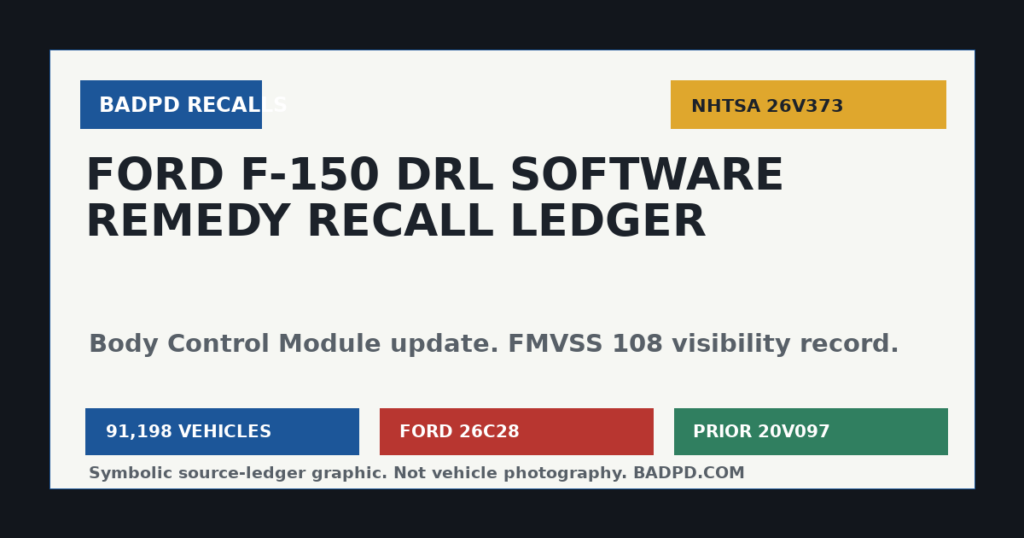
Featured image is symbolic editorial artwork created for BadPD. It is not NHTSA, Ford, dealer, owner, truck, headlamp, DRL, crash, injury, repair, software, VIN, or service-tool photography and is not a depiction of any specific recalled vehicle.
Send receipts for the desk to research
Send corrections, missing records, police-accountability tips, good-cop public-service receipts, government/court/war leads, recall alerts, or property-tax help resources. Tips are leads only until BadPD verifies records.
Links, dates, agency names, docket numbers, bodycam IDs, recall numbers, forms, and official pages.
Every tip is a lead, not a fact. The desk checks records before publishing.
Use advertising inquiry when you want clearly labeled sponsor space or available ad placements on BadPD.