
Chrysler Pacifica PHEV Battery Fire Recall: NHTSA 26V362 Park-Away Warning
News Anchor voice
Ready when you are.
Status, June 30 source check: source-cleared for a BadPD vehicle-safety recall ledger. The official campaign is NHTSA 26V362 / FCA 52D. It covers certain 2020-2022 Chrysler Pacifica Plug-In Hybrid Electric Vehicles with a high-voltage battery fire risk.
This is public-service reporting, not mechanical, electrical, charging, parking, repair, legal, warranty, insurance, or driving advice. The official NHTSA records, FCA owner notice, dealer instructions, and VIN-specific recall lookup control any owner-specific action. BadPD is indexing this separately because prior Jeep fire-risk coverage mentioned the Pacifica PHEV issue only as a different campaign that should not be mixed into the Jeep ledger.
What NHTSA Confirmed
NHTSA’s Part 573 report lists 17,277 potentially involved 2020-2022 Chrysler Pacifica PHEV vehicles and an estimated defect percentage of 1%. The suspect production range starts August 5, 2020 and ends May 2, 2022. FCA says the suspect vehicles may have been built with high-voltage battery packs containing cells produced on an alternative assembly line at LG Energy Solution.
The defect description is direct: a high-voltage battery that fails internally may result in thermal runaway leading to a vehicle fire. The acknowledgment letter uses the public-facing subject line Park Outside: Battery May Catch Fire. It says the battery pack may cause a vehicle fire even when the vehicle is parked with the ignition in the Off position.
The official owner instruction is not subtle. NHTSA’s acknowledgment letter says owners are advised not to charge their vehicles and to park outside and away from structures until the vehicle is repaired. The Part 573 report says FCA is advising owners to refrain from recharging these hybrid vehicles and to park them away from structures and other vehicles until the remedy is complete.
Remedy And Timing
The listed remedy is a high-voltage battery pack control module software update, plus inspection and battery pack assembly replacement as necessary. FCA says the revised BPCM software is intended to monitor battery pack assembly operational status for conditions that could lead to a fire in the battery pack assembly. FCA also says it will provide a warranty extension for impacted customers experiencing messaging related to the defect, with unlimited years and unlimited mileage terms for battery replacement tied to that messaging.
The Part 573 schedule says FCA planned to notify dealers on or about June 11, 2026 and begin notifying owners on or about June 23, 2026. It says 2020 and 2021 model-year vehicles would receive final owner letters, while 2022 model-year vehicles would receive interim owner letters. NHTSA API records accessed June 30 say owner notification letters were mailed beginning June 23, 2026 and that VINs involved in the recall would become searchable on NHTSA.gov on June 11, 2026.
The public record should keep those dates separate. June 4 is the federal report submission date. June 8 is the NHTSA acknowledgment-letter date. June 11 is the dealer/VIN-search date in the Part 573 schedule. June 23 is the owner-notice date. The existence of a mailed owner letter does not prove any individual vehicle is repaired; the repair order and VIN status do that.
Incident And Investigation Receipts
The chronology begins with NHTSA’s January 17, 2024 Recall Query into 2017-2018 model-year RU PHEV vehicles with thermal events originating at or near the high-voltage battery. FCA says it provided a full response on May 3, 2024. On March 27, 2026, NHTSA issued an expanded Recall Query into 2017-2026 model-year RU PHEV vehicles with thermal events originating at or near the high-voltage battery.
FCA opened its technical safety and regulatory compliance investigation on April 30, 2026 into some 2020-2022 Chrysler Pacifica PHEVs experiencing fires originating from the high-voltage battery. FCA provided a full response to the expanded inquiry on May 1, 2026. On May 28, 2026, FCA determined through its Vehicle Regulations Committee that a safety defect existed in certain vehicles.
The incident status is important and should be repeated accurately. Since August 2023, FCA says it received four high-voltage battery fire reports involving vehicles with fires originating from the high-voltage battery. FCA says all had cells produced on the alternative LGES assembly line with limited production. FCA also says it attempted to repurchase those vehicles and received one vehicle for further analysis. The battery pack was analyzed by LGES, and the cause of that fire was undetermined.
As of May 15, 2026, FCA reported three customer assistance records, zero warranty claims, four field reports, and no other service records potentially relating to the issue for all markets, with receipt dates from August 30, 2023 to January 16, 2026. FCA also reported that it was not aware of any accidents or injuries potentially related to the issue for all markets as of that date. BadPD is treating that as FCA’s statement in the federal defect file, not as a guarantee about future complaints, litigation, or later quarterly reports.
Why This Needs Its Own Ledger
Some June recall coverage grouped Jeep fire-risk and Chrysler Pacifica plug-in hybrid fire-risk stories together because both involved Stellantis brands and park-away language. BadPD is separating them because the campaigns are different. The Jeep campaign involved electric hydraulic power steering pump wiring. This Pacifica campaign involves high-voltage battery packs, LG Energy Solution cells, BPCM software, and possible battery-pack replacement.
Combining the two can mislead owners. A Jeep owner needs the Jeep campaign number and Jeep remedy path. A Pacifica PHEV owner needs 26V362 / 52D, the do-not-charge instruction, the park-away instruction, the Pacifica-specific VIN check, and the high-voltage battery remedy path. Fire-risk instructions are only useful when the correct vehicle, component, campaign number, and remedy are kept attached.
This recall also matters because the Part 573 report says the root cause investigation continues. FCA and LGES analyzed warranty returns, manufacturing history, and assembly line processes and had not discovered issues in those reviews at the time of filing. When a recall launches while root-cause work is still open, the public should expect follow-up records, not just a first notice.
Owner, Dealer, And Fleet Record Demand
For owners, the practical records are a current VIN result, the FCA 52D or NHTSA 26V362 campaign number, the owner notice, dealer appointment record, completed software-update proof, inspection result, and battery-pack replacement record if replacement is required. If a vehicle receives only the BPCM software update, the repair order should say that. If inspection leads to pack replacement, the repair order should identify that outcome.
For dealers, the relevant records are open-recall inventory checks, completion status, software update confirmation, inspection findings, battery-pack replacement decisions, parts availability, and any hold or release records for vehicles in stock. For fleets, rideshare operators, caregivers, and families relying on Pacifica PHEVs, a current VIN-level recall file is more useful than a general model-year headline.
For used-car buyers and sellers, the key question is not whether a Pacifica is a plug-in hybrid in the broad model range. The question is whether that VIN is included and whether FCA 52D has been completed. A listing that says “recalls checked” is weaker than a dated VIN printout and a dealer repair order naming 26V362 or 52D. BadPD is not advising any transaction; it is saying the fire-risk recall paper trail should be visible before money changes hands.
Completion Records Should Be Public
NHTSA’s acknowledgment letter reminds FCA that owner letters, dealer communications, bulletins, and follow-up notices must be submitted to NHTSA, and that quarterly status reports are required after purchaser notification. For this campaign, completion reporting should separate vehicles notified, vehicles receiving the BPCM software update, vehicles inspected, vehicles requiring battery-pack replacement, vehicles repaired, vehicles awaiting parts, and unreachable owners.
Because 2022 vehicles were expected to receive interim letters while 2020 and 2021 vehicles received final letters, the public record should also separate final-remedy availability by model year. A recall is not equally mature across the whole population if one model-year lane is still interim. That distinction should remain attached to the campaign until completion data shows otherwise.
Confirmed, Reported, Pending, Not Established
Confirmed by NHTSA records
- NHTSA campaign 26V362 / FCA 52D is an official safety recall.
- The campaign covers certain 2020-2022 Chrysler Pacifica PHEV vehicles.
- NHTSA lists 17,277 potentially involved vehicles and an estimated defect percentage of 1%.
- Owners are advised not to charge the vehicles and to park outside and away from structures until repaired.
- The remedy is BPCM software update, inspection, and battery pack assembly replacement as necessary.
- VINs were scheduled to become searchable on June 11, 2026, and owner letters were expected beginning June 23, 2026.
Reported by FCA in the Part 573 chronology
- Four high-voltage battery fire reports had been received since August 2023.
- All four involved cells produced on an alternative LG Energy Solution assembly line with limited production.
- FCA attempted to repurchase the vehicles and received one for further analysis.
- The analyzed battery pack’s fire cause was undetermined, and root-cause investigation continued.
- FCA was not aware of any accidents or injuries potentially related to the issue as of May 15, 2026.
Pending records
- Final owner-letter PDFs and any 2022 interim-to-final owner-letter update.
- Dealer service bulletin and claim instructions.
- Quarterly completion reports and later annual status reports.
- Counts for software updates, inspections, battery-pack replacements, parts delays, and unreachable owners.
- Any root-cause update, population correction, complaint trend, accident/injury update, or recall termination notice.
Not established by this source set
- That every 2020-2022 Pacifica is included; the source set concerns Pacifica PHEV VINs in the suspect population.
- That any specific VIN is affected without official VIN-level confirmation.
- That a specific dealer, prior owner, seller, auction, lender, or fleet operator ignored the recall.
- That all affected vehicles have received the software update or any required battery-pack replacement.
- That the final root cause has been established beyond the federal record’s current statements.
BadPD Bottom Line
NHTSA 26V362 is a high-value public-safety ledger because it involves a plug-in hybrid battery fire risk, specific do-not-charge and park-away instructions, four reported HV-battery fire events, and an open root-cause investigation. The owner path is evidence-based: check the VIN, preserve the 52D / 26V362 record, follow the official FCA/NHTSA notice, use the dealer remedy, and keep the repair order.
The accountability path is equally direct: publish the final owner letters, dealer bulletin, software-update completion counts, inspection outcomes, battery-pack replacement counts, root-cause updates, and quarterly completion reports. BadPD will update this package if NHTSA posts those records or if FCA changes the campaign.
Source Ledger
- NHTSA Part 573 Safety Recall Report, campaign 26V362, June 4, 2026
- NHTSA acknowledgment letter, campaign 26V362, June 8, 2026
- NHTSA API recall record, 2020 Chrysler Pacifica, accessed June 30, 2026
- NHTSA API recall record, 2021 Chrysler Pacifica, accessed June 30, 2026
- NHTSA API recall record, 2022 Chrysler Pacifica, accessed June 30, 2026
- NHTSA recalls VIN lookup page, accessed June 30, 2026
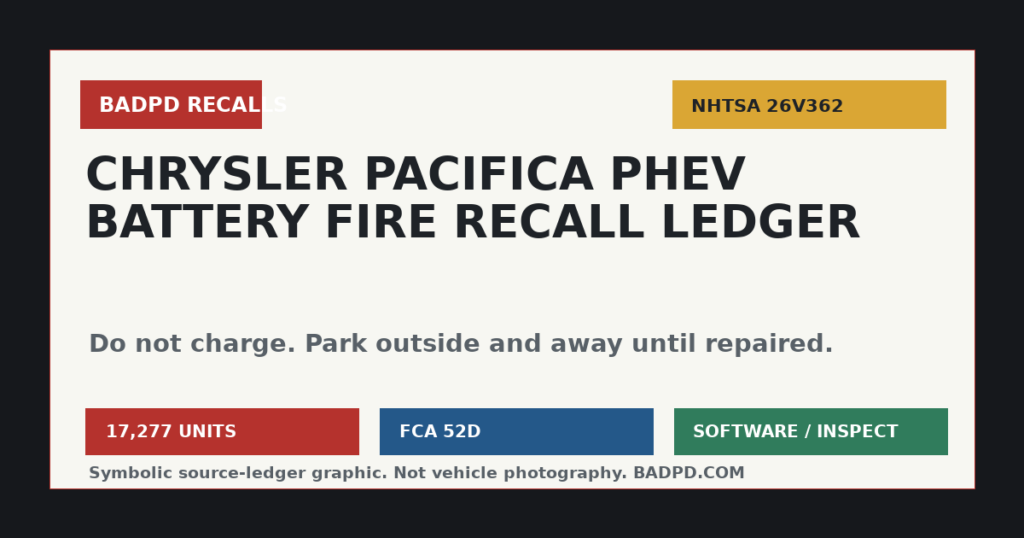
Featured image is symbolic editorial artwork created for BadPD. It is not NHTSA, FCA, Chrysler, LG Energy Solution, dealer, battery, fire, crash, injury, owner, charging, parking, or repair photography and is not a depiction of any specific recalled vehicle.
Send receipts for the desk to research
Send corrections, missing records, police-accountability tips, good-cop public-service receipts, government/court/war leads, recall alerts, or property-tax help resources. Tips are leads only until BadPD verifies records.
Links, dates, agency names, docket numbers, bodycam IDs, recall numbers, forms, and official pages.
Every tip is a lead, not a fact. The desk checks records before publishing.
Use advertising inquiry when you want clearly labeled sponsor space or available ad placements on BadPD.