
Clinton Duquette Regina Police Database Ledger: 67 Searches, A Privacy Charge, And Access Still Need Proof
Field Desk voice
Ready when you are.
BadPD rebuild source-check, June 22, 2026; source dates December 11, 2025 through June 16, 2026: BadPD had a short Regina Police Service post live about a veteran officer charged after an internal database was improperly accessed. The old brief had the headline value. It did not have the accountability file. This rebuild keeps the charge, the privacy-commissioner findings, the discipline dispute, the court status, the victim-notice lane, and the missing public records separated.
This is not a conviction article. Constable Clinton Duquette has been charged under Saskatchewan's Local Authority Freedom of Information and Protection of Privacy Act. RPS says the charge is not a Criminal Code charge. BadPD is not publishing that Duquette committed the statutory offence unless a court proves it, he admits it, or the case resolves in a way that supports that language.
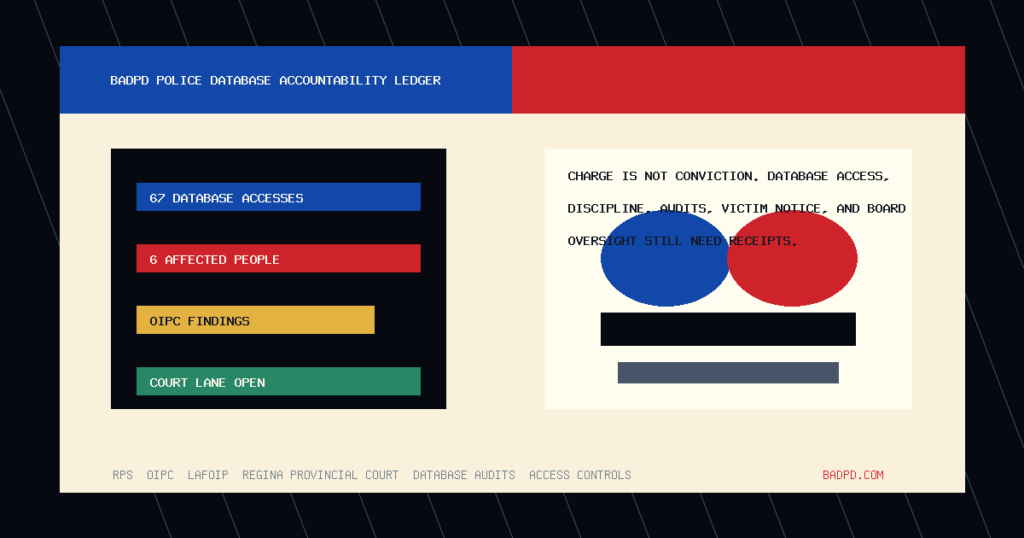
The accountability issue is still severe. The official privacy report says a Regina police officer accessed personal information of six people in an internal police database 67 times without a legitimate need-to-know basis. It says the breaches were intentional and wilful. It says RPS took minimal containment steps and that the discipline adopted by RPS was inadequate for restoring public trust. Those are not internet rumors. Those are official accountability findings.
What RPS Says Happened
Regina Police Service published its officer-charged release on May 14, 2026. RPS said it charged Constable Clinton Duquette under LAFOIP after an internal investigation launched in 2024 found improper access to the RPS internal database on multiple occasions between 2021 and 2023. RPS said the officer used the database to search the complainant and members of the complainant's family and friends without a valid work purpose.
RPS described Duquette as a 10-year constable. It said he received discipline from the chief of police, including suspension without pay, mandatory Police Ethics and Accountability training, further Access and Privacy training, and ongoing random audits for at least two years. RPS also said it proactively reported the breach to the Saskatchewan Information and Privacy Commissioner.
RPS said the Attorney General of Saskatchewan consented to prosecution under section 56(6) of LAFOIP. RPS emphasized that the charge is not a Criminal Code charge. It also said that if convicted, Duquette could face a fine of up to $50,000 or imprisonment for up to one year. The statute source attached to this article confirms that LAFOIP includes offence language and penalty ceilings in that range.
That RPS release is important because it is both an official charge receipt and the agency's own defense of its response. It tells the public the case went beyond internal discipline. It also tells the public RPS believes training, suspension, random audits, and access-and-privacy program improvements are part of the remedy. BadPD is treating that as the agency position, not as final proof that the remedy is adequate.
What The Privacy Commissioner Found
The Saskatchewan OIPC report is the center of the case. It says an RPS Professional Standards Branch investigation into an unrelated matter revealed that a police officer accessed the personal information of six individuals in the Integrated Electronic Information System, or IEIS, from October 2021 to June 2024. The report says the snooping occurred without a legitimate need-to-know basis over more than three years.
The OIPC report says the affected people included a former partner, a former partner's sibling, a former partner's previous partner, and other people. BadPD is not naming private complainants or affected people. The names and relationships matter only to show why misuse of a police database can create fear outside the police building. A badge plus a database can become a stalking tool if access controls are weak.
The report says RPS told the commissioner that the officer accessed personal information for personal reasons and personal gain. It also says the officer had privacy training, had signed a confidentiality protocol, and had clicked through the IEIS privacy disclaimer. That is a critical fact pattern. This was not described as a one-off accidental click inside a confusing system. The commissioner described repeated access despite safeguards.
The OIPC findings are blunt. They say privacy breaches occurred each time the affected people's personal information was accessed in IEIS. They say the breaches were intentional and wilful. They say RPS took minimal steps in containing the breach. They say the notification letter to affected individuals was appropriate in content but not timely. They say the discipline adopted by RPS would not restore public faith.
Why The Discipline Is The Core Fight
A police database is not a casual office tool. It can contain addresses, names, contact information, family relationships, vehicle records, incident records, and other sensitive data. The public gives law enforcement access to that information so police can do legitimate public-safety work, not so employees can run personal searches on partners, former partners, family members, friends, or rivals.
That is why the discipline question is bigger than Duquette. If an officer can repeatedly access private information for personal reasons and still keep access to the database, every resident has a fair question: what would actually get access shut off? The OIPC report recommended permanent revocation of the officer's IEIS access. If RPS did not revoke access, the report recommended focused monthly audits for an indefinite period.
CJME reported in December 2025 that the discipline described at that stage was one day without pay, privacy retraining, signing the confidentiality protocol again, and random audits for two years. CJME reported that the police chief said RPS considered other cases and the officer's prior record, that Duquette had taken responsibility, and that RPS believed discipline is also about remedial steps. BadPD is including that because accountability work must carry the agency's explanation, even when the explanation is not satisfying.
But the OIPC report undercuts the idea that retraining alone solves the problem. It says the officer already had training and privacy warnings before the breaches. The accountability question is not whether RPS can hold another training session. It is whether RPS can prove the next unauthorized query will be prevented, detected quickly, escalated immediately, and punished severely enough to deter the next employee.
The Court Lane Is Open
CJME reported that Duquette's first court appearance was brief, that a lawyer appeared on his behalf, and that the matter was adjourned until July 20 so the defence could receive and review disclosure materials. That is a normal due-process lane. The charge is now public, but the court has not resolved the case.
BadPD should track the July 20 date and any docket updates after that. The next useful receipts are a plea, trial-setting, disclosure dispute, agreed facts, dismissal, sentencing record, or court statement of reasons. Until then, BadPD should not call Duquette guilty of the LAFOIP offence. The right language is charged, alleged, reported, or found by the OIPC where the source supports that specific finding.
The court lane and the discipline lane are different. A criminal or quasi-criminal prosecution asks whether the Crown can prove an offence. A police-accountability ledger asks whether the agency protected residents, contained the breach, notified affected people quickly, disciplined fairly, changed systems, and gave the public enough proof to trust the database again. One lane can remain pending while the other still demands records.
That distinction matters because agencies often hide everything behind pending-case language. RPS can protect the court file while still publishing a recommendation implementation matrix, board briefings, policy updates, audit protocols, database-access changes, and de-identified statistics about privacy breaches. None of that requires leaking protected victim information or interfering with the prosecution.
The Alleged Victim Lane
CJME's June 2026 court update includes statements attributed to an alleged victim who was not named to protect privacy. She reportedly described fear, harm to her mental and emotional health, and concern that the police database access was used to find and isolate her. BadPD is treating those as attributed statements, not court findings.
The statements matter because database cases can look abstract if coverage stops at words like privacy breach. For the person searched, it can mean a police officer may know where they live, who they know, who they date, where their family is, what vehicles are tied to them, and how to locate them. If the person searching has personal history with the person searched, the risk is not abstract at all.
The OIPC report supports the broader concern without turning every complainant statement into a proven fact. It says six people were searched without a proper basis. It says the breaches were intentional and wilful. It says notice was not timely. It says the discipline did not restore public trust. That is enough to justify a public accountability article even without using private names.
BadPD's rule here is simple: protect private people, publish official findings, attribute alleged-victim statements carefully, and press the institution. The target is not to expose the affected individuals. The target is to make sure the public knows whether RPS database access is now safer than it was when the accesses occurred.
The Semenchuck Backdrop
This story also has a Regina-specific backdrop. CJME's reporting and the OIPC discussion refer to another Regina police database-abuse case involving Robert Semenchuck. CJME reported that Semenchuck pleaded guilty after inappropriately accessing victims' private information using police databases with the intent to pursue personal and intimate relationships. That does not make Duquette responsible for Semenchuck's conduct. It does show why residents are asking whether the problem is bigger than one employee.
When one agency has multiple public database-abuse cases, the board and chief should not treat each case as a sealed-off personnel mistake. They should publish system-level answers. How many unauthorized-access investigations has RPS opened in the last five years? How many were substantiated? How many involved personal relationships? How many resulted in lost access, suspension, termination, prosecution referral, or conviction? How long did victim notification take?
Those are not anti-police questions. They are basic governance questions. If the agency has improved, show the proof. If it has not, fix the system. Police cannot credibly demand public cooperation while leaving residents uncertain about who can search them inside the police database and why.
The Audit Problem
Random audits sound good until the details are tested. The OIPC report criticized the limits of random auditing and recommended targeted monthly audits if access was not permanently revoked. The difference is practical. A random audit may or may not catch a person with a known history of unauthorized searches. A targeted audit says: this employee already crossed the line, so the agency must watch that exact risk until the public can trust access again.
The report also recommended a query-reason feature requiring members to provide a reason with enough particularity when conducting database searches. That matters because an audit without a recorded reason can become a guessing game. If a name was searched, the auditor needs to know the file number, incident, call, warrant, investigation, or other work purpose. Without that field, it is harder to prove whether access was legitimate.
BadPD wants the implementation proof. Did RPS permanently revoke IEIS access? If not, did it implement monthly targeted audits for Duquette indefinitely? Did it add a query-reason feature to IEIS? Did it expand random audits to users, not just occurrence files? Did it resource the Access and Privacy Unit? Did it create an unauthorized-access audit protocol? Did it adopt a zero-tolerance policy? Did the Board of Police Commissioners receive updates in public session?
RPS says eight of nine recommendations were already in practice or in progress as of May 14, 2026. CJME later reported the chief said nine of eleven recommendations relating to police privacy breaches were implemented. Those numbers need a public matrix. Residents should not have to reverse-engineer implementation from press clips and meeting comments.
Confirmed, Alleged, Pending, And Not Proven
Confirmed by RPS: Regina Police Service charged Constable Clinton Duquette under LAFOIP on May 14, 2026. RPS says an internal investigation found improper access to the internal database between 2021 and 2023, involving the complainant and members of the complainant's family and friends without a valid work purpose. RPS says Duquette received discipline, training, and audits, and that the Attorney General consented to prosecution. RPS says the charge is not a Criminal Code charge.
Confirmed by OIPC: The privacy commissioner report says six people were accessed in IEIS without a legitimate need-to-know basis. It says the access occurred over more than three years and totaled 67 accesses. It says the breaches were intentional and wilful, that RPS took minimal containment steps, that notice was not timely, and that the discipline was inadequate to restore public faith. It recommended permanent IEIS access revocation or targeted monthly audits indefinitely if access was not revoked.
Reported by accountable media: Global News cross-checked the charge and RPS discipline frame. CJME reported the December discipline dispute, chief response, continued access concerns, Semenchuck backdrop, and June first-appearance update. CJME also reported attributed statements from an alleged victim and a July 20 adjournment.
Alleged or attributed: The complainant statements reported by CJME, including claims about fear, isolation, and harm, are attributed statements unless and until a court or official record makes specific findings. BadPD is not naming private affected people.
Pending: court disposition after the July 20 adjournment, defence or Crown filings, any agreed statement of facts, sentencing or dismissal record, RPS implementation matrix, IEIS access status, targeted-audit proof, query-reason feature deployment, board oversight records, and de-identified privacy-breach statistics.
Not proven by this article: This article does not prove Duquette committed the LAFOIP offence. It does not prove RPS leadership acted unlawfully. It does not prove every RPS database access is unsafe. It does not prove any fact from private social media or comment threads. It proves the old BadPD brief was too thin for the public-record trail now available.
Records BadPD Wants Next
BadPD should seek the Regina Provincial Court docket after July 20, 2026, any information or charging document available to the public, hearing minutes, plea/disposition records, sentencing materials if applicable, and any court statement of reasons. If the charge is withdrawn, dismissed, proven, or resolved by agreement, that update belongs on this same URL.
BadPD should seek the RPS recommendation implementation matrix for OIPC Investigation Report 123-2025. The public should see each recommendation, the RPS response, whether it is complete, the completion date, the policy owner, and the proof. If a recommendation is rejected or modified, the agency should explain why.
BadPD should seek Board of Police Commissioners agenda packets and minutes discussing Duquette, IEIS access, LAFOIP compliance, database audits, access-and-privacy staffing, query-reason fields, zero-tolerance policy, Semenchuck-related reforms, and victim-notification timelines. Board oversight is not a decoration. It is where the public should see whether the chief's promises are being tested.
BadPD should seek de-identified RPS data for unauthorized database-access investigations from 2020 through 2026: number opened, number substantiated, number involving current or former intimate partners, number involving family or friends, discipline imposed, access revoked, prosecution referrals, victim-notification timing, and repeat-offender controls. If RPS has nothing to hide, the aggregate numbers should help restore trust.
BadPD should also seek the technical control record. Does IEIS now require query reasons? Does it require occurrence numbers or another work-purpose identifier? Are reasons searchable during audit? Are CPIC and SGI accesses audited on the same standard? Can supervisors see unusual search patterns? Are employees with prior unauthorized-access findings audited more heavily? Are complainants told how to request the dates and times they were searched?
Why This Belongs On BadPD
BadPD covers police misconduct, public-safety systems, court receipts, government accountability, and records that tell residents whether institutions are worthy of trust. This case belongs because a police officer was charged under privacy law after official findings that an internal database was used for repeated personal searches. It belongs because the police service's discipline response was publicly criticized by the privacy commissioner. It belongs because the affected people are private residents whose safety and dignity depend on whether police databases are controlled.
The article is also a reminder that police accountability is not only shootings, pursuits, jail deaths, and excessive force. Database abuse is power abuse. It can be quieter, but it can follow people into their homes, relationships, jobs, and courts. A resident cannot meaningfully consent to police data collection if the agency cannot prove that personal access is blocked, audited, and punished when abused.
BadPD's demand is narrow and fair: publish the court result when it happens, publish the OIPC implementation matrix, prove whether IEIS access was revoked or heavily audited, show the query-reason fix, report privacy-breach statistics in de-identified form, and protect the affected people from having to relive the breach just to make the institution admit what the official report already found.
The old version was a headline. This version is a public-record map. The next update should not be another headline. It should be receipts.
Source Trail
- Regina Police Service officer-charged release (May 14, 2026; accessed June 22, 2026) – Primary official charge notice for the LAFOIP charge, RPS discipline, Attorney General prosecution consent, non-Criminal Code warning, possible penalty, and first-appearance date.
- Saskatchewan OIPC Investigation Report 123-2025 (December 11, 2025; accessed June 22, 2026) – Primary privacy-commissioner report finding 67 unauthorized IEIS accesses involving six people, intentional and wilful privacy breaches, minimal containment, delayed notice, discipline the commissioner called inadequate, and nine recommendations.
- Saskatchewan Local Authority Freedom of Information and Protection of Privacy Act (current consolidation accessed June 22, 2026) – Official statute text for LAFOIP offence and penalty language, including the fine and imprisonment ceiling described by RPS and local reporting.
- Global News Regina report on Duquette charge (May 2026; accessed June 22, 2026) – Accountable local/national cross-check on the charge, 10-year officer status, suspension/training/audits, and the OIPC/Attorney General lane.
- 980 CJME court update on first appearance (June 16, 2026; accessed June 22, 2026) – Court and complainant-perspective update reporting lawyer appearance, July 20 adjournment, alleged-victim statements, and RPS database-access status; complainant statements are attributed as allegations.
- 980 CJME December report on OIPC findings and discipline (December 18, 2025; accessed June 22, 2026) – Local accountability reporting on the OIPC report, one-day-without-pay discipline, continued access, chief response, Semenchuck backdrop, and permanent-revocation or monthly-audit recommendation.
Send receipts for the desk to research
Send corrections, missing records, police-accountability tips, good-cop public-service receipts, government/court/war leads, recall alerts, or property-tax help resources. Tips are leads only until BadPD verifies records.
Links, dates, agency names, docket numbers, bodycam IDs, recall numbers, forms, and official pages.
Every tip is a lead, not a fact. The desk checks records before publishing.
Use advertising inquiry when you want clearly labeled sponsor space or available ad placements on BadPD.