June 25 Child Ingestion Recall Ledger: Honlyne, Raychy, Small Fish
News Anchor voice
Ready when you are.
Status, June 27 source check: source-cleared for a BadPD official CPSC child-safety recall ledger. This brief groups three Consumer Product Safety Commission notices dated June 25, 2026: Honlyne LED Party Favors, Raychy Children’s Light Sneakers, and Small Fish Montessori Busy Board Toys. The common thread is high-consequence ingestion risk in products marketed for or likely attractive to children.
This is public-safety recall information, not medical advice or product-use advice. The official CPSC notices control the remedy instructions. BadPD is preserving the public record, source dates, sale channels, confirmed facts, reported incident status, and missing notification records.
Why this cluster matters
Battery and magnet ingestion hazards are not ordinary product defects. CPSC warns that swallowed button or coin batteries can cause serious injuries, internal chemical burns, and death. It also warns that swallowed high-powered magnets can attract each other or other metal objects inside the digestive system, leading to perforations, twisting, blockage, blood poisoning, and death.
The three recalls in this ledger all came through the online marketplace lane. CPSC says the Honlyne party favors were sold on Amazon.com from June 2024 through December 2025. It says the Raychy light sneakers were sold on Amazon.com in January 2026. It says the Small Fish busy boards were sold on Amazon.com from March 2026 through May 2026. That makes buyer notification and listing removal the public-record questions to watch.
No incidents or injuries are reported in these three CPSC notices. That is good news, but it is not a reason to downgrade the warning. The purpose of a recall is to prevent the first injury when the hazard is already visible to regulators.
CPSC: Honlyne LED Party Favors
CPSC recall number 26-580 covers Honlyne LED Party Favors. CPSC says the LED party favors violate the mandatory safety standard for consumer products because the battery compartment within the light-up products contains button cell batteries that can be easily accessed by children. The agency lists the remedy as a refund and the affected unit count as about 13,400.
The product package includes multiple light-up items: LED hair fiber optic clips, LED glasses, foam glow sticks, light-up flower crowns, finger lights, and glow sticks. CPSC says “Light Up Party Toy” is printed on the front of the package and that “Brand: Honlyne,” “Product Name: Glow in the Dark Party Supplies,” and “Mo. Number: HON-302HE” are printed on the back.
CPSC says no incidents or injuries were reported. It lists ABGA Advanced Trading Co., Ltd. of Walnut, California as importer and Huizhou Rongheng Network Technology of China as retailer. The sale path was Amazon.com from June 2024 through December 2025 for about $49 per set.
CPSC: Raychy Children’s Light Sneakers
CPSC recall number 26-578 covers Raychy Children’s Light Sneakers Unisex. CPSC says the recalled sneakers violate the mandatory standard for consumer products with button cell and coin batteries because lithium coin batteries can be accessed easily by children. The notice also says the packaging and product do not have warnings required under Reese’s Law.
CPSC describes red, black, and blue sneakers with a spiderweb pattern and soles that light up when walking. The shoes bear the word “Fashion” on the tongue. CPSC lists about 500 units, a refund remedy, no reported incidents or injuries, and online sales at Amazon.com in January 2026 for about $28.
The importer is listed as Shenzhen Qicheng Trading Co., Ltd., doing business as Carina and Rambo, of China. The pending record is narrow: whether the seller and marketplace can prove direct buyer notices, listing takedown, refund completion, and correction of the Reese’s Law warning problem.
CPSC: Small Fish Montessori Busy Board Toys
CPSC recall number 26-579 covers Small Fish Montessori Busy Board Toys, model 2512JX02. CPSC says the busy boards violate the mandatory safety standard for toys because magnets can detach, posing a deadly ingestion hazard. The notice lists about 1,013 units and a refund remedy.
CPSC describes a wooden base with six removable activity panels, including flipping mirror, abacus, finger spinner, spinning gear, rain maker, and bead maze panels. It says “Montessori Busy Board” and model number “2512JX02” are printed on labels on the back of the package.
CPSC says no incidents or injuries were reported. It says the product was sold on Amazon.com from March 2026 through May 2026 for about $16. The distributor is Lesonic Technology Co., Ltd., doing business as Small Fish, of China.
Confirmed, reported, pending, and not established
Confirmed by CPSC
- CPSC dated all three recall notices June 25, 2026.
- Honlyne recall number 26-580 covers about 13,400 LED party favor sets.
- Raychy recall number 26-578 covers about 500 children’s light sneakers.
- Small Fish recall number 26-579 covers about 1,013 Montessori busy board toys.
- CPSC says the Honlyne and Raychy products involve accessible button or coin battery ingestion hazards.
- CPSC says the Small Fish busy boards involve detachable magnet ingestion hazards.
- CPSC lists refund remedies for all three recalls.
Reported by CPSC
- Honlyne: no incidents or injuries reported; sold on Amazon.com from June 2024 through December 2025.
- Raychy: no incidents or injuries reported; sold on Amazon.com in January 2026.
- Small Fish: no incidents or injuries reported; sold on Amazon.com from March 2026 through May 2026.
Pending records
- Amazon buyer-notification proof for all three recalls.
- Marketplace listing removal and seller enforcement records.
- Refund completion counts and destroyed-product verification counts.
- Any later CPSC incident updates or firm corrective-action reports.
- For Raychy, any documentation of Reese’s Law warning-label correction.
- For Small Fish, any magnet testing, redesign, or compliance records.
Not established by this source set
- That any child has been injured by these specific recalled products.
- That every affected product remains in circulation.
- That Amazon, the sellers, importers, or distributors failed to notify buyers.
- That the refund remedy has reached every prior buyer.
Why Amazon notification is the central follow-up
All three recalls identify Amazon.com as the sale channel. That should make notification easier than a cash sale at a temporary retail location, because marketplace order histories can identify prior purchasers. The public should eventually be able to see whether direct buyer emails, order-page warnings, seller messages, or account notices went out.
The recall notices do not publish that proof. They tell consumers to stop using the products and contact the listed seller, importer, or distributor for refund instructions. That is useful, but it does not answer whether every buyer saw the warning. A recall page is public. A direct buyer notice is operational. Both matter.
For child ingestion hazards, speed matters. A product can sit in a toy bin, closet, party box, or shoe rack long after the listing disappears. If a family never sees the recall, the hazard stays in the home. That is why BadPD is treating listing removal, buyer notification, and refund completion as pending records rather than clerical details.
Marketplace accountability questions
The accountable record should not stop at the date of the CPSC notice. For each online-marketplace recall, the next layer is whether the seller, importer, distributor, and platform can show how the warning moved from a public agency page to actual buyers. The basic receipt is not complicated: when was the listing disabled, what buyer population was identified, what warning language was sent, what refund path was opened, and how many buyers completed the remedy?
Those records matter because the three products reached consumers through a searchable retail platform rather than a small offline channel. In that setting, product pages, order histories, seller accounts, fulfillment records, buyer emails, and app notifications can become part of the safety trail. A later enforcement file, civil penalty file, marketplace safety report, or CPSC update could clarify whether the warning was broad enough and fast enough.
The public also needs clarity on product matching. The Honlyne notice lists a set-style package and model markings. The Raychy notice identifies shoes by appearance and product line. The Small Fish notice identifies a busy board model number and packaging labels. If listing titles, storefront names, or product photos shifted over time, buyer confusion becomes more likely. That is why archived listing proof, seller identifiers, and marketplace takedown records are useful public-safety records rather than SEO trivia.
Compliance records to watch
The Honlyne and Raychy notices sit in the button-cell and coin-battery safety lane. For Honlyne, the key source fact is access: CPSC says children can easily access the button cell batteries inside the light-up products. For Raychy, CPSC adds a warning-label issue under Reese’s Law. That makes the follow-up more specific than a generic recall. The question is not only whether refunds are offered, but whether any future version was redesigned, relabeled, retested, or removed from sale.
The Small Fish notice sits in the toy magnet lane. CPSC says the magnets can detach and that the toy violates the mandatory toy safety standard. The follow-up records should show whether the distributor has testing results, batch records, corrective-action documents, or redesign proof. For magnet products, a small part failure can become a severe medical event if multiple magnets are swallowed, so compliance paperwork is part of the prevention record.
BadPD is not alleging that the companies have hidden these records. The current source set simply does not include them. That distinction matters. The CPSC notices are enough to publish a public-safety ledger, but not enough to close the accountability file. Confirmed facts, reported incident status, and missing records should stay separated until new documents fill the gaps.
Why a grouped ledger helps
A single recall notice can be easy to miss. A grouped ledger shows the pattern without inflating the evidence. Here the pattern is narrow: three official CPSC recalls, the same June 25 notice date, child ingestion hazards, online Amazon sales, refund remedies, and no reported incidents or injuries in the notices. That does not prove a platform-wide failure. It does show a practical watch lane for child-product marketplace safety.
The ledger also helps readers avoid false precision. The largest unit count in this cluster is Honlyne at about 13,400 sets. Raychy is smaller at about 500 pairs, and Small Fish is about 1,013 toys. The risk is not measured only by unit count. A small number of products can still justify urgent recall action when the hazard involves accessible batteries or detachable magnets. BadPD’s editorial frame is prevention first, blame only when the record supports it.
For follow-up reporting, the next useful records are concrete and testable: CPSC updates, Amazon buyer-notification proof, seller response letters, refund data, listing removal timestamps, product testing files, and any later incident reports. If those records appear, this article can be updated without changing its core status label. Until then, the post remains an official-source recall ledger with pending accountability questions.
What parents and caregivers should not infer
Do not infer from this article that every light-up party favor, light-up sneaker, or busy board is recalled. Match product names, model numbers, packaging, sale dates, and CPSC descriptions against the official notices. The products here are specific: Honlyne LED Party Favors, Raychy Children’s Light Sneakers Unisex, and Small Fish Montessori Busy Board Toys model 2512JX02.
Do not infer that no risk exists because no injuries were reported. CPSC’s hazard language is based on access to batteries or detachable magnets and the consequences of ingestion. The absence of reported injuries in the notice does not make an accessible battery or detachable magnet safe.
Do not use this post as a substitute for emergency guidance. If a child may have swallowed a battery or magnet, the appropriate response is immediate professional help through emergency services, poison control, or medical providers. BadPD’s role here is the public record and the recall trail.
BadPD record demand
BadPD will watch for CPSC updates, Amazon marketplace notification proof, seller corrective-action records, refund completion counts, incident updates, and any testing or redesign records that show how these products reached the market with accessible batteries or detachable magnets.
The public-interest question is simple. A recall notice says the hazard exists. The accountability file shows whether the warning reached the people who bought the product and whether the same hazard is less likely to recur.
Source ledger
- CPSC, Honlyne LED Party Favors recall, June 25, 2026
- CPSC, Raychy Children's Light Sneakers recall, June 25, 2026
- CPSC, Small Fish Montessori Busy Board Toys recall, June 25, 2026
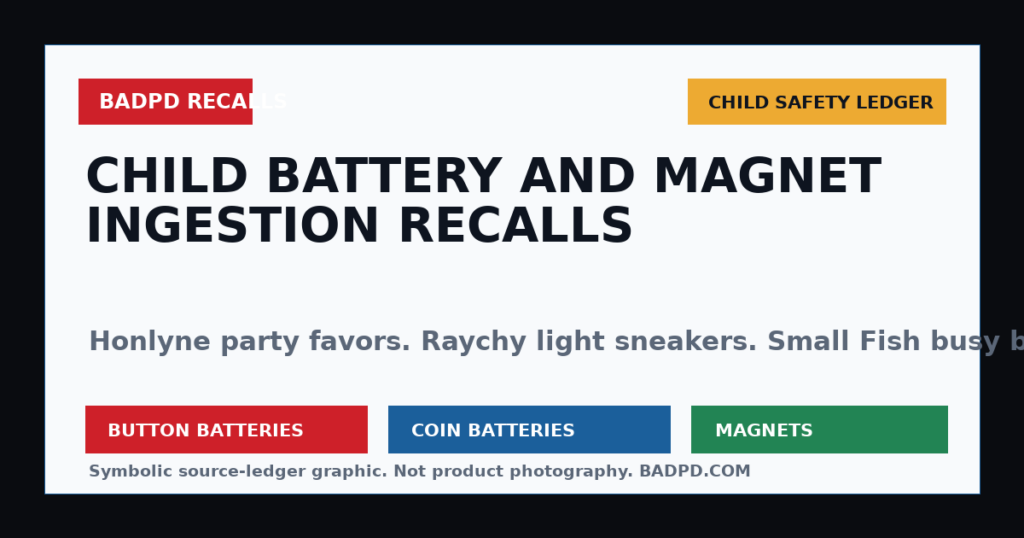
Featured image is symbolic editorial artwork created for BadPD. It is not product photography and is not a depiction of the recalled items.
Send receipts for the desk to research
Send corrections, missing records, police-accountability tips, good-cop public-service receipts, government/court/war leads, recall alerts, or property-tax help resources. Tips are leads only until BadPD verifies records.
Links, dates, agency names, docket numbers, bodycam IDs, recall numbers, forms, and official pages.
Every tip is a lead, not a fact. The desk checks records before publishing.
Use advertising inquiry when you want clearly labeled sponsor space or available ad placements on BadPD.