
FDA PDUFA VIII Public Meeting: Register, Speak and Comment by October 16
News Anchor voice
Ready when you are.
Public-record status, August 15, 2026: The Food and Drug Administration has announced a September 16 hybrid public meeting and an October 16 comment deadline for the next Prescription Drug User Fee Act agreement. The notice and dates are confirmed. Speaking slots, participant capacity, final agreement terms, submitted comments, and policy outcomes remain pending.
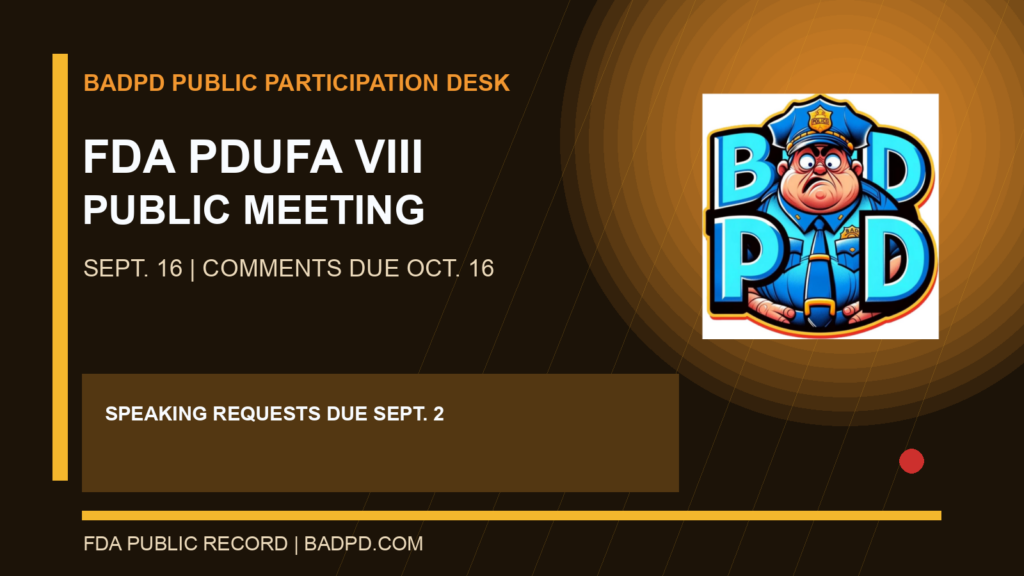
The public has a formal chance to question and shape the next five-year prescription-drug user-fee agreement. FDA will hold a hybrid meeting on Wednesday, September 16, 2026, from 9 a.m. to 2 p.m. Eastern, with written and electronic comments accepted through October 16 at 11:59 p.m. Eastern.
The Federal Register notice opens docket FDA-2026-N-8163 for the reauthorization commonly called PDUFA VIII. The next agreement would cover fiscal years 2028 through 2032.
Meeting details
- Date: Wednesday, September 16, 2026.
- Time: 9 a.m. to 2 p.m. Eastern.
- In person: FDA White Oak Campus, Building 31 Great Room, Silver Spring, Maryland.
- Online: Microsoft Teams access provided through FDA’s registration process.
- Cost: Registration is free.
- Docket: FDA-2026-N-8163.
In-person capacity is limited. People who want a seat should register early through the current FDA PDUFA VIII page. Participants should recheck that page shortly before the meeting because access instructions and agenda materials can change.
Deadlines to speak or request an accommodation
Requests to make an oral presentation are due September 2 at 11:59 p.m. Eastern. FDA says it expects to notify selected speakers by September 9. A request should identify the topic and the amount of time requested. If demand exceeds the available session, FDA may limit speaking time or combine similar topics.
Accessibility requests are also due September 2 at 11:59 p.m. Eastern. Anyone needing an accommodation should use the live FDA instructions rather than wait until the meeting day. Registration alone does not guarantee an in-person seat or a speaking slot.
A person who is not selected to speak can still attend, watch online, and submit a written comment. Written comments create a dated public record and allow more room for sources, specific recommendations, and disclosures than a short oral presentation.
What PDUFA pays for
Under PDUFA, drug manufacturers pay fees that support parts of FDA’s prescription-drug review program. Congress authorizes the program, and FDA and industry negotiate performance commitments before each reauthorization. The current authorization expires in September 2027.
User fees can fund reviewers, program operations, and review-process improvements, but they also create an accountability question: how does the agency preserve independent scientific judgment while a regulated industry supplies substantial program funding? The answer should be measured through public budgets, staffing data, review goals, missed commitments, safety outcomes, and conflict safeguards, not through slogans from either side.
The September meeting is an early public checkpoint. It is not a final vote and does not itself change the law. Any final package will still require agreement terms, public documentation, and congressional action.
Questions worth putting in the docket
Patients, clinicians, researchers, manufacturers, consumer groups, and taxpayers may have different priorities. Useful comments can still share a common standard: identify the specific program change, the evidence supporting it, the measurable result, and the public report that should show whether it worked.
Accountability questions can include:
- Which review goals improved patient access without weakening safety review?
- How should FDA report missed timelines and the reasons for delay?
- What staffing, technology, and inspection capacity should fees support?
- How will the agency measure post-market safety commitments and enforcement?
- What fee, waiver, and small-business rules need clearer public reporting?
- How will FDA disclose and manage conflicts during negotiation and implementation?
A strong comment should cite a public study, agency report, docket document, or specific experience and explain its limits. It should not expose private medical records or make an unsupported claim about a person, product, or company. Participation in this process is not medical or legal advice.
How to submit a comment
Electronic comments can be filed through Regulations.gov docket FDA-2026-N-8163. The Federal Register notice also provides instructions for written submissions. Commenters should follow the current docket instructions, clearly identify the docket number, and review how confidential information is handled before uploading anything sensitive.
The deadline in the notice is October 16, 2026, at 11:59 p.m. Eastern. A submission close to the deadline can fail because of a file, browser, or network problem, so retaining a confirmation and submitting early is the safer public-record practice.
What remains pending
FDA has not selected every speaker or announced final PDUFA VIII terms. The meeting record, public comments, negotiation commitments, fee structure, and congressional language remain pending. BadPD will treat a lobbying proposal as a proposal until it appears in a dated agency or congressional record.
Sources and dates
- Federal Register meeting notice, published August 14, 2026.
- GovInfo official PDF of the notice, Federal Register issue dated August 14, 2026.
- FDA PDUFA VIII page, linked for current registration and meeting materials.
- Regulations.gov docket FDA-2026-N-8163, linked for public comments and docket materials.
Source Trail
This fallback trail lists external receipts detected in this article metadata or article body so older receipt hubs keep a consistent audit trail.
Send receipts for the desk to research
Send corrections, missing records, police-accountability tips, good-cop public-service receipts, government/court/war leads, recall alerts, or property-tax help resources. Tips are leads only until BadPD verifies records.
Links, dates, agency names, docket numbers, bodycam IDs, recall numbers, forms, and official pages.
Every tip is a lead, not a fact. The desk checks records before publishing.
Use advertising inquiry when you want clearly labeled advertiser placement on BadPD.