
Passaic Valley Water Commission Consent Decree: Reservoir Violations Alleged
News Anchor voice
Ready when you are.
Public-record status, August 15, 2026: The Justice Department filed a complaint and lodged a proposed consent decree involving Passaic Valley Water Commission. The filing and the proposed terms are confirmed public records. The asserted violations remain allegations, the remedies and penalty remain proposed, and court approval and public-comment outcomes are pending.
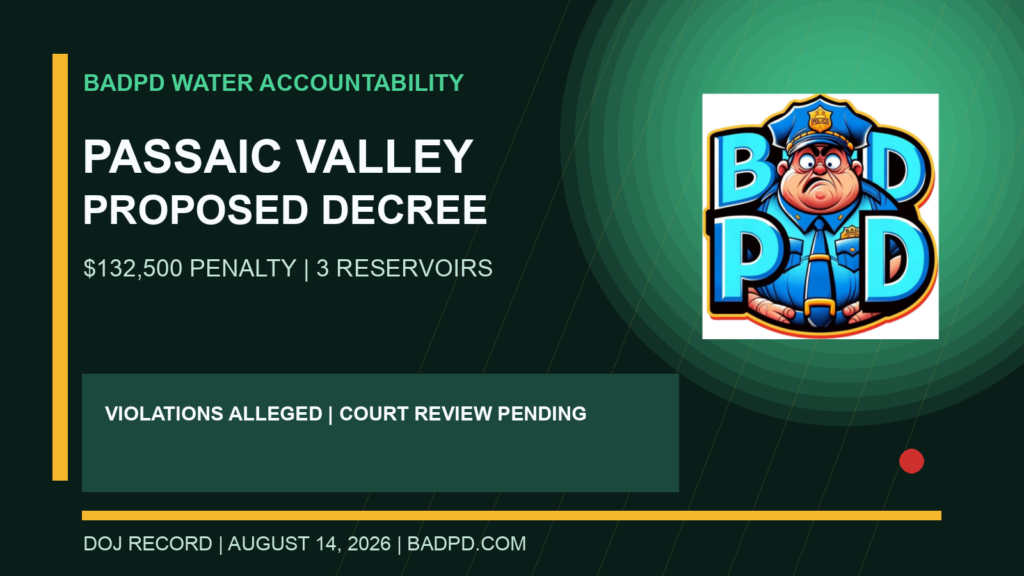
A proposed federal consent decree would require Passaic Valley Water Commission to study and complete drinking-water compliance projects, use interim protections, and pay a $132,500 civil penalty. The agreement concerns three uncovered reservoirs in northern New Jersey.
The Federal Register notice published August 14 says the Justice Department lodged the proposal on August 12 in the U.S. District Court for the District of New Jersey. The case is United States, et al. v. Passaic Valley Water Commission, Civil Action No. 2:26-cv-10199.
What the government alleges
The complaint alleges violations of the Safe Drinking Water Act and the Long Term 2 Enhanced Surface Water Treatment Rule involving the Great Notch, Levine, and New Street Reservoirs. According to the notice, federal rules require the commission to cover the reservoirs or treat water discharged from them before that water is provided for human consumption.
Those are allegations in a filed complaint. The notice does not establish a final judicial finding, and it does not say that every glass of water supplied by the commission is unsafe. BadPD will not turn a compliance allegation into a broader health claim that the public record does not make.
The distinction matters. A filed environmental case is a serious accountability record, but the legal process gives the commission and other parties a chance to respond. The proposed decree is a negotiated path toward resolution, not a final verdict.
What the proposed decree would require
The Federal Register notice summarizes three kinds of relief:
- Civil penalty: A proposed payment of $132,500.
- Compliance planning: Feasibility studies and projects intended to bring the reservoirs into compliance.
- Interim protection: Measures that would remain in place while the longer-term work is evaluated and completed.
The short notice does not replace the decree itself. People evaluating the proposal should read the lodged document for deadlines, engineering milestones, reporting requirements, enforcement language, and any provisions governing delay or modification.
A useful public-accountability question is not merely whether a project is promised. It is who must deliver it, on what date, at what cost, under what public reporting rule, and what happens if a milestone is missed. The court record and future compliance reports should answer those questions.
How public comment works
The Justice Department is accepting comments for 30 days after publication of the notice. The department identifies the matter with reference number 90-5-1-1-12573/1.
Anyone planning to comment should use the live Justice Department consent-decrees page and the Federal Register notice to verify the current deadline, submission method, subject line, and document availability. Do not rely on a third-party summary if DOJ changes an instruction or extends a deadline.
A focused comment can identify a specific decree section, reservoir, project schedule, public-health safeguard, reporting gap, or enforcement concern. A commenter should distinguish personal experience from a documented technical claim and avoid publishing private account numbers, medical details, home-security information, or unsupported accusations.
What residents should ask next
Residents and ratepayers deserve a plain-language implementation ledger if the decree is approved. That should include the selected compliance option for each reservoir, engineering and construction milestones, interim treatment or protection measures, cost allocation, missed deadlines, and links to reports filed with regulators or the court.
The public also needs clarity about how the proposed civil penalty and project costs could affect the commission’s finances. The notice does not establish a rate change. Any claim about a bill increase would need a separate rate filing, board record, budget, or other official receipt.
New Jersey and federal officials should explain how they will measure compliance and how quickly they will notify customers if a monitoring result requires action. A decree can create enforceable obligations, but accountability depends on whether milestone and monitoring data remain visible after the initial announcement.
What remains pending
The court has not yet approved the proposed decree. Public comments may lead the Justice Department to support, modify, or withdraw the proposal. The filing does not by itself prove the alleged violations, complete the projects, or establish future water-quality results.
BadPD will update the record when the court acts, a final decree becomes available, or the commission publishes a dated implementation schedule. Until then, the precise labels are: complaint filed, violations alleged, decree and penalty proposed, public comment open, and outcome pending.
Sources and dates
- Federal Register notice of lodging, published August 14, 2026; decree lodged August 12, 2026.
- GovInfo official PDF of the notice, Federal Register issue dated August 14, 2026.
- Justice Department Environment and Natural Resources Division consent-decrees page, linked for the live comment instructions and decree materials.
Source Trail
This fallback trail lists external receipts detected in this article metadata or article body so older receipt hubs keep a consistent audit trail.
Send receipts for the desk to research
Send corrections, missing records, police-accountability tips, good-cop public-service receipts, government/court/war leads, recall alerts, or property-tax help resources. Tips are leads only until BadPD verifies records.
Links, dates, agency names, docket numbers, bodycam IDs, recall numbers, forms, and official pages.
Every tip is a lead, not a fact. The desk checks records before publishing.
Use advertising inquiry when you want clearly labeled advertiser placement on BadPD.