
SSA OIG: Agency May Recover $106 Million in Overpayments After Beneficiaries Died
News Anchor voice
Ready when you are.
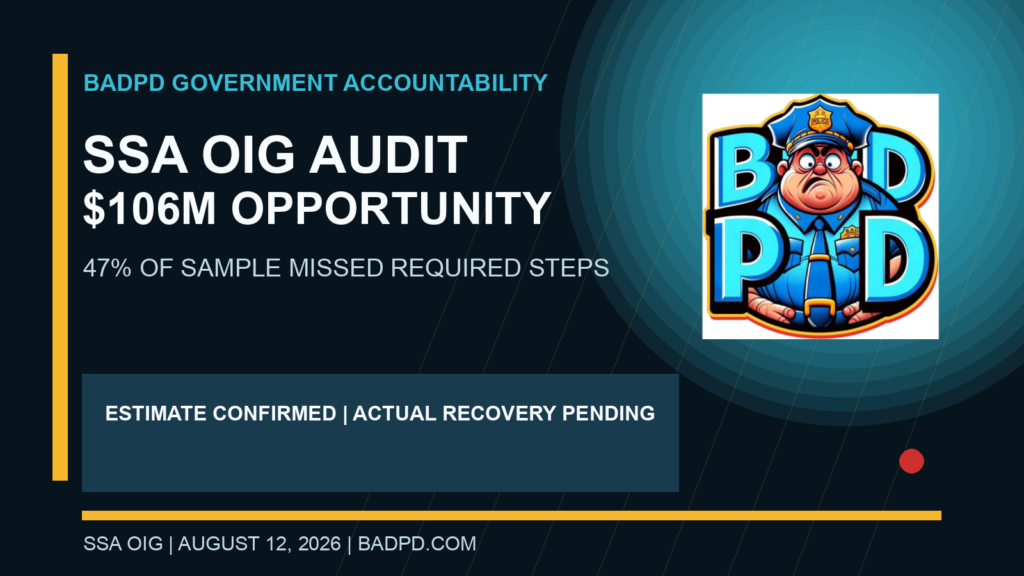
Status: CONFIRMED AUDIT FINDING. On August 12, 2026, the Social Security Administration Office of Inspector General said SSA may be able to recover about $106 million in outstanding overpayments tied to 8,486 deceased beneficiaries. That is an estimate from a sample-based audit. It is not a finding that $106 million has already been recovered, stolen, or lost forever.
The watchdog examined whether SSA employees followed the agency’s own order of recovery after beneficiaries died with unpaid balances. The answer was mixed. SSA followed policy in only 66 of 125 sampled cases, or 53 percent. It did not follow policy in 59 cases, or 47 percent.
What the auditors found
The SSA OIG release dated August 12, 2026 says auditors identified 17,979 adults who died from December 2022 through December 2024 with about $240 million in outstanding Old-Age, Survivors, and Disability Insurance overpayments.
Auditors reviewed a random sample of 125 people. In 40 cases, employees did not try to recover money from the deceased beneficiary’s estate. In 15 cases, SSA did not finish pending work involving another person who might be liable. In four cases, employees did not withhold a lump-sum death payment to offset the debt.
The full audit report, Recovery Efforts for Deceased Beneficiaries’ Overpayments, says the OIG referred the sampled cases back to SSA for corrective action. The report estimates that consistent use of existing recovery steps could let the agency pursue about $106 million owed by 8,486 deceased beneficiaries.
Why this is an agency-control problem
This is not a demand to collect blindly from every grieving family. Federal rules include notice, appeal, waiver, and liability limits. The point is simpler: a public agency should apply its written process the same way from case to case. When almost half a test sample misses that process, management controls need work.
SSA’s public guidance says an overpayment occurs when someone receives more than the agency says was due. The agency can collect in several ways. Its official overpayment page also explains that a person may appeal the amount or request a waiver. It warns that, after a beneficiary dies, SSA may seek repayment from people who receive benefits on that record.
The governing federal rule at 20 C.F.R. 404.502 lists possible recovery from an estate, amounts due an estate, a lump-sum payment, or certain later benefits. Those routes are not interchangeable in every case. That is why complete case work and accurate notices matter.
What SSA agreed to do
OIG recommended controls to make sure staff consistently pursue the required sequence. That includes checking estates, other liable people, and lump-sum death payments. According to the watchdog, SSA agreed with the recommendation.
Agreement is not completion. The next useful receipts are a target date, the control SSA selects, the number of cases reviewed, money actually recovered, and the number of debts waived or found uncollectible after proper review.
What remains unknown
The audit does not say SSA will collect the entire $106 million. Some estates may have no assets. Some debts may be waived. Others may be barred or too expensive to pursue. The estimate also comes from a sample, not a case-by-case decision on all 8,486 accounts.
BadPD will treat the $106 million as a recovery opportunity until SSA publishes actual results. Taxpayers deserve the same thing beneficiaries and families deserve: consistent rules, correct notices, working appeals, and a public accounting of what the agency fixed.
Source ledger
- SSA OIG news release, August 12, 2026: confirmed audit summary and recommendation.
- SSA OIG audit 032406: confirmed sample, projection, methods, and agency response.
- SSA overpayment guidance and 20 C.F.R. 404.502: confirmed public process and legal recovery routes.
Send receipts for the desk to research
Send corrections, missing records, police-accountability tips, good-cop public-service receipts, government/court/war leads, recall alerts, or property-tax help resources. Tips are leads only until BadPD verifies records.
Links, dates, agency names, docket numbers, bodycam IDs, recall numbers, forms, and official pages.
Every tip is a lead, not a fact. The desk checks records before publishing.
Use advertising inquiry when you want clearly labeled advertiser placement on BadPD.