
ATF National Tracing Center Audit: 38,000 Record Boxes Backlogged as Firearm Trace Requests Rise
News Anchor voice
Ready when you are.
Status as of August 13, 2026: The Justice Department Office of the Inspector General released Audit Report 26-079 and made three recommendations to the Bureau of Alcohol, Tobacco, Firearms and Explosives. ATF agreed with all three. OIG lists the recommendations as resolved, but not closed; closure still requires implementation evidence.
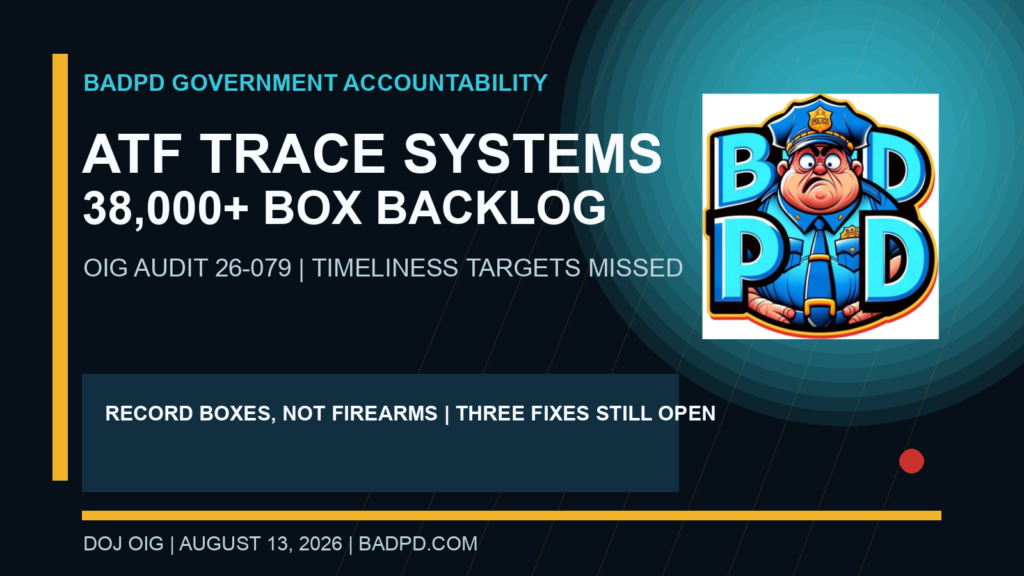
The federal center that traces guns recovered in criminal investigations got faster while its workload climbed. It also missed two timeliness targets, relied on scattered instructions and employee-made “cheat sheets,” fought recurring technology failures, and watched an unscanned paper-record backlog grow beyond 38,000 boxes.
Those findings come from the DOJ OIG audit of ATF’s National Tracing Center, released August 13, 2026. This is an operational audit. It does not accuse ATF employees of crimes, and the 38,000 figure refers to boxes of firearm transaction records, not 38,000 guns or gun owners.
The workload rose faster than the budget
Law-enforcement trace requests rose 30 percent between fiscal years 2020 and 2024, from 490,844 to 639,295. Completed traces rose 34 percent, from 482,044 to 645,965. Over the same period, the National Tracing Center budget rose about 20 percent, from $31 million to $38 million.
NTC officials told auditors that the center receives an average of 1,500 to 2,000 requests per day and has roughly 10,000 to 15,000 active traces at any given time. More than 10,000 law-enforcement agencies were participating in eTrace by the end of the audit period, up from about 8,200 in 2020.
The audit gives the center real credit: it kept pace with higher demand and reduced average completion time. Average urgent-trace time fell from 3.35 days in fiscal 2020 to 0.46 days in fiscal 2024. Average routine-trace time was 10.04 days in 2020, rose to 16.98 days in 2021, and fell to 5.80 days in 2024.
That improvement matters. It does not erase the targets the center still missed.
No trace-request backlog, but two missed targets
OIG drew an important distinction: the center did not have a backlog of pending trace requests from law-enforcement agencies. Its large backlog was unscanned paper records from gun dealers that had gone out of business.
For fiscal 2024, the center completed 92.1 percent of urgent traces within 48 hours, below ATF’s 95 percent target. It completed 61.9 percent of routine traces within seven days, well below the 75 percent target.
ATF changed the urgent-trace process in August 2024, assigned experienced ATF employees to complete an urgent trace from start to finish, and added a weekend shift. OIG reported that the center met the urgent target in the first quarter of fiscal 2025. That is a promising improvement, but it does not answer whether the gains lasted or whether routine traces reached their target.
The paper backlog passed 38,000 boxes
When a federally licensed firearms dealer goes out of business, required transaction records are sent to ATF. The tracing center scans those records into non-searchable image files and indexes them for use in traces. Nearly half of completed firearm traces involve these out-of-business records, according to OIG.
The unscanned backlog increased from more than 18,000 boxes in fiscal 2020 to more than 29,000 boxes in September 2024. A report footnote updates the count to more than 32,000 boxes in September 2025 and more than 38,000 in March 2026.
The center estimated that clearing the then-current backlog would take about 18 months if no additional records arrived. New records did keep arriving. OIG found that incoming volume generally exceeded scanning capacity, which makes a simple “work harder” answer inadequate. ATF needs a measurable plan that accounts for staffing, equipment, incoming volume, storage, and legal limits.
The delay is not abstract. In OIG’s sample, personnel took an average of two days to locate an unscanned paper record. They found scanned records the same day. Boxes were stored across two facilities, forcing personnel to identify likely boxes and search documents manually.
Paper also creates a preservation risk. Until a record is scanned, the paper may be the only copy. OIG cited risks from damage, degradation, and disasters, while noting that ATF had moved records from outside containers into secure, climate-controlled space.
A national tracing function ran on scattered guidance
OIG found no standardized, centralized procedure covering the tracing process from start to finish. Policies, training references, and instructions were spread across documents. Materials focused more on straightforward traces than complex technical scenarios.
Personnel filled the gaps through word of mouth, personal notes, and “cheat sheets.” That may keep work moving in the short term. It is not a durable knowledge system for a national law-enforcement function, especially when experienced personnel leave or contractors change.
OIG’s first recommendation tells ATF to build centralized operational and technical guidance and distribute it to NTC personnel. ATF said it would update standard operating procedures and work instructions and publish them in a centralized repository. OIG still wants evidence that this work was completed and distributed before closing the recommendation.
Auditors watched systems interrupt active traces
Auditors observed network disruptions during live demonstrations. Personnel had to pause or restart traces, including some that were nearly complete. Officials also described workflow stalls, timeouts, technology staffing shortages, and software patches that brought back previously fixed errors.
The center did not track the number of network outages. That means the public audit documents the problem but cannot quantify its frequency or total effect. OIG made no separate IT recommendation, instead urging continued cooperation between the tracing center and ATF’s Office of Science and Technology.
That leaves a basic management question open: if an agency says outages are slowing a time-sensitive national system, why is it not measuring the outages?
ATF’s “successful” code did not mean a purchaser was found
The center coded a trace as successful when personnel traced a firearm as far as available records allowed. That did not necessarily mean a purchaser was identified. OIG reviewed successful-coded traces that did not identify one.
The center and requesting agencies also did not routinely exchange outcome information showing whether a trace contributed to an arrest, prosecution, or trafficking disruption. OIG did not require ATF to build an arrest or prosecution feedback system. Its narrower third recommendation requires ATF to track whether a trace identified a purchaser and report the percentage that did.
ATF said it already has that capability and has published related data through calendar year 2021. OIG still requires current evidence that the center records and maintains the measure before closing the recommendation.
Resolved is not closed
ATF agreed to all three recommendations: centralize tracing guidance, create and implement a formal strategy to reduce and eliminate the paper backlog within existing resources, and track purchaser identification.
OIG therefore marked the recommendations resolved. In federal audit language, that means the agency’s planned response is acceptable. It does not mean the work is finished. Each recommendation remains open until ATF supplies evidence and OIG accepts it.
BadPD will track four receipts next: closure evidence for all three recommendations, the backlog trajectory after March 2026, outage-frequency data, and implementation dates. Promises are the starting line. Closure evidence is the finish line.
Legal boundary: tracing is not a federal gun registry
Federal law restricts creation of a searchable federal registration system for firearms, owners, or transactions. The OIG report says the technology components auditors reviewed did not appear to create a prohibited searchable purchaser database. OIG also states that testing legal compliance with those restrictions was outside this audit’s scope.
That boundary matters in both directions. The paper and non-searchable-image process cannot be fairly described as proof of an illegal registry, and statutory limits should not become an excuse for unmanaged boxes, unmeasured outages, or undocumented procedures.
Dated source trail
- DOJ OIG release, August 13, 2026: audit summary, three findings, and ATF concurrence.
- DOJ OIG report page, August 13, 2026: Report 26-079, audit classification, and three recommendations.
- Full OIG audit, August 2026: methodology, fiscal-year data, backlog updates, system findings, recommendations, ATF response, and closure requirements.
Correction and update policy: BadPD will update this report when OIG closes a recommendation, ATF publishes newer backlog or trace-performance data, or either agency corrects the underlying record.
Source Trail
This fallback trail lists external receipts detected in this article metadata or article body so older receipt hubs keep a consistent audit trail.
Send receipts for the desk to research
Send corrections, missing records, police-accountability tips, good-cop public-service receipts, government/court/war leads, recall alerts, or property-tax help resources. Tips are leads only until BadPD verifies records.
Links, dates, agency names, docket numbers, bodycam IDs, recall numbers, forms, and official pages.
Every tip is a lead, not a fact. The desk checks records before publishing.
Use advertising inquiry when you want clearly labeled advertiser placement on BadPD.