
Darwin’s Raw Pet Food Lawsuit: DOJ Seeks Halt After FDA Pathogen and Recall Allegations
News Anchor voice
Ready when you are.
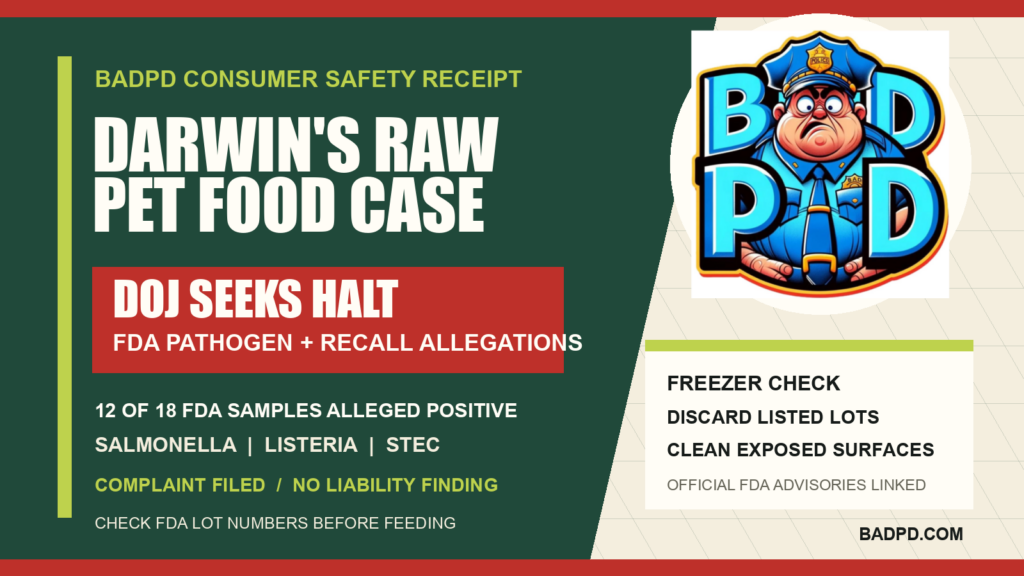
Source status, August 11, 2026: The Justice Department has filed a civil complaint asking a federal court to stop Arrow Reliance Inc., which does business as Darwin’s Natural Pet Products, and company president Gary T. Tashjian from manufacturing or distributing pet food until specified federal requirements are met. These are government allegations. The defendants have not been found liable, and no final injunction is reflected in the source package reviewed by BadPD.
Consumer action: FDA advisories identify specific Darwin’s lots that the agency says should not be fed to pets. Check frozen packages before use. FDA says affected food should be discarded in a secure container, not donated, and that exposed pet supplies, food-preparation areas, refrigerators, freezers, and other surfaces should be cleaned and disinfected. Contact a veterinarian or health-care provider about symptoms; this article is not medical or veterinary advice.
The lawsuit turns a long-running food-safety dispute into a direct federal court test. DOJ says the company kept producing nationally distributed raw pet food after repeated FDA inspections, laboratory findings, warning letters, and recall requests. The company will have the opportunity to answer those allegations in court.
The lawsuit asks a judge to halt production.
DOJ’s August 11 announcement says the United States filed the case on August 7 in the U.S. District Court for the Western District of Washington. The 24-page complaint, case 2:26-cv-02805, seeks a permanent injunction under the Federal Food, Drug, and Cosmetic Act.
The requested order would prevent production and distribution until the defendants complete sanitation improvements, comply with preventive-control requirements, and satisfy other conditions. A requested remedy is not a court order. DOJ’s release expressly says the government would have to prove the complaint’s claims by a preponderance of the evidence if the case proceeds to trial.
The complaint says the Tukwila, Washington, operation produces approximately 85,000 pounds of finished raw pet food per week. It alleges roughly 8% is shipped directly to Washington customers, 36% directly to customers in other states, and 56% through warehouses in Pennsylvania and Texas. That alleged distribution footprint is why this is a national consumer-safety case, not a local plant dispute.
What FDA testing allegedly found.
The complaint alleges that 12 of FDA’s 18 most recent samples of Darwin’s finished raw pet food collected since 2023 contained pathogens: nine with Salmonella, one with Listeria monocytogenes, and two with both. It also alleges that third-party testing in 2025 found two lots with Salmonella and one with Shiga toxin-producing E. coli, or STEC.
Those numbers describe samples, not the percentage of every package sold. They do not by themselves prove that every Darwin’s product was contaminated. They do support the government’s demand for lot-level records, sanitation evidence, and an enforceable preventive-control plan.
The complaint further alleges FDA inspections in 2017-2018, 2018-2019, 2021, 2022, 2023, and 2024. It describes rusted or pitted equipment, deeply cut and discolored cutting boards, and water or debris on sanitizer containers during the 2024 inspection. The defendants may dispute those descriptions; the court has not adjudicated them.
The child case is serious, but the exposure route still matters.
FDA’s July 29, 2025 advisory says a four-year-old child developed an STEC infection and hemolytic uremic syndrome in August 2024 and required hospitalization and follow-up care. FDA says whole-genome sequencing showed an exact genetic match between E. coli O157:H7 in the child’s stool sample and a closed Darwin’s beef dog-food sample from the household freezer.
FDA also says the child had direct contact with the family dog but no known direct contact with the food. The agency described exposure through the dog, its waste, or contaminated objects and surfaces as a possible route. That distinction matters: the genetic match is a strong laboratory receipt, while the precise transmission path remains an inference rather than a witnessed event.
The July 2025 advisory identifies three frozen products: BioLogics Beef Recipe for Dogs lot 10662, BioLogics Chicken Recipe for Dogs lot 10683, and Natural Selections Duck Recipe for Dogs lot 10638. FDA said the products had no expiration date on the label and could remain in consumers’ freezers.
Check these later FDA advisory lots too.
FDA’s September 24, 2025 advisory identifies two BioLogics Beef Recipe for Dogs lots: 11895, manufactured July 29, 2025, and 11826, manufactured July 7, 2025. FDA says one sample tested positive for Listeria and the other for both Salmonella and Listeria.
The agency said Arrow Reliance reportedly notified customers about Listeria and a withdrawal, but had not provided enough documentation to show the food was removed from the marketplace and customer freezers. FDA also said one customer letter did not disclose the Salmonella finding. That is FDA’s account; BadPD has not independently obtained the customer letter or the company’s full submission.
An earlier September 20, 2024 advisory identifies six Natural Selections chicken lots: cat-food lots 10832, 10856, and 10890, and dog-food lots 10828, 10844, and 10887. FDA said five samples tested positive for Salmonella and one for both Salmonella and Listeria. Consumers should rely on the linked FDA pages for package photographs and the agency’s current instructions.
Illness and death figures are reports, not causation findings.
The complaint alleges that FDA received 49 consumer complaints connected to Darwin’s products from 2016 through January 2026. Within those reports, 34 dogs were reported sick, including five reported deaths, and 35 cats were reported sick, including four reported deaths.
Those are adverse-event reports. They are not nine adjudicated findings that the food caused nine deaths. A report can trigger sampling and investigation, but causation requires case-specific medical, veterinary, laboratory, and exposure evidence. BadPD will not turn a complaint count into a proven death total.
The government does cite more specific evidence in some episodes. For example, the complaint alleges sequencing linked Salmonella from a 2017 cat-food sample to an isolate from a kitten’s liver after the kitten died. That remains an allegation in the new civil case, not a finding entered after trial.
The recall history is not one-sided.
FDA’s public record shows Darwin’s did conduct voluntary recalls in 2018. An FDA-hosted company announcement covered four lots after testing found Salmonella or STEC. The company said it believed the risk to dogs was low, pointed to food-handling instructions, told customers to discard affected food, and offered replacement product.
The new complaint alleges a different pattern later: FDA recommended or formally requested recalls in 2022, 2023, 2024, and 2025, while the defendants declined or did not complete recalls acceptable to the agency. In 2022, the company sued federal officials over an FDA public notice. A federal judge later dismissed that Administrative Procedure Act case, concluding the notice was not final agency action subject to that challenge.
That history gives the defense context without erasing the government’s case. The company has previously recalled products and has publicly disputed FDA’s risk framing. As of this review, BadPD had not located a filed answer to the August 2026 complaint or a current company statement addressing every new allegation.
What the court and FDA still need to make public.
- Has the company continued manufacturing or shipping since the August 7 filing, and under what controls?
- Which lots remained in commerce or customer freezers after each FDA recall request?
- What documentation did the company provide for its 2025 customer notification and withdrawal?
- Which consumer complaints had a laboratory match, a veterinary diagnosis, both, or neither?
- What independent testing, environmental monitoring, and sanitation verification would satisfy a final injunction?
- Has the court set a response deadline, hearing, consent-decree process, or interim restriction?
The public-interest standard is straightforward. FDA should publish lot-level safety instructions and segregable testing records promptly. The company should answer the complaint with evidence, not slogans. And the court should distinguish proven facts from disputed claims as the record develops.
Dated source ledger.
- Justice Department announcement, dated and updated August 11, 2026. Source for the filing date, requested injunction, parties, allegation summary, and burden-of-proof notice.
- United States v. Arrow Reliance Inc. complaint, filed August 7, 2026. Source for the case number, production and distribution allegations, inspection history, testing figures, consumer-report counts, and requested relief.
- FDA September 2025 advisory, dated September 24, 2025. Source for lots 11895 and 11826, test results, customer-notification description, and disposal guidance.
- FDA July 2025 advisory, dated July 29, 2025. Source for lots 10662, 10683, and 10638, the child case, genomic match, exposure limitation, and freezer warning.
- FDA September 2024 advisory, dated September 20, 2024. Source for six Natural Selections chicken lots, laboratory results, and cleaning instructions.
- FDA-hosted 2018 company recall announcement, dated March 26, 2018. Source for the four-lot voluntary recall, company risk position, disposal direction, and replacement offer.
- FDA warning letter to Arrow Reliance, dated April 2, 2018. Source for FDA’s earlier inspection, sampling, and compliance position.
Correction and update policy: BadPD distinguishes laboratory results, consumer reports, government allegations, company statements, court findings, and proven causation. Send a dated primary record or documented correction through the site contact page. We will add a visible update note when the court or company responds.
Source Trail
This fallback trail lists external receipts detected in this article metadata or article body so older receipt hubs keep a consistent audit trail.
- www.justice.gov/opa/pr/justice-department-files-complaint-stop-washington-firm-manufacturing-…
- www.justice.gov/opa/media/1457006/dl
- www.fda.gov/animal-veterinary/outbreaks-and-advisories/fda-advisory-do-not-feed-certain-lots-…
- www.fda.gov/animal-veterinary/outbreaks-and-advisories/fda-advisory-do-not-feed-two-lots-darw…
- www.fda.gov/animal-veterinary/outbreaks-and-advisories/fda-advisory-do-not-feed-certain-lots-…
- www.fda.gov/safety/recalls-market-withdrawals-safety-alerts/darwins-natural-pet-products-issu…
- www.fda.gov/inspections-compliance-enforcement-and-criminal-investigations/warning-letters/ar…
Send receipts for the desk to research
Send corrections, missing records, police-accountability tips, good-cop public-service receipts, government/court/war leads, recall alerts, or property-tax help resources. Tips are leads only until BadPD verifies records.
Links, dates, agency names, docket numbers, bodycam IDs, recall numbers, forms, and official pages.
Every tip is a lead, not a fact. The desk checks records before publishing.
Use advertising inquiry when you want clearly labeled advertiser placement on BadPD.