
Salt Lake City Police De-Escalate Call Involving Autistic Child, Department Says: A Good Cop Wall Training Receipt
News Anchor voice
Ready when you are.
Status: source-cleared department public-service receipt. The family is not identified.
On July 28, 2026, the verified Salt Lake City Police Department Instagram account posted this video. It shows the result the public should expect when officers spot the difference between a crime report and a person in crisis. Slow the scene down. Make space. Communicate. Keep everyone safe.
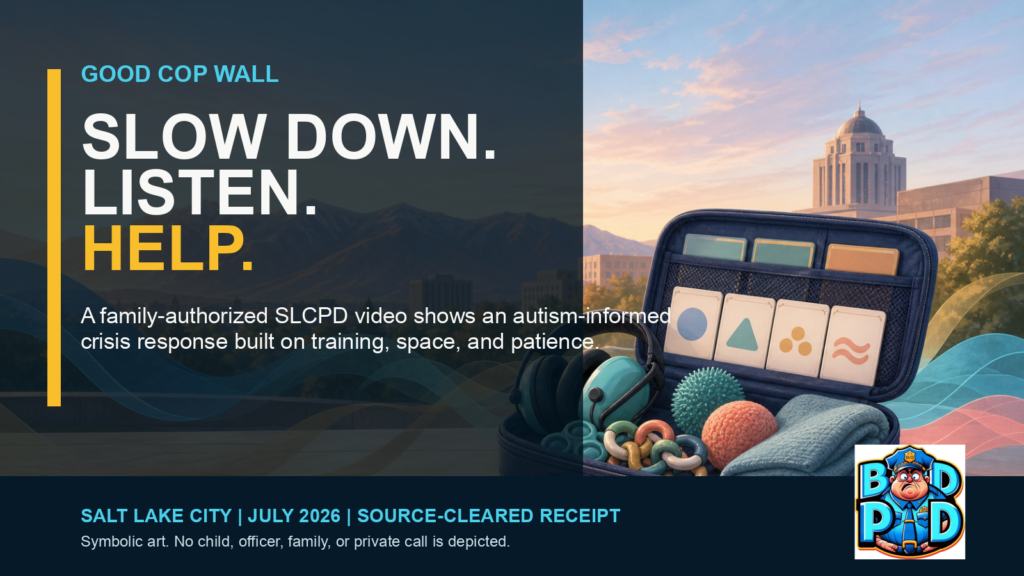
The department says the video was shared with the family’s permission. It says officers were dispatched to a report of an assault involving an elderly woman, then recognized on arrival that they were dealing with an autistic child in crisis. SLCPD says officers adjusted their approach, de-escalated, and used specialized training and sensory-support tools to reduce overload and communicate more safely.
This belongs on the Good Cop Wall because the conduct is specific, the source is the department’s verified account, and the training claim has public records behind it. This story also needs care. BadPD is not naming the child, family, officers, address, call number, or health details. The reel is not a full incident report. We are not rebuilding a private family emergency from a short video. We report what the department said. We link the original video. We also check whether the training and sensory tools are real.
Watch the official source video
Video source: verified Salt Lake City Police Department Instagram reel, July 28, 2026. The department states that the family gave permission for its post. BadPD embeds the original source and does not download, re-edit, or rehost the family’s crisis video.
What SLCPD says happened
SLCPD’s caption makes the call a lesson in recognition. The officers came for one type of complaint. Within moments, they saw a different need. They changed their approach. The department says they de-escalated and kept the people there safe. That is the right public standard. A distressed child should not be pushed into a normal enforcement script just because the first dispatch note sounded alarming.
The caption says many officers have a personal link to autism. It also says the department trains officers to spot mental-health and developmental crises. Personal experience can build empathy. Still, the key test is training, policy, and tools. Care should not rely on an officer knowing someone with the same diagnosis. It should be part of the job.

The training receipt behind the caption
The program is not just a social-media claim. In 2020, SLCPD announced a KultureCity partnership for Certified Sensory Inclusive training for police, fire, and 911 staff. The department said the training would build understanding, acceptance, and empathy for people with sensory needs. It also described a voluntary Autism Safe Registry. The registry can give responders useful details at an address.
In 2021, Salt Lake City said more than 90% of its first responders had been trained and certified through the program. The city also said first-responder vehicles had a sensory bag and a decal for trained staff. Those records support the reel’s basic claim. Sensory tools and sensory-inclusive training were already part of the city’s response plan. They were not a prop made for a viral post.
SLCPD’s policy manual also says annual training must include 16 hours on mental health, crisis response, arrest control, and de-escalation. A rule on training does not prove each fact about one private call. It does show that the department treats crisis response and de-escalation as core work.
Why this belongs on the Good Cop Wall
Good police work is not only about catching someone after harm is done. It is also about seeing when a scared or overwhelmed person needs a safer approach. The goal is to stop a confusing call from turning into injury, force, or trauma. The public can ask for a high bar. Training must be real. Tools must be there. Officers must use them. Departments must protect the dignity of people in crisis.
On the facts released by SLCPD, this call appears to have met that standard. The department says its officers recognized an autistic child in crisis, slowed down, de-escalated, and kept everyone safe. The family permission statement matters. The documented sensory-inclusive program matters. The decision not to name or expose the child matters.
BadPD will update this receipt if SLCPD releases a public incident summary, names officers for recognition, or adds key facts. Until then, the fair headline is simple. Officers reportedly used training and patience to make a hard call safer for a child and family.
Source Ledger
- Verified Salt Lake City Police Department Instagram reel (July 28, 2026) – Primary department video and caption. SLCPD says the family authorized sharing and describes the reported dispatch, de-escalation, training, and sensory-kit context.
- SLCPD: KultureCity Certified Sensory Inclusive training announcement (October 15, 2020) – Primary department announcement describing sensory-inclusive training, its goals, annual recertification, and the Autism Safe Registry.
- Salt Lake City: Sensory Inclusive City recognition (August 20, 2021) – Primary city record stating that more than 90% of first responders were trained and that vehicles were equipped with sensory bags.
- Salt Lake City Police Department policy manual, Training Policy 204 (May 2, 2024) – Department policy manual stating annual certified training includes 16 hours focused on mental-health and other crisis-intervention responses, arrest control, and de-escalation training.
- SLCPD: 21 officers graduate police academy (July 18, 2024) – Primary department account describing academy and field-training coverage of crisis intervention and de-escalation.
Send receipts for the desk to research
Send corrections, missing records, police-accountability tips, good-cop public-service receipts, government/court/war leads, recall alerts, or property-tax help resources. Tips are leads only until BadPD verifies records.
Links, dates, agency names, docket numbers, bodycam IDs, recall numbers, forms, and official pages.
Every tip is a lead, not a fact. The desk checks records before publishing.
Use advertising inquiry when you want clearly labeled advertiser placement on BadPD.