
Sviyatp Pool Drain Cover Recall July 2026: CPSC Says Stop Using Pools Until Covers Are Replaced
News Anchor voice
Ready when you are.
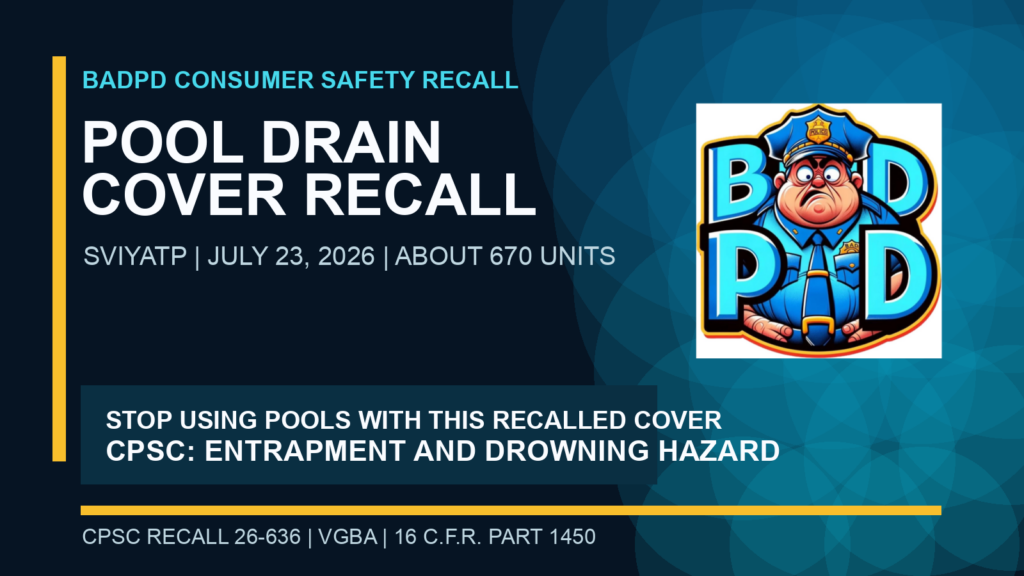
Recall status: confirmed by the U.S. Consumer Product Safety Commission. Pool owners, pool operators, and consumers should stop using pools with recalled Sviyatp pool drain covers until the covers have been removed and replaced, according to a July 23, 2026 CPSC recall. The agency says the covers violate the anti-entrapment protection standards in the Virginia Graeme Baker Pool and Spa Safety Act and can create entrapment and drowning hazards.
The recall is specific to Sviyatp white replacement pool drain covers. It is not a finding that every drain cover or every pool is unsafe. But it is a plain reason to identify the cover before another swimmer gets in the water.
What CPSC says is recalled
CPSC says the recall involves a white Sviyatp replacement pool drain cover. The product itself has no label or product identification. The clear package is marked “X0050114ZZ,” “SV-SP1030-001,” “Sviyatp Dual Suction Outlet,” and “MADE IN CHINA.” The package includes two stainless-steel screws.
According to the federal recall, about 670 units were sold online at Amazon.com from March 2026 through June 2026 for about $18. CPSC lists Shenzhen Meilanxiang Trading Co., Ltd., doing business as Sviyatp, as the retailer and says the covers were manufactured in China. The agency’s recall record listed no incidents or injuries at the time of publication. No incidents reported does not make an unsafe product safe; it means the agency had not listed reports in that notice.
What owners and operators should do
CPSC’s action instruction is immediate: stop using pools with the recalled drain covers. The agency directs owners and operators to contact Sviyatp for a full refund. The stated process is to remove the cover, write “RECALL” on it, take a photograph, and dispose of it. If feasible, CPSC says to disable the cover by cutting its perimeter structure so it cannot be reinstalled or used again.
The consumer contact identified in the recall is SviyatpRecall@qq.com. Keep the order record, photos, packaging, and any correspondence. Those materials help establish that the product is the recall item and create a paper trail if a refund problem develops.
Confirmed: CPSC recalled about 670 Sviyatp pool drain covers on July 23, 2026.
Confirmed: CPSC says the covers violate VGBA entrapment-protection standards and pose entrapment and drowning hazards.
Confirmed: the recall page listed no incidents or injuries when published.
Not established: whether a particular installed cover is recalled. Check the package identifiers, purchase record, and the CPSC notice.
Why a drain cover is not a cosmetic part
Drain covers are part of a pool or spa’s anti-entrapment system. CPSC’s business guidance says the federal law requires pool and spa drain covers manufactured, distributed, or entered into U.S. commerce to comply with the applicable performance standard, now administered through 16 C.F.R. part 1450. The guidance says public pools and spas have needed compliant anti-entrapment covers since December 19, 2008. In certain single-drain or closely spaced-drain configurations, a secondary device or system is also required to prevent entrapment.
That does not mean a consumer should attempt to diagnose compliance by looking at an online listing or by improvising a replacement. Drain-cover compatibility, rating, installation, and the rest of the pool’s suction system matter. A recalled cover should not be sold, donated, or put back into service. Pool operators should use qualified service and the applicable safety requirements to ensure a replacement is appropriate for the system.
How to check the receipt
Start with the packaging and your Amazon order history. Compare the package words and product code to the CPSC recall notice. If the cover is installed and the product cannot be identified safely, pause use of the pool and seek qualified pool-service assistance rather than reaching into a live suction system. CPSC also directs the public to ensure pools and spas have VGBA-compliant covers and to teach children to stay away from drains.
BadPD is preserving the official recall link and the federal standard reference below so consumers can check the primary record rather than relying on a repost. If CPSC updates the remedy, incident count, or product identifiers, this article should be updated with that new receipt.
Recall versus warning: why the distinction matters
CPSC publishes both recalls and product-safety warnings. They are not interchangeable. This notice is a recall with a stated full-refund remedy, a listed contact, and a recall number: 26-636. A separate CPSC warning can arise when the seller will not cooperate or when a consumer remedy is not available. Consumers who see a social-media post should check the CPSC page to learn which type of action it is, what product is covered, and what the agency says to do next.
The distinction also helps prevent a common mistake: treating a generic marketplace listing as a complete product record. The recall identifies packaging language and the included screws because an installed cover itself may have no label. Order history, package photographs, a receipt, and an e-mail confirmation may be more useful than the current product page, which can change or disappear after a recall.
A practical safety checklist without improvising a repair
First, do not allow swimming in a pool with a confirmed recalled cover. The CPSC instruction is to stop using pools with the recalled covers until they have been replaced. Second, preserve the evidence: photograph the cover and packaging in place if that can be done without putting anyone at risk, then save the order number and seller information. Third, follow the CPSC remedy instructions for the refund rather than sending a product to an unverified address found in a comment thread.
Fourth, do not assume that a cover with a similar diameter, color, or two-screw layout is an acceptable replacement. A drain cover is part of a specific suction-outlet fitting assembly. Compatibility, installation, flow rating, the plumbing configuration, and the rest of the protective system are not determined by a quick visual match. For an installed or public-pool system, qualified pool-service help and the applicable inspection requirements are safer than an improvised swap.
Fifth, do not pass the recalled cover along. CPSC tells consumers not to put the product back into use; its refund procedure calls for marking and disposal and, where feasible, disabling the cover so it cannot be reinstalled. That is an important part of recall accountability. A removed cover sitting in a shed, offered online, or handed to another owner can re-enter the market without its recall history.
What the federal rule does and does not tell a homeowner
CPSC’s guidance identifies the governing federal framework: the Virginia Graeme Baker Pool and Spa Safety Act and 16 C.F.R. part 1450. The guidance says manufacturers and importers of covered drain covers must certify compliance through a General Certificate of Compliance. It also explains that public pools and spas have had federal anti-entrapment-cover requirements since 2008, with additional protection needed in certain drain configurations.
That framework is not a do-it-yourself certification. It does not tell a resident that every white replacement cover is unsafe, nor does it let a homeowner confirm an installed product merely by reading an old package. It does explain why a product recall should be taken seriously: drain-cover performance is regulated because the hazard is tied to the system, not to a cosmetic defect.
Local construction, health, building, and pool rules can add requirements. This BadPD report is a public-safety resource, not engineering, inspection, or legal advice. A public-pool operator should follow its local authority, maintenance program, and qualified professional requirements in addition to following the CPSC recall. A resident with an uncertain installed cover should get a qualified assessment before reopening the pool.
The record the public should be able to see
Product safety improves when a recall leaves a searchable record. In this case, the CPSC record preserves a date, seller name, sales window, unit estimate, price, package identifiers, hazard, remedy, and contact method. That is enough for a purchaser to begin a check, but it also exposes a broader accountability issue: consumer marketplaces need fast, accurate ways to notify buyers when a regulated replacement part is recalled.
BadPD will not infer a marketplace’s internal actions without receipts. The CPSC notice says the covers were sold on Amazon.com; it does not, by itself, establish what notice every buyer received or whether every listing was removed. If a buyer did not receive notice, the purchaser can preserve the order record and report the experience to CPSC through SaferProducts.gov. If there is an immediate emergency, call 911 or the local emergency number first.
Questions still worth asking
The CPSC notice listed no incidents or injuries when it was issued. That is a status point, not a guarantee that none will ever be reported. CPSC can update recall information as new reports or remedy details emerge. The public questions are simple: How many buyers were directly notified? Did purchasers receive the promised refund? Were recalled covers removed from resale? And will the agency update the record if incidents, injuries, or a broader distribution footprint are confirmed?
Those are the right questions because they can be answered with records. This article will be corrected or expanded if CPSC changes the recall, publishes additional identifiers, or reports new verified incident information.
Timeline and source status
The timeline in the current federal record is narrow and useful. CPSC dated the recall July 23, 2026. It says the affected covers were sold from March through June 2026 and estimates about 670 units. That sales window is the right place for consumers to begin looking through account history and saved order confirmation e-mails. It is not evidence that a pool was safe before the recall date or unsafe after the stated sales period; it identifies the products included in the agency’s published action.
The product’s lack of labeling on the cover creates a practical identification problem. CPSC’s inclusion of the clear-package wording is therefore not minor detail. Consumers, property managers, and service companies should retain that wording in their work orders and refund notes so another person can understand why a cover was removed. A maintenance log should record the date a suspected cover was taken out of service, who evaluated the system, and what replacement was installed. That is ordinary safety documentation, not an accusation against a pool owner.
The federal agency, not BadPD, is the authority for the hazard and recall instructions quoted in this report. BadPD’s role is to preserve the source, give purchasers usable identifiers, and track whether the public remedy works. The source ledger below links the recall, CPSC’s compliance guide, and the current regulation so readers can audit every material claim.
Source Ledger
- CPSC recall: Sviyatp Pool Drain Covers (July 23, 2026) – Primary recall record: affected product, 670-unit estimate, sale period, hazard, remedy, contact, and listed incident count. Recall 26-636.
- CPSC pool and spa drain-cover guidance (Accessed July 28, 2026) – Federal compliance context under the Virginia Graeme Baker Pool and Spa Safety Act and 16 C.F.R. part 1450.
- eCFR, 16 C.F.R. Part 1450 (Accessed July 28, 2026) – Current federal regulatory text for the Virginia Graeme Baker Pool and Spa Safety Act.
Send receipts for the desk to research
Send corrections, missing records, police-accountability tips, good-cop public-service receipts, government/court/war leads, recall alerts, or property-tax help resources. Tips are leads only until BadPD verifies records.
Links, dates, agency names, docket numbers, bodycam IDs, recall numbers, forms, and official pages.
Every tip is a lead, not a fact. The desk checks records before publishing.
Use advertising inquiry when you want clearly labeled advertiser placement on BadPD.