
Santa Fe HUD Grant Fraud Settlement: $735,000 Housing-Funds Accountability Ledger
News Anchor voice
Ready when you are.
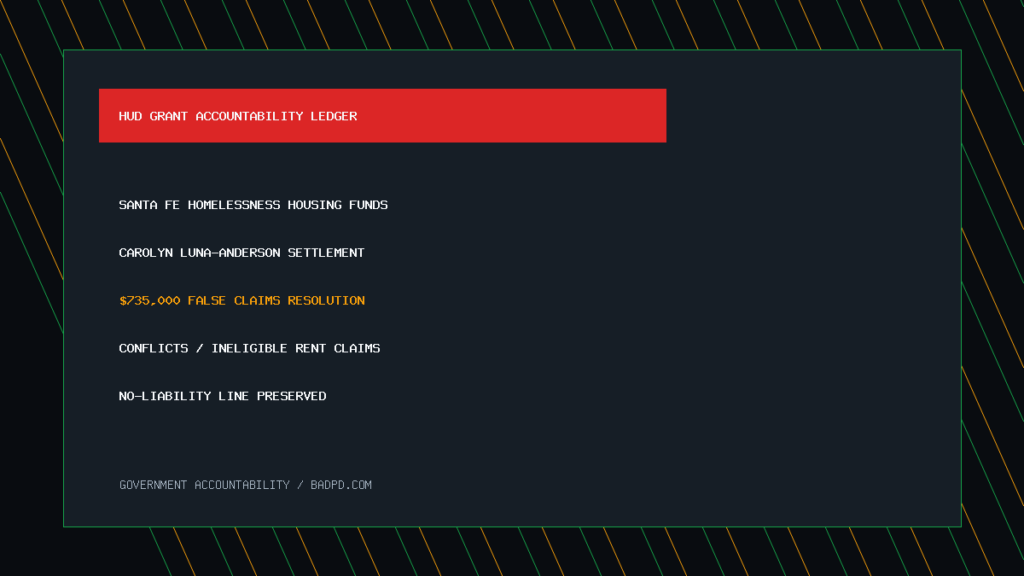
BadPD source-check, July 8, 2026: the U.S. Attorney’s Office for the District of New Mexico says Carolyn Luna-Anderson agreed to pay $735,000 to resolve allegations that she improperly obtained federal housing assistance funds by concealing conflicts of interest and submitting claims for ineligible rental-assistance payments through a HUD-funded program serving people experiencing homelessness.
This is a public-money accountability ledger, not a criminal conviction article and not a finding of civil liability by a court. DOJ’s release says the settlement resolves civil claims and also states that the claims resolved by the settlement are allegations only, with no determination of liability. BadPD is preserving that line clearly. The public-interest issue is still real: homelessness housing funds are limited, federally backed, and supposed to reach eligible households and eligible project costs.
What DOJ Says The Settlement Resolves
According to DOJ, Luna-Anderson founded and served as executive director of The Life Link, a Santa Fe nonprofit that received HUD Continuum of Care grants to provide housing assistance at La Luz Special Needs Apartments. The government alleged that she simultaneously controlled the nonprofit administering federal grants and the entity that owned the apartment complex, while repeatedly certifying that no conflicts of interest existed in HUD grant applications and disclosure forms submitted between 2015 and 2018.
DOJ also says the government alleged that Luna-Anderson sought HUD reimbursement for rental-assistance payments that were not permitted under program rules. The examples listed by DOJ are payments for vacant units and amounts exceeding allowable rental-assistance limits.
To resolve those allegations, DOJ says Luna-Anderson agreed to pay $735,000 to the United States. DOJ says the settlement resolves civil claims under the False Claims Act, the Program Fraud Civil Remedies Act, and common-law theories including breach of contract, payment by mistake, unjust enrichment, and fraud.
The No-Liability Line And The Admission Line
This settlement has two lines that have to be read together. DOJ says the claims resolved are allegations only and that there has been no determination of liability. That means BadPD is not calling Luna-Anderson civilly liable by judgment and is not treating the settlement as a criminal conviction.
But DOJ also says that, as part of the settlement, Luna-Anderson admitted and acknowledged that the conduct underlying the government’s allegations involved misrepresentations, fraudulent omissions, and deceptive conduct that caused financial harm to the United States. That is not nothing. It is settlement language that belongs in the public record, especially because the money was attached to housing assistance for people experiencing homelessness.
Why This Fits The BadPD Housing-Funds Desk
BadPD tracks property-tax help, homeowner resources, civil-rights resources, housing funds, public-benefit systems, and government accountability because the same basic question keeps repeating: did public money reach the people it was supposed to help, or did insiders and weak controls redirect it?
HUD Continuum of Care grants are not abstract paperwork. HUD describes the CoC lane as part of the national structure for funding local homelessness response through nonprofit providers, states, tribes, local governments, and collaborative applicants. The whole point is to move people toward stable housing, services, and self-sufficiency. When the grant record includes conflict-of-interest certifications, vacant-unit reimbursement allegations, and over-limit rental-assistance claims, the accountability issue is not only repayment. It is control design.
The Life Link’s public housing-support page describes La Luz as permanent supportive housing for people needing both independence and structure while working on recovery from mental illness and substance abuse. BadPD is not using that page to prove DOJ’s allegations. It is using it to show why the program context matters: the funding lane is connected to vulnerable people and supportive housing, not a generic office expense account.
Confirmed, Alleged, Pending, Disputed
Confirmed by DOJ: Luna-Anderson agreed to pay $735,000 to resolve HUD grant fraud allegations. DOJ says the settlement resolves civil claims under the False Claims Act, Program Fraud Civil Remedies Act, and common-law theories. DOJ says HUD OIG and the U.S. Attorney’s Office investigated and handled the matter.
Confirmed by DOJ settlement-description language: DOJ says Luna-Anderson admitted and acknowledged, as part of the settlement, that the conduct underlying the government’s allegations involved misrepresentations, fraudulent omissions, and deceptive conduct that caused financial harm to the United States.
Alleged by the government: the government alleged that Luna-Anderson concealed conflicts of interest while controlling both the grant-administering nonprofit and the entity that owned the apartment complex. The government also alleged that HUD reimbursement was sought for ineligible rental assistance, including vacant-unit payments and amounts above allowable limits.
Pending: the full settlement agreement, payment schedule, HUD grant applications, conflict-of-interest forms, reimbursement invoices, vacancy records, rent-limit calculations, board minutes, corrective-action plans, any debarment or compliance terms, and whether current tenants or eligible applicants experienced service impacts.
Disputed or limited: DOJ says there has been no determination of liability. BadPD is not asserting facts beyond the settlement record, and is not accusing current Life Link staff, current residents, or current Santa Fe County housing officials of wrongdoing based on this settlement.
Records BadPD Wants Next
- the full settlement agreement and payment schedule;
- HUD Continuum of Care grant applications and disclosure forms from 2015 through 2018;
- conflict-of-interest certification policies used by The Life Link and HUD reviewers;
- La Luz ownership and management records relevant to the alleged conflict period;
- rental-assistance reimbursement claims, vacancy records, and rent-limit worksheets;
- board minutes and internal compliance memos from the nonprofit;
- HUD OIG closeout records, corrective-action letters, or monitoring reports;
- any suspension, debarment, or future-grant eligibility terms tied to the settlement;
- current program safeguards showing how conflicts and ineligible rental claims are prevented now;
- a tenant-protection statement explaining whether services or housing placements were affected.
What A Fair Follow-Up Should Ask
A fair follow-up is not hard to define. It starts with records. It asks who knew what. It asks who checked the forms. It asks who had the power to stop payment. It asks whether the same risk can happen again.
HUD should be able to show the review trail. The nonprofit should be able to show board oversight. Any property-side entity should be able to show rent and vacancy records. The public should not have to guess. The answer should be in dated files, signed forms, payment records, and audit notes.
BadPD is also watching for tenant impact. If no tenant lost housing, say that with records. If a tenant was affected, say how the person was protected. If eligible applicants waited while funds were tied up, say that too. Housing money is not only a budget line. It is a roof, a room, and a path out of crisis.
What Not To Overclaim
This record does not support a broad attack on every housing nonprofit. It does not support blaming tenants. It does not prove current workers did anything wrong. It does not prove every current Life Link program has a problem. Those claims would need separate records.
The record does support a narrow and serious question. Did the control system catch the conflict risk in time? Did it catch vacant-unit claims in time? Did it catch over-limit rental claims in time? If the answer is no, the public needs to know why.
That is the BadPD lane here. Name the public money. Name the control. Name the gap. Name the fix. Do not smear people outside the record. Do not hide the settlement language either.
Public Money Needs Conflict Controls
The easiest way to lose public trust in homelessness funding is to treat conflict forms as paperwork instead of guardrails. A conflict-of-interest certification is supposed to force a basic transparency question before money moves: who controls the applicant, who controls the property, who benefits from the rent stream, and who verifies eligibility?
DOJ’s allegations describe the risk plainly. If one person can control the nonprofit side and the property side while telling HUD there is no conflict, then the public needs to know what independent review existed. Who checked ownership? Who checked related-party status? Who compared vacancy records to reimbursement claims? Who tested rent caps? Who signed off?
BadPD’s position is not anti-nonprofit and not anti-housing assistance. It is the opposite. Housing assistance survives politically only when the public can see that the money is controlled, audited, and delivered to eligible people through eligible claims. Every weak-control case gives ammunition to people who want to cut help for everyone. The fix is not less accountability. The fix is more receipts.
Local Housing Context
Santa Fe County’s Housing Authority page says its mission is to provide safe, decent, and sanitary housing to low-income and very-low-income families and lists public housing, housing choice vouchers, homeownership, family self-sufficiency, and resident-service programs. That local context matters because housing systems are linked. A problem in one HUD-funded lane can affect public confidence across vouchers, supportive housing, homelessness services, and affordable-housing development.
HUD’s FY2025 CoC award materials also show that current New Mexico CoC funding remains active and substantial. BadPD is not saying those current award lines are improper. The point is that current and future grants need transparent controls precisely because the funding stream continues and because the need is high.
Why The Santa Fe HUD Grant Fraud Settlement Matters
The phrase Santa Fe HUD grant fraud settlement is technical, but the public question is simple. Was federal housing aid handled with clean hands and clear records? That is the standard.
When a settlement involves homelessness funds, public trust can be damaged in two directions at once. Taxpayers wonder if grant money was protected. People who need housing wonder if the system is fair. Honest providers wonder if one case will hurt the reputation of many programs that are doing hard work.
The answer is transparency. Publish the controls. Publish the fixes. Publish the repayment proof. Publish the safeguards for current grants. If public money was exposed, the public should see how that exposure ended.
BadPD Take
The settlement amount is important, but the control problem is the story. The public needs the full settlement agreement, not only a press release. It needs the conflict forms, vacancy records, reimbursement worksheets, and current compliance controls. If the program is fixed, publish the fix. If the money is being repaid, publish the schedule. If current tenants were protected, publish that too.
People experiencing homelessness should not have to compete with insiders, related-party deals, or paperwork games for housing dollars. Taxpayers should not have to guess whether HUD grant money is reaching eligible units and eligible residents. And honest housing nonprofits should not have to work under a cloud created by weak controls elsewhere.
BadPD will watch for the settlement document, any HUD OIG follow-up, current grant-monitoring records, and local corrective-action proof tied to The Life Link, La Luz, and Santa Fe-area homelessness housing funds.
Source Trail
- DOJ New Mexico: Former Santa Fe nonprofit executive agrees to pay $735,000 to resolve HUD grant fraud allegations (Published July 8, 2026; accessed July 8, 2026) – Primary source for settlement amount, allegations, admitted/acknowledged settlement language, no-determination-of-liability line, and HUD OIG/USAO roles.
- HUD: Continuum of Care Program competition and award context (Accessed July 8, 2026) – Official HUD context for the CoC program funding lane and national homelessness-response grant framework.
- The Life Link: Housing Support / La Luz program page (Accessed July 8, 2026) – Program-context source for La Luz housing support description; not used for settlement allegations.
- Santa Fe County Housing Authority page (Accessed July 8, 2026) – Local official housing context for low-income housing, vouchers, and resident services in Santa Fe County.
- HUD FY2025 CoC award announcement PDF (Published April 27, 2026; accessed July 8, 2026) – Official HUD award context showing current New Mexico CoC renewal project lines including Life Link project names and amounts.
Send receipts for the desk to research
Send corrections, missing records, police-accountability tips, good-cop public-service receipts, government/court/war leads, recall alerts, or property-tax help resources. Tips are leads only until BadPD verifies records.
Links, dates, agency names, docket numbers, bodycam IDs, recall numbers, forms, and official pages.
Every tip is a lead, not a fact. The desk checks records before publishing.
Use advertising inquiry when you want clearly labeled sponsor space or available ad placements on BadPD.