Former Spartanburg County Sheriff Chuck Wright Gets 41 Months In Public Corruption Case
News Anchor voice
Ready when you are.
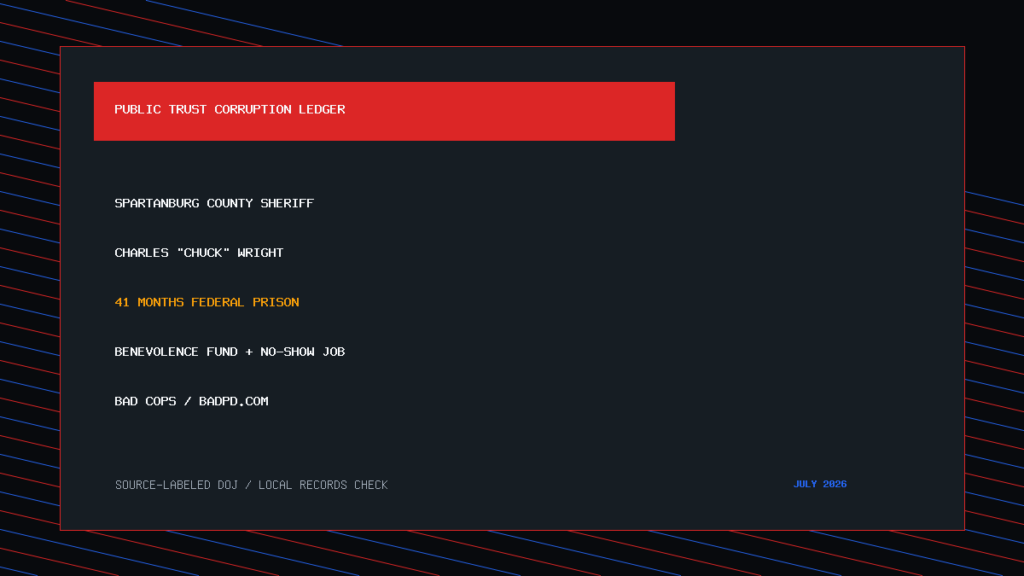
BadPD source-check, July 8, 2026: former Spartanburg County Sheriff Charles “Chuck” Wright has been sentenced to 41 months in federal prison in a public-corruption case that hit the core of police accountability: money meant for deputies in crisis, a county payroll job prosecutors say was not performed, county-card spending, and prescription pills obtained through misuse of a take-back narrative.
The U.S. Attorney’s Office for the District of South Carolina says Chief U.S. District Judge Timothy M. Cain sentenced Wright on July 7, 2026 to 41 months in federal prison followed by three years of supervision. DOJ says Wright, 61, of Wellford, had pleaded guilty to conspiracy to commit theft concerning programs receiving federal funds, conspiracy to commit wire fraud, and obtaining controlled substances by misrepresentation.
The Public Trust Ledger
DOJ’s sentencing release says the Spartanburg County Sheriff’s Office Chaplain’s Benevolence Fund was supposed to provide financial help to deputies and their families during bereavement, financial difficulty, and traumatic line-of-duty events. That is the kind of fund that should be treated like a public trust account, even if structured through a nonprofit. A sheriff touching that fund has to understand the people behind the dollars: injured deputies, grieving families, and employees under pressure.
According to DOJ, Wright hired Amos Durham as the director of the Benevolence Fund. DOJ says Wright then directed Durham to withdraw cash and write checks to Wright, and that Wright used the money for personal enrichment instead of for deputies and families in need. DOJ says one employee’s family approached the fund for help covering hospice bills and another deputy asked for help with bills tied to a tree falling on the deputy’s house, but both were turned away because the fund was empty.
That is the BadPD angle. This is not only a theft case. It is a police-leadership case. A sheriff’s office cannot tell deputies to trust command, trust leadership, and trust the badge if the fund built for their emergencies becomes a private source of cash.
What DOJ Says Happened
DOJ says Wright took more than $89,000 in donated cash from the Benevolence Fund for private use. DOJ also says Wright charged more than $17,000 in personal expenses on a county credit card, including fitness programs, Apple products, online games, and streaming-platform subscriptions.
The payroll side is separate and just as serious. DOJ says Wright employed and paid his cousin Lawson Watson at least $200,000 in taxpayer funds for a no-show job across a four-year period. DOJ says Watson received full salary and benefits for work he did not perform from at least January 2021 through March 2025, and that Wright knew his cousin was not working but allowed him to continue receiving pay and benefits. DOJ also says Wright gave the cousin a county vehicle and county phone for use at a private job.
The controlled-substance count adds another layer. DOJ says Wright repeatedly obtained oxycodone and hydrocodone pills fraudulently by misleading employees and members of the public into turning over prescription pills for what he claimed was part of the sheriff’s office take-back narcotic disposal program. DOJ says Wright actually obtained the narcotics for personal use. DOJ also says he targeted people at SCSO and in the community who were suffering loss and medical hardship, including at funerals, at church, and after surgery, and that while in uniform with badge and service weapon, he bought drugs from a street-level pill dealer in the sheriff’s office parking lot on several occasions.
The Plea Record
DOJ’s October 30, 2025 plea release says Wright, Durham, and Watson pleaded guilty for their roles in a public-corruption scheme that defrauded the county of public funds for years. DOJ said Wright pleaded guilty to three counts: conspiracy to commit theft concerning programs receiving federal funds, conspiracy to commit wire fraud, and obtaining controlled substances by misrepresentation.
That same DOJ plea release said Durham pleaded guilty to conspiracy to commit theft concerning programs receiving federal funds and Watson pleaded guilty to conspiracy to commit wire fraud. DOJ said sentencing would follow presentence reports from the U.S. Probation Office. The July 7 sentencing release says Durham and Watson are scheduled to be sentenced on July 9, 2026.
Local Restitution And County Harm Claims
FOX Carolina reported on June 18 that a filing described an agreed range of 33 to 41 months in prison for Wright and a restitution amount of $462,866.06. The same report said Watson’s listed restitution figure was $349,885.22 with a 10-to-16-month imprisonment range, and Durham’s listed restitution figure was $95,442.39 with a six-to-12-month imprisonment range. BadPD labels those as local reporting from court-document context, not as the final judgment unless and until the judgment and restitution schedule are pulled directly.
FOX Carolina separately reported that Spartanburg County’s victim-impact filing listed roughly $1.31 million in claimed losses tied to compensation, the Benevolence Fund, and election costs, not including additional staffing impacts. Spectrum News also reported that the county was seeking more than $1 million and argued direct and indirect financial losses plus impaired law-enforcement capacity and efficacy. Those are county claims in a victim-impact posture. They are important, but they still need final court treatment and collection details.
FOX Carolina’s July 7 sentencing report adds one detail residents will care about: Wright was able to leave the courthouse and must self-report for prison within approximately 45 days, according to that outlet. The same report says prosecutors discussed monthly payment expectations and that Wright would have three years of supervised release after prison. BadPD wants the judgment and supervision terms before treating every payment detail as final.
Confirmed, Alleged, Pending, Disputed
Confirmed by DOJ: Wright was sentenced to 41 months in federal prison and three years of supervision. DOJ says there is no parole in the federal system. DOJ confirms the charges of conviction and says the investigation was handled by FBI Columbia and the South Carolina Law Enforcement Division, with Assistant U.S. Attorney Lothrop Morris and Criminal Chief Elliott B. Daniels prosecuting.
Confirmed by DOJ plea-stage record: Wright, Durham, and Watson pleaded guilty in the case. DOJ says the Benevolence Fund was designed to assist sheriff’s office officers during hardship, and says Wright and Durham abused their positions to siphon funds. DOJ says Watson received pay and benefits for work not performed.
Alleged or claimed by county/local filings as reported: the county says the total harm reached roughly $1.31 million and included direct and indirect losses, impaired law-enforcement capacity, election costs, morale problems, overtime, and staffing impacts. Those numbers matter, but BadPD wants the judgment, restitution order, and victim-impact filing before calling the entire claimed figure judicially ordered.
Pending: Wright’s judgment, restitution schedule, co-defendant sentencing for Durham and Watson, final forfeiture/restitution collection terms, sheriff’s office internal-control changes, county audit trail, Benevolence Fund governance records, county-card approval chain, payroll approval chain, vehicle/phone usage records, and any state ethics or certification follow-through.
Disputed or limited: Wright’s mitigation arguments, including addiction or PTSD references reported locally, do not erase the confirmed guilty plea and sentence. They may matter at sentencing, but they do not answer the public-control failure.
Records BadPD Wants Next
- the federal judgment, statement of reasons if accessible, restitution order, and payment schedule;
- the presentence positions, sentencing memoranda, and victim-impact filing;
- Durham and Watson sentencing records after the July 9 hearing;
- Benevolence Fund bylaws, bank statements, board oversight records, and check authorization records;
- county-card statements, reimbursement policies, and supervisor/auditor review logs;
- Watson payroll approvals, timesheets, job description, certification records, and county vehicle/phone records;
- SCSO drug take-back policy, chain-of-custody logs, pill disposal audit trail, and parking-lot incident records;
- county council, auditor, or treasurer corrective-action records after Wright’s resignation;
- SLED/FBI investigative closeout records and any South Carolina ethics or certification action;
- public explanation of how deputies and families denied help will be made whole.
Why The Benevolence Fund Detail Matters
When a public official steals from a general budget, the victim is still the taxpayer. When a sheriff corrupts a benevolence fund for deputies, the betrayal is more direct. The money was tied to hardship, bereavement, traumatic line-of-duty events, and emergency family needs. DOJ’s description of hospice-bill and tree-damage requests being turned away because the fund was empty is exactly why this case belongs in the Bad Cops lane.
A department cannot preach brotherhood and public service while leadership drains an emergency fund. Deputies and detention officers already work under stress. If a fund exists because the job can wreck families financially, that fund needs governance stronger than personality trust in an elected sheriff.
The No-Show Job Is A Sheriff-Office Control Failure
The Watson allegation is also not a side issue. DOJ says at least $200,000 in taxpayer funds went to Wright’s cousin for work not performed. FOX Carolina’s victim-impact reporting says the county’s claimed compensation figure for Watson was approximately $349,885 when broader benefits and related costs were counted. Either way, the control failure is obvious: who approved time, who verified work, who tracked vehicle use, who checked certification, and why did it continue for years?
BadPD wants this handled as a payroll-control case as much as a criminal case. Sentencing one sheriff does not prove the system is fixed. The county needs a durable answer on elected-official relatives, no-show work, county assets, certification requirements, and independent audit authority inside the sheriff’s office.
The Take-Back Program Cannot Be A Trust Loophole
Drug take-back programs rely on trust. Residents and employees give up medications because they believe law enforcement will safely dispose of them. DOJ says Wright used that trust to obtain oxycodone and hydrocodone for personal use. If that is the final record, it should trigger a full chain-of-custody audit.
Every sheriff’s office running a take-back program should be able to show who received medications, how they were logged, how they were stored, who witnessed destruction, and how exceptions are reviewed. A badge cannot be the only control.
BadPD Take
Chuck Wright’s 41-month sentence is not the end of the public story. It is the first hard accountability marker after years of elected authority. The remaining work is institutional: restitution collection, co-defendant sentencing, audit transparency, sheriff-office payroll controls, drug-disposal controls, and a public answer for deputies and families allegedly denied help when the fund was empty.
The court can sentence Wright. Spartanburg County and the sheriff’s office have to prove they fixed the doors he walked through.
Source Trail
- DOJ South Carolina: former Spartanburg County sheriff sentenced to 41 months (Published July 7, 2026; accessed July 8, 2026) – Primary sentencing source for 41-month prison term, three years supervision, benevolence fund, no-show job, county-card, controlled-substance, and co-defendant sentencing details.
- DOJ South Carolina: former sheriff and two employees plead guilty (Published October 30, 2025; accessed July 8, 2026) – Primary plea-stage source for counts, defendants, maximum penalties, benevolence fund structure, Watson no-show job, and 147-pill controlled-substance admission.
- FOX Carolina: Chuck Wright sentenced to federal prison (Published/updated July 7, 2026; accessed July 8, 2026) – Local sentencing report for guideline-range context, self-report timing, monthly payment terms, local prosecutor/FBI framing, and county impact context.
- FOX Carolina: sentencing range and restitution figures in new documents (Published June 18, 2026; accessed July 8, 2026) – Local court-filing report for agreed sentencing ranges and restitution figures for Wright, Watson, and Durham.
- FOX Carolina: victim impact statement says county losses reached $1.31 million (Published June 10, 2026; accessed July 8, 2026) – Local victim-impact reporting on county-claimed losses, compensation, election costs, morale, overtime, and law-enforcement-capacity impact.
- Spectrum News: Spartanburg County seeks restitution in Wright case (Published June 11, 2026; accessed July 8, 2026) – Regional confirmation that Spartanburg County sought more than $1 million and argued direct and indirect losses plus impaired law-enforcement capacity.
Send receipts for the desk to research
Send corrections, missing records, police-accountability tips, good-cop public-service receipts, government/court/war leads, recall alerts, or property-tax help resources. Tips are leads only until BadPD verifies records.
Links, dates, agency names, docket numbers, bodycam IDs, recall numbers, forms, and official pages.
Every tip is a lead, not a fact. The desk checks records before publishing.
Use advertising inquiry when you want clearly labeled sponsor space or available ad placements on BadPD.