
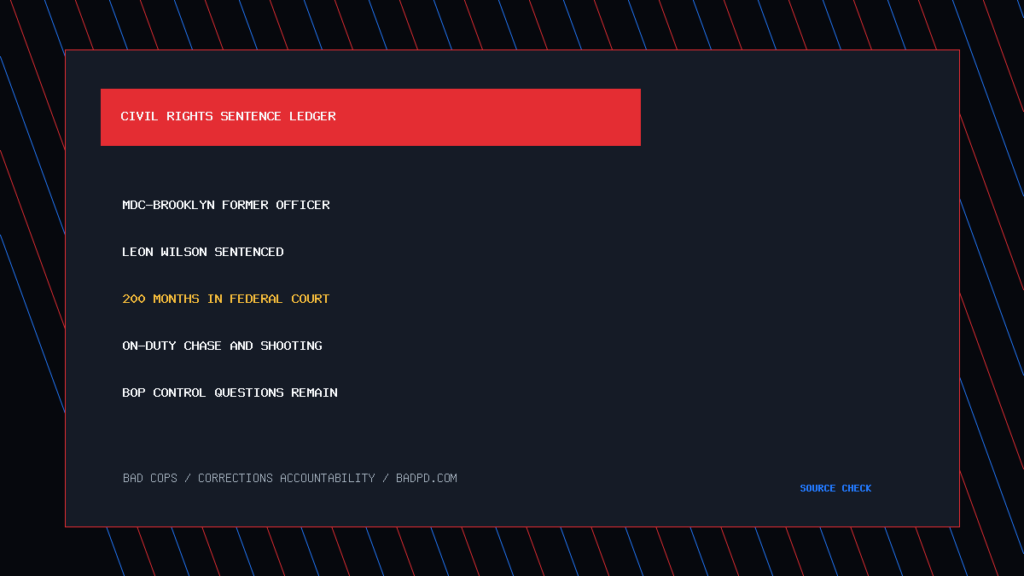
Former MDC Brooklyn Officer Leon Wilson Gets 200 Months In Civil-Rights Shooting Case
News Anchor voice
Ready when you are.
BadPD source-check, July 7, 2026: Leon Wilson, a former correctional officer at the Metropolitan Detention Center in Brooklyn, has been sentenced to 200 months in federal prison after a civil-rights and firearm conviction tied to an unauthorized on-duty vehicle chase and shooting, according to the U.S. Attorney’s Office for the Eastern District of New York.
This is a conviction and sentencing article, not an allegation-only brief. DOJ says Wilson was convicted at trial in October 2025 on both counts of the indictment and was sentenced June 30, 2026 by U.S. District Judge Pamela K. Chen. The current public record says a federal correctional officer used government authority, a BOP vehicle, and a firearm in a way the jury and court treated as criminal. That puts this squarely inside BadPD’s bad-cops and corrections-accountability lane.
What DOJ says happened
DOJ says Wilson was on duty at MDC-Brooklyn on September 4, 2023 when he chased a civilian BMW out of the facility’s staff parking lot and off MDC-Brooklyn property. DOJ says he had no authority to pursue the car past the property line, but did so anyway, ultimately chasing it toward the Brooklyn Bridge, about 3.5 miles from the facility.
During the chase, DOJ says Wilson exceeded the speed limit, passed other vehicles, and ran red lights. About two minutes after the chase began, and nearly a mile from MDC-Brooklyn, DOJ says Wilson fired several shots at the BMW. One shot penetrated the rear of the vehicle and struck a backseat passenger in the chest and lungs. DOJ says Wilson continued the chase for several minutes after firing and never reported the on-duty shooting to NYPD, MDC-Brooklyn, or Bureau of Prisons personnel.
The charge-stage DOJ release from September 30, 2024 framed the same conduct as an alleged civil-rights violation under color of law. At that point, Wilson was presumed innocent. The June 30, 2026 sentencing release changes the status: DOJ says he was convicted at trial in October 2025 and sentenced to 200 months. BadPD is therefore using conviction and sentencing language only for the case status now supported by the record.
Why this is bigger than one rogue officer
A correctional officer is not a street patrol officer. A BOP officer’s authority is tied to the institution, the post, the facility perimeter, the custody mission, and Bureau of Prisons policy. DOJ says Wilson crossed that line anyway. The case is not only about the trigger pull. It is about jurisdiction, post abandonment, use-of-force rules, pursuit authority, reporting obligations, radio access, supervisor response, and whether the institution had enough control to detect and report a shooting by its own on-duty employee.
The most alarming operational fact is the alleged silence after gunfire. DOJ says Wilson never reported the shooting to NYPD, MDC-Brooklyn, or BOP personnel. If a civilian had been shot and no one inside the agency knew because the officer did not report it, then the public needs to know what systems have changed. A facility should not depend solely on a shooter self-reporting an on-duty shooting.
BadPD wants the institutional ledger, not just the sentence. Who saw the BOP vehicle leave? What logs exist for the vehicle, post, weapon, ammunition, gate, radio, camera, and supervisor chain? Did anyone notice Wilson was off property? Did anyone reconcile firearm rounds after the shift? Did anyone audit incident-report gaps? Those are not side questions. They are the difference between a criminal conviction and a fixed agency.
The court record adds another layer
A public court-order mirror of United States v. Wilson says the indictment charged Wilson with depriving a person of constitutional rights under color of law through unreasonable force under 18 U.S.C. 242 and using a firearm during a crime of violence under 18 U.S.C. 924(c). The mirror says a jury convicted him after a six-day trial, and the court denied post-trial motions for acquittal or a new trial on June 8, 2026.
That same public court-order mirror says the victim was identified at trial, but BadPD is not repeating the victim’s name in this public article because DOJ’s sentencing release did not name him and the accountability focus here is the officer, the institution, and the public records still missing. If a victim or family representative wants public naming or correction, BadPD can update with direct permission or a clear court-record reason.
The court-order mirror also describes the government’s theory of willfulness. It says the government pointed to conduct it characterized as plainly wrongful, conduct contrary to Wilson’s training and responsibilities, and concealment after the fact, including failure to report. BadPD treats that mirror as a public court-record source, but still separates it from DOJ’s sentencing release because the best practice is to label exactly where each fact comes from.
Local reporting and the rejected defense theory
Corrections1 republished New York Daily News trial reporting after the October 2025 conviction. That reporting said Wilson testified in his own defense, claiming he thought he had interrupted a jailbreak or contraband situation and that he saw someone in the fleeing car point a gun. It also reported that the jury convicted him after about three hours of deliberation. BadPD is not presenting the defense theory as true; it is important because it shows what the jury heard and rejected.
News 12’s July 1, 2026 sentencing coverage preserved the core public facts for local readers: the 200-month sentence, the October 2025 conviction, the chase from MDC-Brooklyn, the shooting that struck a backseat passenger, and the failure to report to NYPD, MDC-Brooklyn, or BOP personnel. BKReader also carried the local follow-up and linked the Brooklyn neighborhood context.
The local coverage matters because federal correctional officers can operate behind institutional walls. BadPD wants those cases pulled into the same public-accountability daylight as police shooting cases. A badge inside a federal facility is still government power. When that power leaves the property line, chases a civilian car, fires into it, and goes unreported, the public has a right to ask for the full file.
Confirmed, pending, disputed
Confirmed by DOJ: Wilson was a former MDC-Brooklyn correctional officer; he was convicted at trial in October 2025 on both counts of the indictment; he was sentenced to 200 months in prison; DOJ says the conduct involved an on-duty chase off MDC-Brooklyn property, gunfire into a civilian car, a backseat passenger struck in the chest and lungs, and no report to NYPD, MDC-Brooklyn, or BOP personnel.
Confirmed by the public court-order mirror: the indictment charged a Section 242 civil-rights count and a Section 924(c) firearm count; the jury convicted Wilson after trial; Judge Chen denied post-trial motions for acquittal or a new trial. BadPD wants the official ECF documents and judgment for a future update.
Reported by local outlets: News 12, BKReader, and Corrections1/New York Daily News reported the sentencing and/or trial record, including the rejected defense framing and the local Brooklyn context.
Pending: the final criminal judgment, sentencing transcript, victim-impact record, BOP discipline file, OIG closeout, use-of-force review, vehicle log, radio log, firearm/ammunition accounting, post orders, supervisor discipline, and policy changes after the shooting.
Disputed or limited: Wilson’s defense theory was reported publicly, but the jury convicted him. BadPD is not claiming every BOP officer at MDC-Brooklyn knew about the shooting. BadPD is also not claiming the entire institution is criminal. The current source-cleared case is Wilson’s conviction and the institution’s unanswered control questions.
Records BadPD wants next
BadPD wants the records that show whether this was an isolated criminal act or a system that failed to detect one of the most serious things an officer can do: fire at civilians during an unauthorized chase and not report it. The practical records list is straightforward:
- the final judgment and sentencing transcript;
- the trial exhibits showing pursuit path, firearm evidence, vehicle damage, and injury evidence;
- BOP vehicle checkout, GPS, gate, and camera logs from September 4, 2023;
- firearm issue, ammunition, and post-shift accounting records;
- radio traffic and supervisor notification records;
- post orders showing Wilson’s authority and property-line limits;
- BOP and DOJ OIG internal investigation closeout records;
- disciplinary action, termination, decertification, or employment status records;
- policy changes made after the shooting and after the conviction;
- records showing whether any supervisor failed to detect or follow up on the off-property pursuit.
The BOP problem: walls do not erase public accountability
Federal detention centers are not transparency machines. Much of the day-to-day accountability system is internal: post orders, shift logs, incident reports, use-of-force packets, OIG referrals, and personnel files. That makes after-the-fact public releases especially important. If an on-duty officer can leave property, run a dangerous chase, fire into a car, and return without reporting the shooting, then the public needs more than a sentence. It needs proof of a control fix.
BOP should publish a plain-language corrective-action summary. It does not need to release private medical records or every security detail. It can say whether vehicle tracking changed, whether weapons accounting changed, whether gate logs are now audited, whether off-property authority was retrained, whether post orders were rewritten, and whether supervisors now receive automatic alerts when an armed officer leaves a post or property line without authorization.
The point is not paperwork for paperwork’s sake. The point is prevention. A civilian was shot. Other drivers and pedestrians were allegedly endangered. The institution allegedly did not get a report from the officer. If the fix is invisible, residents, detainees, staff, and future victims are left taking the agency’s word for it.
Civil-rights enforcement should not depend on luck
This case also shows why civil-rights enforcement has to be more than a press-release victory lap. DOJ, DOJ OIG, FBI, and NYPD did bring the case to conviction and a long sentence. That matters. But criminal prosecution after a shooting is the back end. The front end is a system designed to stop unauthorized pursuits, detect use of force, preserve evidence, and force immediate reporting.
BadPD gives credit where receipts support it: investigators and prosecutors produced a conviction against a federal correctional officer. That is real accountability. But the agency side still owes the public the prevention ledger. A conviction proves the officer crossed a criminal line. It does not, by itself, prove BOP fixed the supervision, vehicle, firearm, and reporting failures that allowed the incident to become a hidden on-duty shooting.
BadPD take
Leon Wilson’s 200-month sentence is a major civil-rights result, but the sentence cannot be the end of the story. The public needs the institutional file. A former federal correctional officer was convicted after a chase and shooting that DOJ says he had no authority to conduct. The victim survived a gunshot wound to the chest and lungs. The alleged failure to report should make every oversight office ask how many safeguards depended on one officer telling the truth after firing a weapon.
BadPD’s position is simple: publish the BOP control ledger. Show the pursuit authority rules. Show the weapon accounting fix. Show the reporting-failure investigation. Show whether any supervisor or policy failed. Show what changed at MDC-Brooklyn after September 4, 2023, after the October 2025 conviction, and after the June 2026 sentence. If the government can ask the public to trust correctional officers with custody, weapons, vehicles, and force, it can show the public how it prevents this from happening again.
This is the kind of police/corrections accountability story that should not disappear behind courthouse language. The core public question is not complicated: how did an on-duty federal officer leave the facility, chase a civilian car, shoot a passenger, fail to report it, and return to work without an immediate institutional alarm? Until BOP answers that, the ledger stays open.
Source Trail
- DOJ EDNY: Federal correctional officer sentenced to 200 months for federal civil-rights and firearm offenses (Published June 30, 2026; accessed July 7, 2026) – Primary sentencing source for conviction, 200-month sentence, on-duty chase, shooting, lack of authority, and failure to report.
- DOJ EDNY: MDC correctional officer charged with federal civil-rights violation (Published September 30, 2024; accessed July 7, 2026) – Primary charge-stage source for complaint allegations, MDC-Brooklyn status, BOP van, pursuit, shots, injury, and initial docket number.
- CaseMine mirror: United States v. Wilson memorandum and order (Order dated June 8, 2026; accessed July 7, 2026) – Public court-order mirror for indictment counts, trial conviction, post-trial motion denial, and court discussion of willfulness evidence.
- CourtListener RECAP PDF: government motions in limine in United States v. Wilson (Filed September 22, 2025; accessed July 7, 2026) – Public court filing preserving government pretrial evidence arguments and disputed evidentiary issues; treated as advocacy, not final fact unless corroborated.
- Corrections1 / New York Daily News: ex-MDC Brooklyn CO convicted after pursuing car and shooting passenger (Published October 29, 2025; accessed July 7, 2026) – Local trial reporting on conviction, defense position, jury rejection, and courtroom context.
- News 12 Brooklyn/Bronx: federal correction officer sentenced for civil-rights violations and firearm offenses (Published July 1, 2026; accessed July 7, 2026) – Local sentencing coverage confirming core DOJ timeline and failure-to-report point.
- BKReader: federal correction officer sentenced for civil-rights violations, firearm offenses (Published July 1, 2026; accessed July 7, 2026) – Brooklyn local follow-up preserving neighborhood context and News 12 link trail.
- Federal Bureau of Prisons: MDC Brooklyn official institution page (Accessed July 7, 2026) – Official facility context for MDC-Brooklyn; access/fetch issues noted separately in local report.
Send receipts for the desk to research
Send corrections, missing records, police-accountability tips, good-cop public-service receipts, government/court/war leads, recall alerts, or property-tax help resources. Tips are leads only until BadPD verifies records.
Links, dates, agency names, docket numbers, bodycam IDs, recall numbers, forms, and official pages.
Every tip is a lead, not a fact. The desk checks records before publishing.
Use advertising inquiry when you want clearly labeled sponsor space or available ad placements on BadPD.