
Gaza Humanitarian Shelters Claim: Are Palestinians Being Moved Into Camps?
News Anchor voice
Ready when you are.
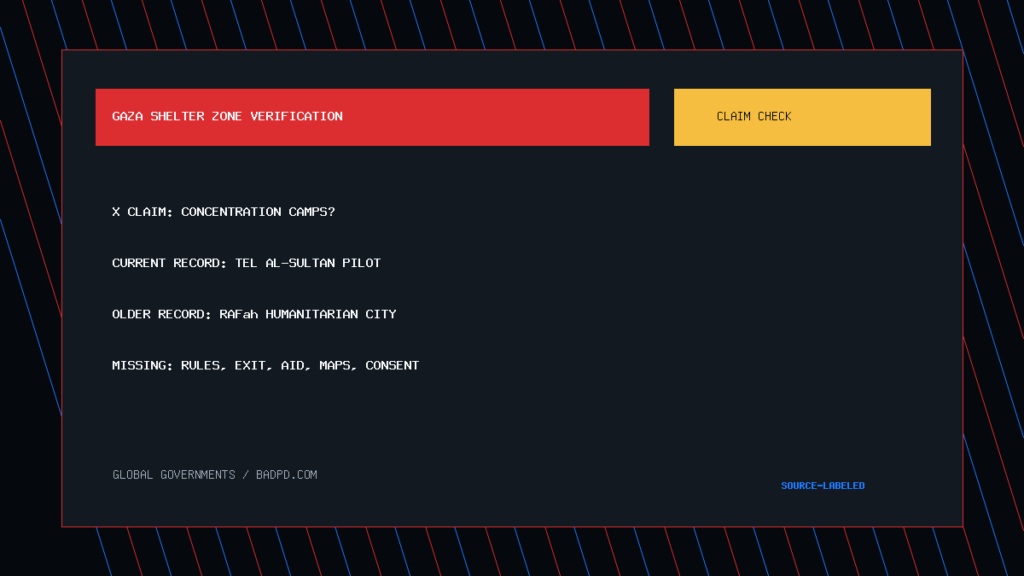
BadPD verification, July 6, 2026: posts on X are claiming that Palestinians are being moved into concentration camps. That phrasing is not an official label in the current record. But the underlying issue is real enough to demand immediate public exposure: Israeli media reports a Board of Peace pilot program to direct civilians into managed humanitarian shelter zones near Rafah, while the older 2025 Israeli “humanitarian city” plan already produced explicit concentration-camp warnings from legal scholars, rights advocates, and former Israeli prime minister Ehud Olmert.
BadPD is treating the X posts as claims-watch leads, not as final proof. The verification question is not whether a viral phrase sounds harsh. The question is whether the record shows forced transfer, enclosure, screening, exit restrictions, aid dependency, armed control, lack of consent, or a policy goal of pushing Palestinians out of Gaza. Those are the facts that move the story from political spin into possible war-crimes and crimes-against-humanity territory.
This article is about governments, militaries, foreign policy, civilian harm, and U.S. accountability. It is not an attack on Jews, Palestinians as a people, Americans, or any protected religious or ethnic group. BadPD is scrutinizing state policy, military control, international governance, and the U.S.-chaired Board of Peace because American power and money are now part of the machinery being described.
Short verdict
What is confirmed: Israel Hayom reported on June 30, 2026 that the Board of Peace will launch a pilot program in coming weeks to manage humanitarian shelters in parts of Gaza not under Hamas control. The first reported destination is Tel Sultan near Rafah. The report says civilians without weapons or Hamas affiliation will be directed there, multinational forces under Board of Peace management will deploy, and the IDF will keep its positions while deepening control beyond the yellow line.
What is reported but not yet independently documented: the current shelter program is described by Israel Hayom through unnamed-source reporting. Anadolu, Novara, Middle East Eye, Democracy Now, and social posts are largely downstream of that Israeli report. BadPD found official records establishing the Board of Peace, NCAG, and ISF framework, but not yet a public official operating order for the Tel Sultan shelter pilot.
What makes the X claim plausible enough to investigate hard: this is not appearing in a vacuum. In 2025, Israeli Defense Minister Israel Katz publicly advanced a “humanitarian city” concept on the ruins of Rafah. AP, Times of Israel, Just Security, Guardian, and others reported that the prior plan involved concentrating large numbers of Palestinians in a closed zone, screening entrants, restricting exit, and linking it to “voluntary emigration.” Israeli international-law scholars warned that such a plan would be manifestly illegal if implemented. Olmert called it a concentration camp.
What is not yet proved: BadPD does not yet have public documents proving that the current 2026 Tel Sultan pilot has the same exit ban, full-population transfer goal, or explicit emigration pathway as the 2025 Katz plan. That is the central records gap. The current plan may be sold as shelter and aid; the legal test depends on consent, freedom of movement, family unity, access to aid outside the zone, neutral monitoring, and whether people can leave without being forced out of Gaza entirely.
The current report: Tel Sultan humanitarian shelters
Israel Hayom says the Board of Peace pilot is tied to Section 17 of President Trump’s Gaza plan and is intended to separate Hamas from civilians in areas not under Hamas control. The reported first zone is Tel Sultan, near Rafah. The report says civilians with no weapons or Hamas affiliation will be directed there. It also says multinational forces under Board of Peace management will arrive, use nonlethal weapons to maintain order, and be based at Camp Amitai near Gaza.
The same report says food and medical aid will be sent into the shelter zones, large logistics warehouses are being identified near the Gaza border, and caravans rather than concrete reconstruction will be used in areas described as temporarily rehabilitated. The report’s most important power line is not the humanitarian wording. It is the military-control wording: Israel Hayom says the IDF will continue holding positions and deepen its grip beyond the yellow line.
Anadolu summarized the same report on July 1 and highlighted the same core elements: Tel al-Sultan near Rafah, civilians directed there, an International Stabilization Force deployment, nonlethal weapons, Israeli military consolidation beyond the yellow line, no concrete for reconstruction, mobile housing units, medical services, and a Board of Peace framework backed by U.N. Security Council Resolution 2803.
That is enough for a publishable verification ledger. It is not enough to call every detail proven. The first-source report is Israeli media citing unnamed sources. The official public order, map, force directive, rules of engagement, screening protocol, movement policy, aid policy, complaint process, and legal memo are still missing. BadPD wants those documents published immediately.
The social-media claim
Novara Media reported on July 2 that the plan had been condemned on social media and cited historian Assal Rad posting on X that “They’re building concentration camps.” That sentence is a claim and a judgment. It is not a court finding. But it points to a real question: if civilians are directed into fenced or controlled zones, screened by armed or security forces, given aid through those zones, and unable to freely leave or return home, the concentration-camp comparison stops being mere rhetoric and becomes a legal and historical warning.
BadPD is not publishing the X phrase as settled fact. BadPD is publishing the evidence trail that makes the claim serious: current shelter-zone reporting, U.S.-backed Board of Peace governance, ISF deployment, Israeli military territorial control, older Rafah “humanitarian city” plans, and prior legal warnings about concentrating Gaza’s population.
The older plan matters because it had the missing camp elements
The 2025 Katz plan is the reason the current 2026 shelter story deserves maximum scrutiny. AP reported in July 2025 that Israel’s defense minister outlined plans to pack hundreds of thousands of Palestinians into a closed border zone in Gaza. AP described critics warning that such a move would amount to forcible displacement because Israel’s offensive and blockade had made Gaza largely uninhabitable. The Israeli official frame was civilian separation from Hamas and an option for Palestinians to emigrate.
Times of Israel reported that Katz’s vision involved eventually confining Gaza’s civilian population in a zone, screening entrants to prevent Hamas access, and not allowing people to leave. It also reported that Katz emphasized an ambition to encourage Palestinians to voluntarily emigrate from Gaza. That combination is why legal scholars focused on coercion. “Voluntary” departure from a ruined, controlled, enclosed, aid-dependent territory can become forced displacement if people have no genuine alternative.
Just Security published an urgent letter from Israeli international-law scholars warning officials against a plan to concentrate Gaza’s population in south Gaza. The scholars argued that an order to plan and execute such a program would be manifestly illegal and could constitute grave international crimes. They also emphasized an earlier IDF chief-of-staff statement saying the IDF did not intend to force Gaza’s population to move within or exit the Strip, and they called on authorities to uphold that commitment in practice.
Olmert’s Guardian interview matters because he is not an anti-Israel activist outside the system. He is a former Israeli prime minister. He said the “humanitarian city” would be a concentration camp and that forcing Palestinians inside would be ethnic cleansing. He also distinguished between lawful evacuation from combat zones and a mass camp project aimed at deportation. That distinction is useful: the issue is not whether civilians can ever be moved for safety during combat. The issue is whether the move is forced, indefinite, enclosed, linked to expulsion, or designed to remove people from their land.
The U.S. exposure
This is not only an Israel story. The current report puts the Board of Peace at the center of the shelter program. The White House announced the Board of Peace structure in January 2026 and said it would provide strategic oversight, mobilize resources, and ensure accountability as Gaza transitions. The statement named President Trump as chairman, named senior advisers, identified Nickolay Mladenov as High Representative for Gaza, and named Major General Jasper Jeffers as commander of the International Stabilization Force.
That creates direct U.S. accountability questions. If a U.S.-chaired body is directing or enabling civilians into controlled shelter zones, Congress should demand the operating order, funding stream, security contract, legal memo, humanitarian-access protocol, screening standards, and rules of engagement. The American public should not learn through social media that a U.S.-backed board is helping create zones that critics compare to concentration camps.
The Guardian reported in February 2026 that Board of Peace contracting records described a planned 5,000-person military base in southern Gaza for the ISF, with armored watch towers, bunkers, military equipment storage, and barbed wire. The report also raised unanswered questions about rules of engagement, land consent, and how the ISF would handle renewed Israeli attacks, Hamas attacks, or disarmament disputes. Those are not academic questions if the same force is now being discussed as the security layer for humanitarian shelter zones.
The humanitarian context
OCHA’s July 3 humanitarian situation report does not verify the camp claim, but it shows the pressure environment in which any shelter plan would operate. OCHA reported a sharp rise in chickenpox cases tied to deteriorating environmental conditions, overcrowding, sanitation and hygiene gaps, and summer conditions. It also reported severe medical-service constraints, including dialysis-related shortages. That context matters because “choice” becomes questionable when the rest of the territory lacks safe shelter, medical care, sanitation, water, education, and stable aid access.
AP reported on July 6 that Hamas says it dissolved its Gaza government and is preparing to transfer authority to a UN-backed technical committee as part of the U.S.-brokered ceasefire framework. AP also reported that the Board of Peace said it would judge the move by actions, not promises, and stressed that the technocratic committee must control all weapons. AP described the second phase as deadlocked over disarmament and reconstruction, while Israeli strikes continue almost daily despite being reduced from wartime levels.
That means the current shelter-zone story lands inside a stalled, armed, fragmented, high-pressure environment. If civilians are told aid, medical care, or protection will only be available inside controlled zones, that is not a normal shelter choice. It is a coercion warning sign.
Confirmed, alleged, pending, disputed
Confirmed: the White House has publicly announced the Board of Peace, NCAG, High Representative, and ISF framework. The UN has a public Security Council document record for the Board of Peace report. OCHA has current Gaza humanitarian-condition reporting. AP confirms ongoing ceasefire implementation disputes and Hamas’s July 6 governance announcement.
Reported: Israel Hayom reports a current Board of Peace shelter pilot in Tel Sultan near Rafah, civilians directed there, ISF deployment, nonlethal weapons, aid and medical services, caravans rather than concrete reconstruction, logistics warehouses, and IDF control beyond the yellow line. Anadolu and other outlets repeated or summarized that report.
Historically documented: the 2025 Katz “humanitarian city” proposal involved mass concentration of Palestinians in south Gaza, screening, reported exit restrictions, and emigration language. AP, Times of Israel, Guardian, and Just Security documented the plan and the legal criticism.
Alleged or characterized: the phrase “concentration camps” is a social-media and critic characterization, not the official name of the current 2026 Board of Peace shelter plan. It is a serious warning label that becomes more supportable if records show forced movement, enclosure, exit bans, aid coercion, indefinite detention-like conditions, or expulsion pathways.
Pending: the Board of Peace operating order; Tel Sultan map; site ownership and land-consent record; ISF rules of engagement; screening criteria; family-unity rules; list of allowed and barred persons; aid-access rules outside the zones; whether civilians can leave; whether people can return to home areas; what Israel controls around the zone; and whether independent UN, ICRC, press, and legal monitors will have access.
Disputed: Israeli and U.S.-aligned officials frame these proposals as civilian separation from Hamas, aid delivery, governance transition, and stabilization. Critics frame them as forced transfer, internment, population control, and a pathway to removing Palestinians from Gaza. The documents that decide that dispute are not public enough.
BadPD records demand
BadPD wants the Board of Peace, White House, State Department, Defense Department, Israeli government, IDF, and ISF contributors to release the following records before any civilians are directed into the Tel Sultan pilot:
- the full written order authorizing humanitarian shelter zones;
- maps of all proposed zones, perimeter controls, entry points, exit points, military positions, and logistics warehouses;
- rules on voluntary entry, forced entry, refusal, exit, return, family unity, and appeal;
- screening standards for alleged weapons possession or Hamas affiliation;
- rules of engagement for ISF forces, Israeli forces, private contractors, and local police;
- aid-delivery rules proving that food, water, medical care, and shelter are not conditioned on surrendering freedom of movement;
- the legal memo explaining compliance with the Fourth Geneva Convention, forced-transfer prohibitions, and human-rights law;
- contracts for Camp Amitai, warehouses, caravans, fencing, surveillance, weapons, security services, and biometric or identity systems;
- the monitoring plan for UN agencies, ICRC, international press, Palestinian civil society, and independent lawyers;
- the complaint, investigation, and remedy process for abuse inside or around the zones.
BadPD take
The X claim is not fully proved by public documents yet. The underlying policy danger is real. A U.S.-backed, Israel-coordinated system that directs displaced Palestinians into controlled zones while the IDF holds or expands territory needs aggressive scrutiny now, before the infrastructure becomes permanent and before officials hide behind humanitarian language.
Words like “humanitarian shelter” and “temporary rehabilitation” do not answer the core questions. Can people refuse? Can they leave? Can they return home? Can they receive aid elsewhere? Who screens them? Who guards them? What happens to people labeled affiliated with Hamas? Where are families placed? Who owns the land? What happens after the pilot? What is the appeal process? If officials cannot answer those questions in writing, the camp accusation is not irresponsible. It is a warning flare.
BadPD’s position is simple: no secret camp policy, no aid-for-movement coercion, no population transfer through euphemism, no U.S. taxpayer role without public records, and no taking Israeli, U.S., Hamas, Board of Peace, or aligned-media claims at face value. Release the orders, maps, legal memos, contracts, rules of engagement, and independent-monitoring plan now.
Source Trail
- Israel Hayom: Board of Peace to open Hamas-free humanitarian zones in Gaza (Published June 30, 2026; modified July 1, 2026; accessed July 6, 2026) – Current Israeli media report on a pilot shelter program, Tel Sultan near Rafah, civilians screened for weapons/Hamas affiliation, ISF deployment, nonlethal weapons, aid, caravans, logistics warehouses, and IDF control beyond the yellow line.
- Anadolu: Board of Peace to soon begin managing humanitarian shelter centers in Gaza (Published July 1, 2026; accessed July 6, 2026) – Secondary wire-style report summarizing Israel Hayom and placing it in the Board of Peace, ISF, Tel al-Sultan, humanitarian-zone, and UN Security Council Resolution 2803 context.
- Novara Media: Palestinians to be herded into humanitarian shelters in Gaza (Published July 2, 2026; accessed July 6, 2026) – Critical report preserving the X/social claim language and linking the current shelter story to the concentration-camp criticism. Used as a claims-watch source, not as final authority.
- White House: Comprehensive Plan to End the Gaza Conflict implementation statement (Published January 16, 2026; accessed July 6, 2026) – Official U.S. statement naming the Board of Peace, NCAG, High Representative Nickolay Mladenov, ISF Commander Jasper Jeffers, and Gaza Executive Board personnel.
- UN Digital Library: S/2026/418 Board of Peace report to Security Council (Dated May 15, 2026; accessed July 6, 2026) – Primary UN document record for the Board of Peace report under Security Council Resolution 2803.
- AP: Hamas dissolves Gaza government and plans transfer to UN-backed committee (Published July 6, 2026; accessed July 6, 2026) – Current AP context on Hamas governance announcement, Board of Peace response on X, NCAG, disarmament deadlock, continuing strikes, and civilian conditions.
- OCHA oPt: Humanitarian Situation Report, 3 July 2026 (Published July 3, 2026; accessed July 6, 2026) – Official humanitarian situation update on Gaza health, overcrowding, sanitation, disease, and service conditions.
- Guardian: Trump officials plan 5,000-person military base in Gaza, files show (Published February 19, 2026; accessed July 6, 2026) – Report based on Board of Peace contracting records describing a fortified ISF base footprint, watch towers, barbed wire, bunkers, rules-of-engagement uncertainty, and land-consent questions.
- AP: Israel outlines plans to pack Gaza population into closed border zone (Published July 2025; accessed July 6, 2026) – Prior source-checked record on the Katz Rafah humanitarian city plan, closed-zone allegations, emigration language, and rights-group concentration-camp criticism.
- Times of Israel: experts see war-crime risk in Katz humanitarian city plan (Published July 2025; accessed July 6, 2026) – Israeli outlet summary of Katz plan details, including eventual confinement of Gaza civilians, screening, exit restrictions, voluntary-emigration claim, and legal criticism.
- Just Security: Israeli international law scholars on plan to concentrate Gaza population (Published July 11, 2025; accessed July 6, 2026) – Legal scholars published an urgent letter warning that a plan to concentrate Gaza population in south Gaza would be manifestly illegal and could amount to grave international crimes if implemented.
- Guardian: Ehud Olmert says humanitarian city would be concentration camp (Published July 13, 2025; accessed July 6, 2026) – Former Israeli prime minister Ehud Olmert explicitly used the concentration-camp label for the prior Rafah humanitarian city plan and warned about ethnic-cleansing implications if forced relocation occurred.
- J Street: six-month assessment of Gaza ceasefire status (Published April 16, 2026; accessed July 6, 2026) – Policy assessment documenting stalled Board of Peace implementation, Israeli control of much of Gaza, NCAG non-deployment, ISF recruitment issues, humanitarian restrictions, and the alternative-option section of the plan.
Send receipts for the desk to research
Send corrections, missing records, police-accountability tips, good-cop public-service receipts, government/court/war leads, recall alerts, or property-tax help resources. Tips are leads only until BadPD verifies records.
Links, dates, agency names, docket numbers, bodycam IDs, recall numbers, forms, and official pages.
Every tip is a lead, not a fact. The desk checks records before publishing.
Use advertising inquiry when you want clearly labeled sponsor space or available ad placements on BadPD.